
In this article
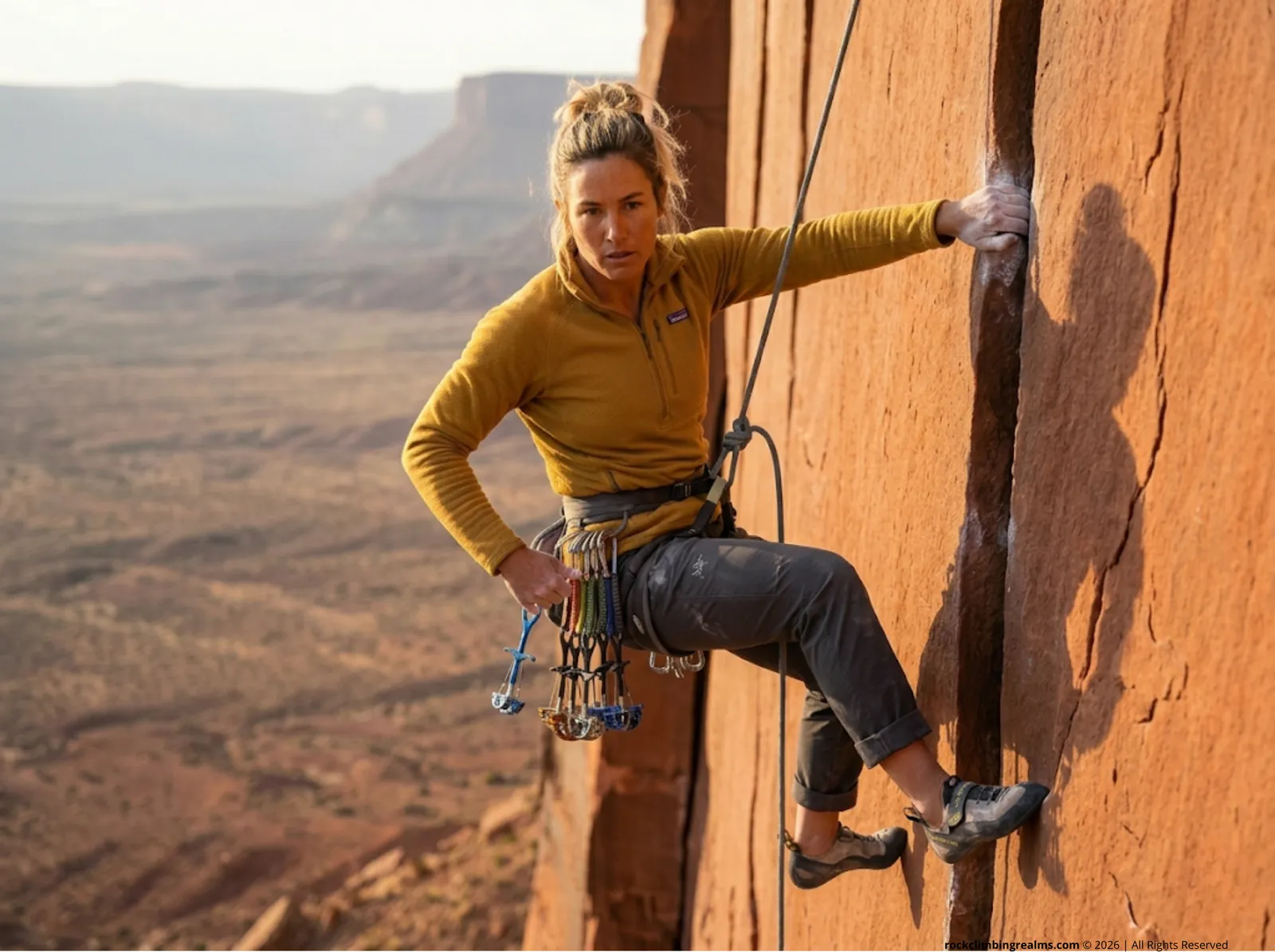
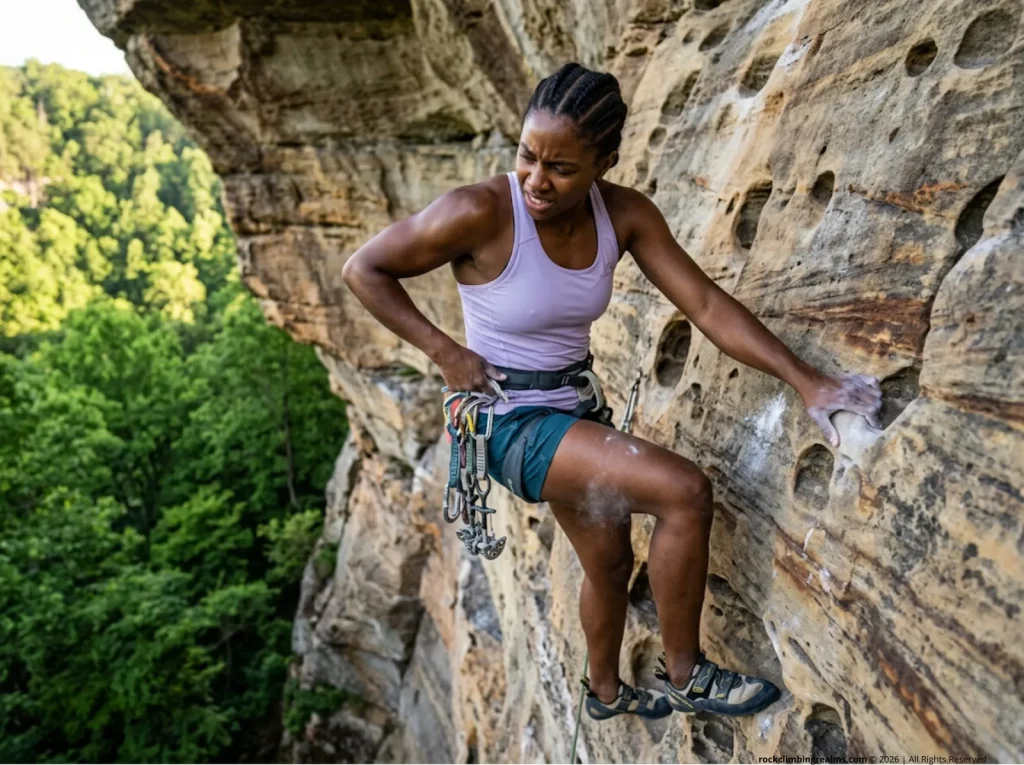
Five moves into the crux, forearms on fire, I reached for a #1 Camalot that should have been on my front-right loop. My hand found a cordelette. Then a locker. Then the wrong cam. Twenty seconds of blind fumbling at 80% pump — not because my rack was empty, but because I had no system. I came off. The gear held. The lesson didn’t.
That was ten years ago. I’ve watched the same thing happen to climbers at every level since — not because they lacked the gear, but because nobody explained why things go where they go. “Rack small to large” sounds useful until you’re pumped and blind-reaching behind your hip for a piece you can’t find.
This guide treats rack organization as a performance discipline. Not a packing chore. You’ll learn why your rack’s weight distribution changes how you move on steep terrain, why big cams on front loops actively hurt you on slabs, and how to build the no-look gear selection system that lets you place a stopper in eight seconds at full pump. The framework is built on field-tested principles and how the brain processes gear placement under load — not tradition.
⚡ Quick Answer: Rack gear front-to-back in ascending size order, gates out. Micro nuts and finger cams (#0.3–#0.75) go on front loops to preserve foot visibility and speed. Hand cams (#1–#3) go on middle loops. Fist cams (#3.5+) and anchor tools go on rear loops or a shoulder sling. Perform a blind touch check before every lead. Repeat the same layout on every route until it’s faster than conscious thought.
| Climbing Gear Racking Guide | |||
|---|---|---|---|
| Gear Type | Loop Position | Gate | Primary Reason |
| Micro nuts (#0.1–0.4) | Front Left | N/A | Foot visibility + fastest reach |
| Finger cams (#0.3–0.75) | Front Right | Gates Out | Most-used at crux |
| Hand cams (#1–#3) | Middle | Gates Out | Weight balance + reach radius |
| Fist/OW cams (#3.5+) | Rear / Sling | Gates Out | Weight low, out of visual field |
| Nuts/Stoppers | Front Left | N/A | Two-biner split system |
| Alpine Draws (60cm) | Rear or Sling | Spine out | Rope drag management |
The Physics Behind Every Racking Decision
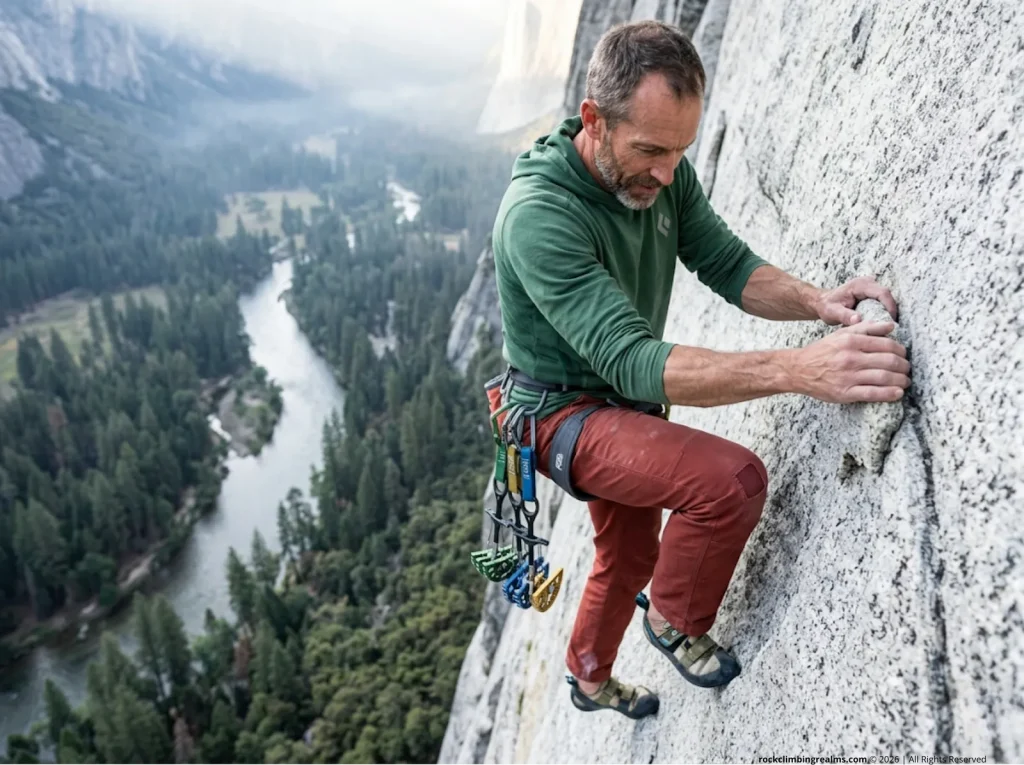
Most guides skip straight to “put this here.” Fine if you never fall. But if you want to understand why the system works — so you can adapt it on unfamiliar terrain — you need to understand what a full rack actually does to your body when you carry it.
A full trad rack regularly exceeds 1.5 kg of hardware. Distribute that weight wrong and you shift your center of gravity forward and down. On overhangs, that pulls your hips off the wall — exactly where you can’t afford to lose position. On slabs, it can actually help stability. The difference matters, which is why experienced climbers think about where gear sits on the harness, not just whether they have it.
Then there’s what I call the swing effect. Unsecured gear mass creates rotational force during lateral moves. You’ve felt it — that moment on a traverse when you reach hard left and the whole rack swings with you, pulling you off balance in a barn-door. That’s physics, not bad luck. Loose, unorganized gear on a long sling amplifies it.
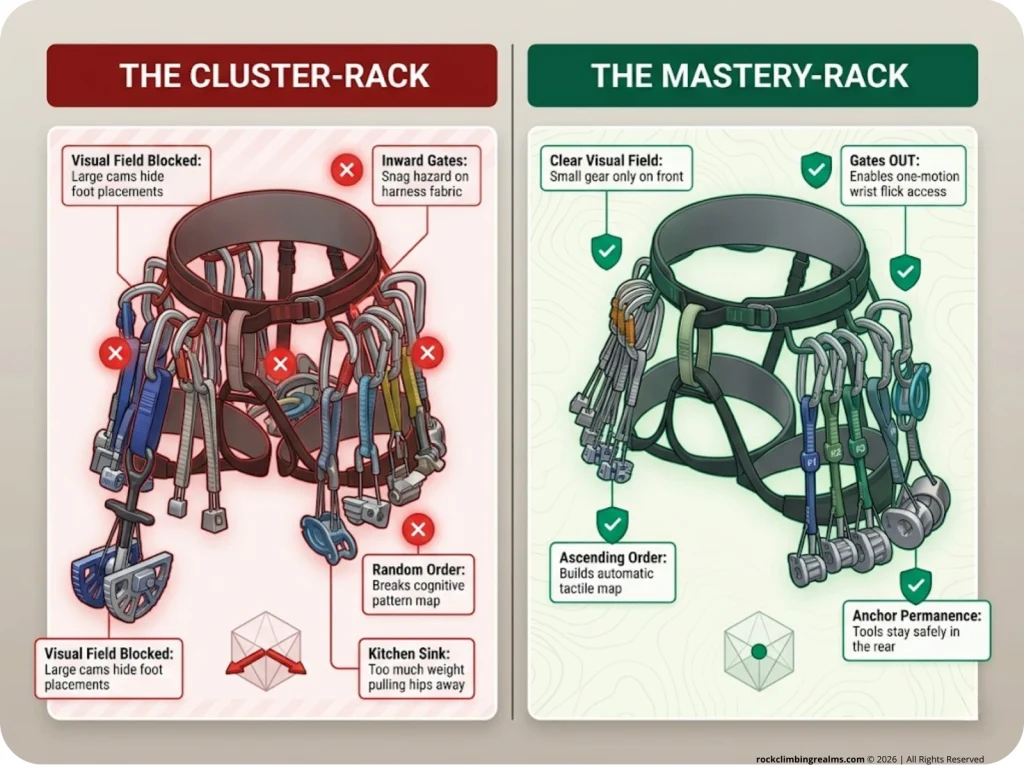
The third factor is the visual field gap. Your vertical visual field is roughly 120 degrees. Load big #3 or #4 Camalots on your front loops and you physically block your view of your feet — the exact zone you need for smearing, edging, and reading the next foot placement. Controls that you grab first should fall within your primary visual field. In climbing, that maps directly to front loops. Which means front loops get small nuts and finger cams only. Everything else lives behind your hip.
Research on oxygen consumption and energy expenditure in rock climbing confirms what experienced climbers have known for decades: fumbling for gear creates a measurable metabolic penalty under sustained high-intensity climbing. Every second you spend searching at the crux is wasted energy you can’t get back.
Pro Tip: Before you rack up, identify your two or three most-used pieces for the upcoming pitch. Those go on front loops, regardless of size. The goal is fastest access for most-likely placements.
Center of gravity — how your rack changes your body position
Trad harnesses weigh 450–600g to start — compared to sport harnesses at 300–400g — with that weight already biased toward the front by design. Adding a double rack on front loops drops your center of gravity forward another full kilogram. On a slab, fine. On anything past vertical, you’re fighting your own gear.
One kilogram of extra weight increases energy expenditure by roughly 3% — data drawn from ski mountaineering, which is physiologically close enough to alpine climbing to be relevant. On a long pitch, that accumulates. The rack system tested across six months of real routes consistently showed that rear-heavy loading on overhangs increases perceived exertion even when total weight is identical.
The fix is simple: move fist cams (#3.5+) to rear loops or a shoulder sling. They’re rarely used mid-crux. Getting them off your front loops recovers center of gravity position and clears your visual field simultaneously.
The visual field gap — why big cams don’t belong on front loops
Stand at the base of a slab with a #3 Camalot on your front-right loop. Look down at your feet. Notice what you can’t see. That’s the visual field gap — and it’s not a minor thing. The precise zone blocked by bulky front-loop gear is the same zone you use to locate smearing position on vertical terrain.
Front loops get small nuts and finger cams — nothing larger than a #1 equivalent. Everything else lives behind your hip, accessible by touch rather than sight. That’s not inefficiency. That’s the system working: you see your feet, you trust your rack position by feel, and you move faster.
Decision latency — the cognitive cost of a disorganized rack
Under high pump and stress, complex decision-making slows and the brain defaults to pattern recognition. If your rack is standardized — same size, same loop, every session — you build a spatial-tactile memory that bypasses conscious decision-making entirely. Call it a cognitive map. Real climbers call it just knowing where the gear is.
The time difference between a systematic rack and a random one is 10–30 seconds per placement. On a 15-piece pitch, that’s 150–450 seconds of saved high-intensity isometric contraction. That’s the difference between a clean send and pumping out at the last piece. Build the map by performing the same blind touch check every time — at the belay, eyes on the route, hands touching each loop in sequence, naming pieces by position and size.
The Quadrant System — Assignment Rules for Every Piece
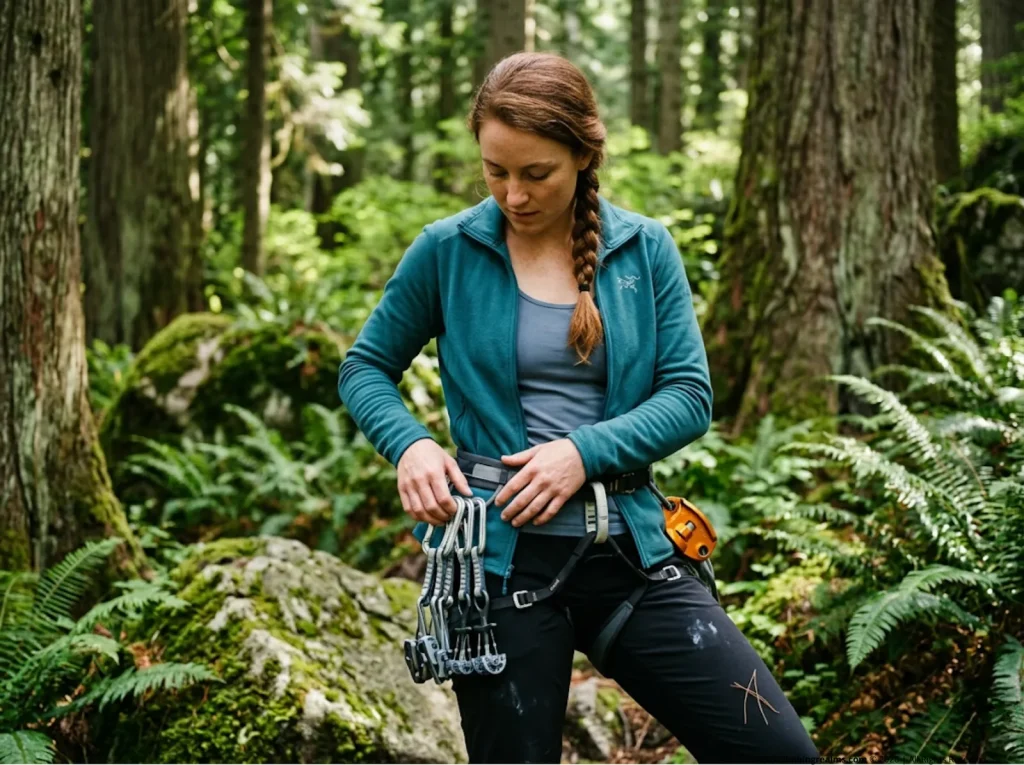
The quadrant system divides your harness into functional zones based on use frequency, weight, and visual access. This is the AMGA-standard approach — not arbitrary, not traditional. Every placement decision follows logically from the principles covered above.
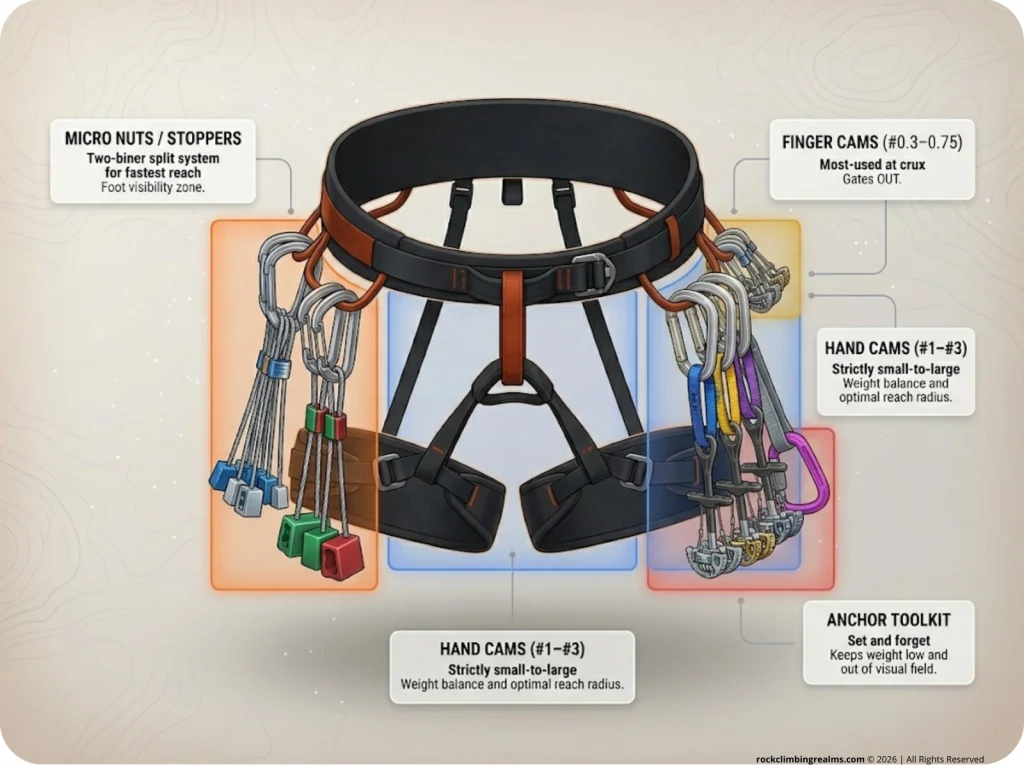
Front-left loop: Micro nuts and wired stoppers, split across two carabiners — small group on one, large group on another. This nut grouping efficiency trick cuts search time in half. You’re not scanning 12 stoppers; you’re reaching for small or large.
Front-right loop: Finger cams #0.3–#0.75 (Black Diamond Camalot C4 sizing). Gates out, always. These are the most-used pieces on thin crack pitches and the first pieces you reach for at the crux. The cam placement logic that mirrors how you should rack them starts at the front loop and works backward by size.
Middle loops: Hand cams #1–#3. The body of the rack. Gates out, sequenced strictly small-to-large moving front to back. Any deviation breaks the cognitive map.
Rear loops: Fist cams #3.5+ if not shouldered. Extended 120cm slings racked as alpine draws. Belay device, master locker, prusik cord — these live here permanently and never migrate to lead.
One critical warning: standard gear loops are not load-bearing anchor points. Never use them for personal anchoring unless you’re on specifically rated loops (like Metolius Safe Tech). The international UIAA safety standards for vertical gear are unambiguous on this.
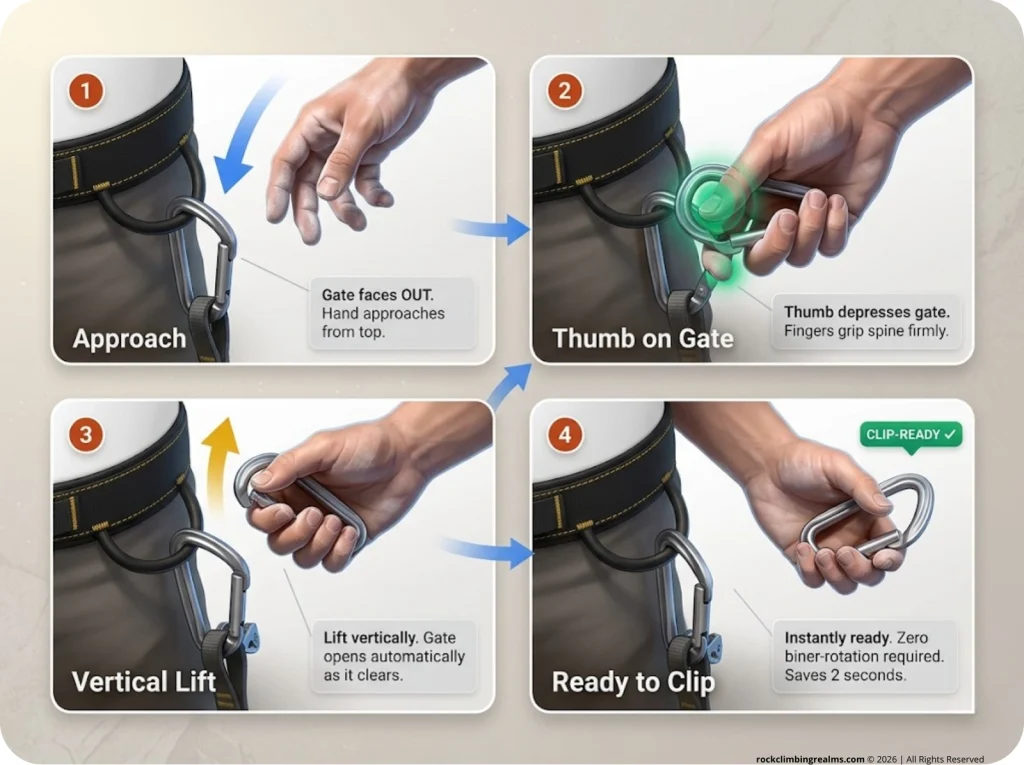
Pro Tip: Practice the wrist flick at home. Rack three biners on a door handle, gates out, and practice the one-motion pop — thumb depresses gate, biner lifts vertically off the loop, gate is already open — until it takes less than a second. That’s the motion you want at the crux.
Front loops — small gear, maximum visibility
Nothing larger than a #1 equivalent on any front loop. That’s the rule, and the reasoning is the visual field gap: you need to see your feet, and front-loop gear is the only hardware positioned to block that view.
Color-coding accelerates identification. Black Diamond’s Camalot C4 line uses a consistent system across sizes — #0.3 red, #0.5 yellow, #0.75 purple, #1 blue, #2 green, #3 red. Most experienced climbers internalize this within a season. For mixed racks or DMM Dragon cams on the same harness, the color systems diverge. The fix: a dot of nail polish or colored electrical tape on wire keepers. Brand-agnostic, user-defined, maintenance-free.
The paint mark also works as ownership ID on multi-partner days. One color = yours. Two colors = partner’s. On a shared rack at the crux belay, this is not optional.
Resist lazy racking — tossing a #3 on whatever loop is open because you’re tired of sorting. One misplaced large cam on a front loop costs 20+ seconds at the crux AND blinds your foot placements. You’ll pay for the shortcut.
Middle and rear loops — hand cams and the anchor toolkit
Middle loops carry the heaviest, most frequently placed pieces: #1 through #3. Keep strict size order — #1 at the front of the middle section, #3 at the rear. Any deviation breaks the spatial map your hands are trying to read.
Rear loops are the “set-and-forget” zone. Your ATC-Guide, master locker, and prusik stay here and don’t migrate. This is the anchor permanence rule: if you move your belay device to lead, you will fumble the pitch transition at the top. Leave it clipped. Every route. Without exception.
Fist cams (#3.5+) belong on rear loops or shouldered to a sling — moving them to front and middle is only done as a deliberate terrain-specific choice, not a default.
Slings and alpine draws — the rope drag layer
60cm slings rack doubled over the shoulder or tripled on a carabiner. Alpine draws — a 60cm sling plus two carabiners — are the standard tool for trad leads because they extend gear past rock features and eliminate rope drag on wandering pitches.
If you want to understand exactly how extending protection with alpine draws reduces rope drag friction, the short version is this: the more your rope bends around a protection point, the more friction accumulates. Alpine draws eliminate the bend.
Never rack more than four alpine draws without considering whether a secondary gear sling is needed for capacity. And never use standard quickdraws (~25cm) for placements above the first bolt equivalent on a trad pitch — the extension isn’t there.
Harness vs. Gear Sling — the Anti-Sell Decision Matrix
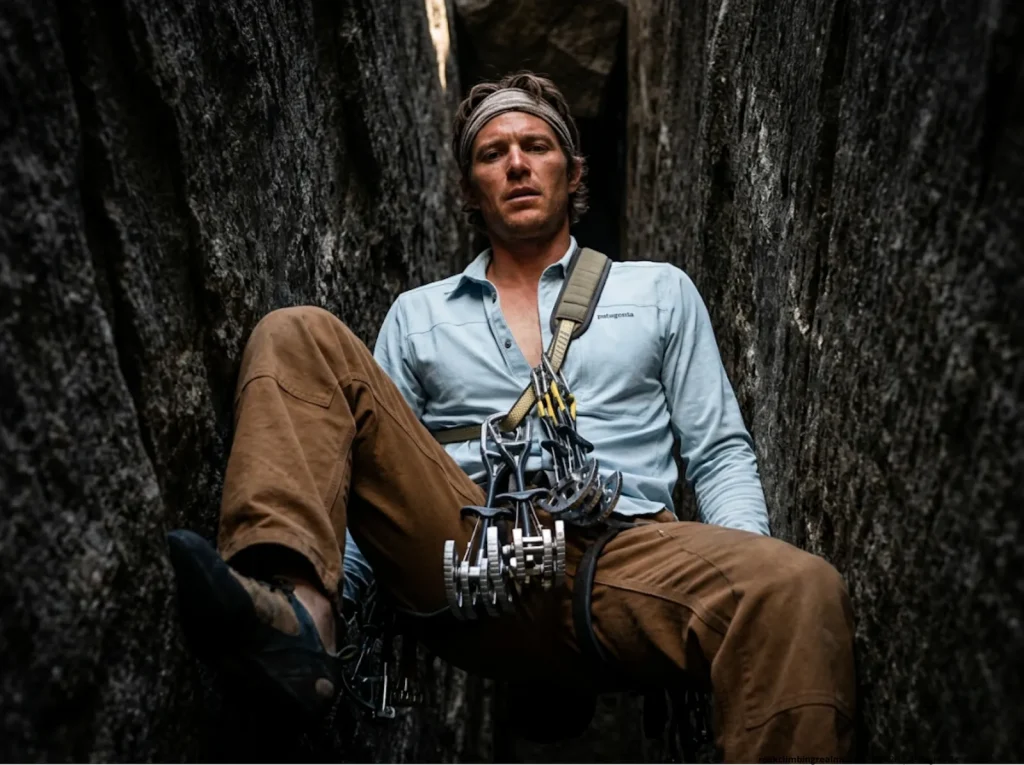
The internet is full of opinions on this. Here’s what actual professionals say, without filtering for product placement.
Hazel Findlay: “I don’t like the way the sling swings around and usually sits to one side and on the shoulder… I already have my harness so I don’t need more options for racking.” Babsi Zangerl: “I prefer the gear loops because the gear is placed on the side of your harness and it is not in the way… The free movement while climbing is way better.” Jon Bracey, IFMGA Guide: “For alpine climbing, the combination of having bulkier clothing, and a potentially bigger rack means I always use a gear sling in addition to gear loops.”
Read those three quotes and notice what they agree on: harness loops are the default for performance, gear slings are additive for volume or terrain-specific needs.
The failure mode nobody talks about is what I call the chandelier swing: heavy gear slings oscillate when you reach laterally, creating a pendulum effect that can torque your shoulder and snag on features. The D-modification trick for stabilizing a gear sling under load addresses this directly — but it’s still a workaround for a limitation that harness loops don’t have.
Pro Tip: If you’re debating harness vs. sling mid-approach, ask yourself: Is this route under five pitches with a rack under 20 pieces? Harness-only wins every time. Above that threshold, run hybrid.
When harness loops win — the default system
On trad harnesses with purpose-built gear loops designed for this load, four to six reinforced loops carry a full rack without sag or rotation issues. Sport harnesses with two to four loops fail at double rack capacity — the sag is real and measurable, and it can rotate the waist belt off your iliac crest, which is a genuine safety concern, not a comfort complaint.
Gates-out racking on loops allows one-handed access: thumb depresses gate, biner lifts off the loop. Total motion: one second. No migration between moves, no searching under clothing. For routes under five pitches with a rack under 20 pieces, harness-only is almost always faster.
When gear slings win — chimneys, off-widths, alpine volume
In chimneys and off-widths, hip-racked gear gets pinched between your body and the rock. “Shoulder the junk” is the move: shift gear to a sling before entering a constricted section. The shoulder position keeps hardware above the hip-rock contact zone and accessible during the grovelfest.
On multi-pitch alpine objectives, a gear sling enables the “gear dump” maneuver at the belay — the follower hands over a full sling to the leader without touching harness gear, saving five minutes of sorting at stances where you’d rather not linger.
Jon Bracey’s alpine logic is sound: bulkier layers make harness gear less accessible, and slings provide clearance above the jacket layer. On sustained steep terrain, the same slings become liabilities. Match the medium to the terrain.
The hybrid system — when you need both
Hybrid means harness loops carry the core rack, gear sling carries doubles, extended slings, and anchor spares. Best for double-cam objectives, alpine routes above three pitches, or routes with radically varied crack systems demanding terrain swaps mid-pitch.
The failure mode: total gear weight exceeding 2.5 kg. At that point, cognitive load reduction becomes impossible — too many pieces across too many zones, no reliable tactile map. If you can’t complete the blind touch check in under 30 seconds, the rack is too big to lead efficiently.
Color-Coding and Tactile Systems — the No-Look Protocol
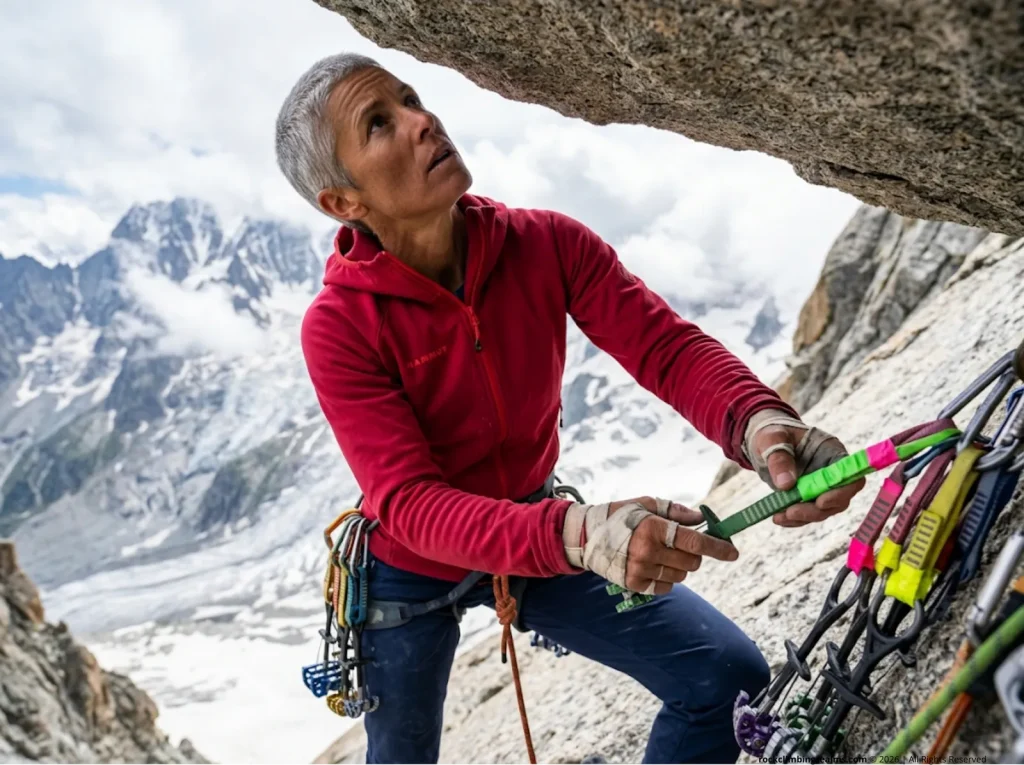
Building a first trad rack with color-coded identification from the start solves the mixed-brand problem before it starts. The Camalot C4 color taxonomy is industry-standard for many climbers, but the moment you add DMM Dragon cams or Wild Country Friends to the same harness, brand-specific color systems diverge and the map breaks down.
The solution is a brand-agnostic system built before you buy. Choose one color per size grouping and commit: micro cams = orange tape; finger cams = yellow; hand cams = blue; fist cams = red. Nuts: white for small group, green for large group. Re-tape when tape peels — a loose tape is a false tactile signal, which is worse than no signal.
The wrist flick makes this system work when you’re pumped. Gates-out orientation means the gate faces away from your body, hinge-pin toward you. Access sequence: thumb hits gate → forefinger and middle finger grip the spine → biner lifts vertically off the loop → gate is already open and presented to the rock. The biner-rotation step that gates-in racking requires? Gone. On a 15-placement pitch, that saves 15–30 seconds. At one specific crux placement, it saves you from bailing.
Building the color map — brand-agnostic system
Spend ten minutes before a climbing day doing touch-and-name drills: eyes closed, touch each piece, speak its size. This is the trad climbing equivalent of a pre-flight checklist. The spatial map builds through repetition — the more consistent the layout, the faster and more reliable muscle memory becomes.
Define your map before you buy, not after. Retroactively color-coding a mixed rack is annoying and error-prone. If you’re building your first trad rack with color-coded identification from the start, you establish mental anchors before you’ve developed any bad habits.
The blind touch check — zero-look gear audit
At the belay ledge, before you leave the anchor: eyes on the route, hands touching each loop in sequence, naming pieces by position and size. Under 30 seconds for a standard single-pitch rack. The check confirms your piece count and reinforces the spatial map through one more repetition.
A missing cam discovered at the belay is a non-event. A missing cam discovered mid-crux is a retreat. These are the two possible outcomes of doing the check versus skipping it.
Terrain-Specific Racking — off-widths, splitters, multi-pitch
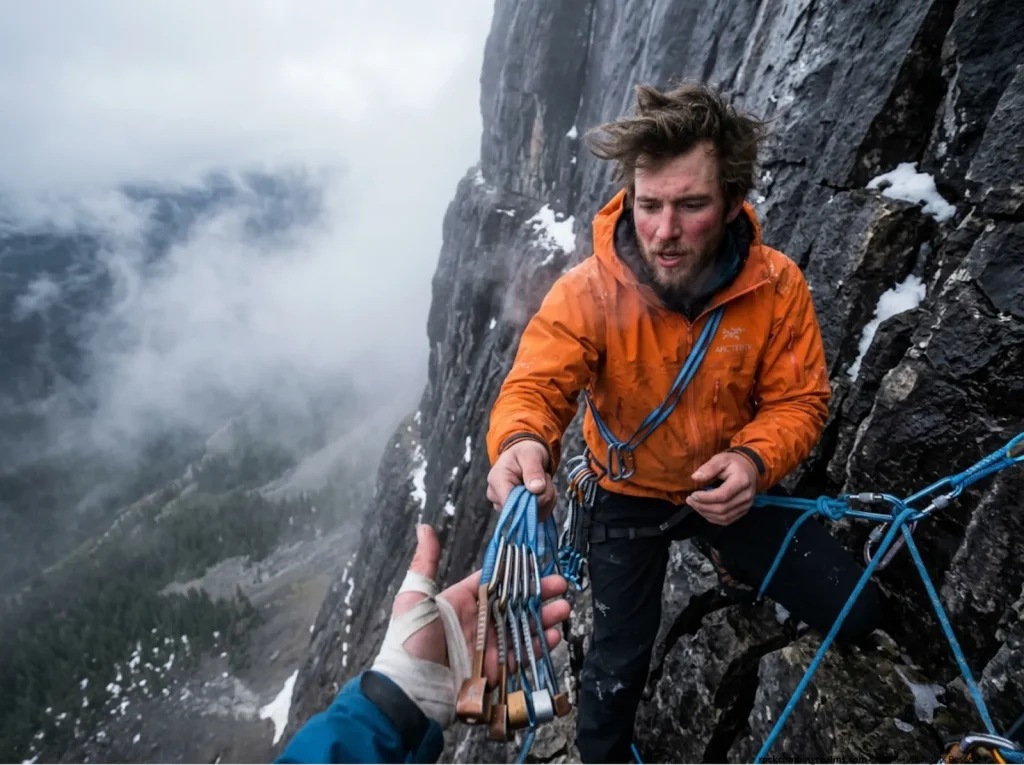
The base quadrant system adapts to terrain. The framework stays fixed; the gear load floats. Getting this right before you leave the ground is itself a performance skill — pre-pitch rack selection based on topo reading and crack sizing.
At Indian Creek, most pitches take a predictable repetitive placement — usually one or two sizes dominate the full pitch. Know which sizes before you rack: study the topo, talk to people who have done it, read the crack as you approach. The double-cam rack strategy specific to Indian Creek sandstone means carrying 3–5 of the dominant size, sequenced together on adjacent loops. Stagger their position or add a tape mark to distinguish duplicates — without tactile differentiation, your blind touch check becomes meaningless.
Always carry two sizes above your projected maximum. Indian Creek crack widths are remarkably consistent, but protrusions demand gear one size larger than expected. The most preventable trad mistake is running out of the one size the crack accepts.
Pro Tip: “Sport-fucking a trad route” — placing a piece every three feet out of fear — means you’ll run out of critical sizes before the crux. Rack for the route, not for your anxiety. Pre-climb beta exists precisely to prevent this.
Splitter cracks — doubling down on the critical sizes
Single-crack splitters like the Yosemite dome routes demand identical repetitive placements across the full pitch. The rack isn’t a variety show — it’s a depth chart for one or two sizes. Pre-route: know the crack, rack three to five of the dominant size on a single loop or two adjacent loops.
On multi-pitch splitters, the seconding climber cleans and racks gear in correct size order while following — not in whatever order the placements came out. At the belay, they present cleaned gear to the new leader sequenced and ready. The transition should feel surgical, not frantic.
Off-widths and chimneys — the shoulder rack solution
Off-width cams (#3.5–#6) are the heaviest, most awkward pieces in the rack — and the worst ones to have on your hips in a chimney. They jam between rock and body, restricting movement and creating the exact kind of stuck scenario that makes “grovelfest” feel generous as a description.
Move all wide pieces to a shoulder gear sling before entering the off-width section. The shoulder rack keeps massive cams accessible above the hip-rock contact zone. After placing a piece, the empty sling goes back over the shoulder for the next placement. Read crack widths to predict which gear sizes the route will consume before deciding what goes on your hips versus your shoulder for a specific pitch.
Multi-pitch racking — the transition protocol
Belay transitions are where most trad teams lose time. The leader arrives at the anchor pumped and relieved; the follower shows up with a chaotic pile of cleaned gear. Five minutes disappear into sorting.
The fix starts from below. The seconding climber cleans gear and racks it in systematic order while following — organized by size, not by how pieces came out of the crack. At the belay, they present cleaned gear in size-sequenced order, ready for the new leader to move directly.
Before the next pitch begins: the tie-in check. The figure-8 knot forms a proper C shape. Buckle is doubled back. This is the “C for Closed” check, and it happens before every lead transition. Then rope management — stack neatly on the belay ledge or drape over feet. Rope spaghetti tangles at the worst possible moment.
The multi-pitch transition systems that govern efficient belay changeovers cover the full sequence. The principle behind all of it: anchor permanence. Belay device, master-point locker, prusik — they live on the rear loop and don’t move for leading. If it has to be re-rigged every pitch, it will eventually be forgotten at the worst moment.
The Five Most Expensive Racking Mistakes
These aren’t edge cases. They’re the patterns AMGA guides see across thousands of pitches, from new trad leaders to climbers who’ve been doing this for years. The relationships between climbing performance and muscle endurance under load confirm what field experience shows: added rack weight and poor organization directly reduce performance under sustained climbing intensity.
The Kitchen Sink mistake: Carrying a double rack for a 30-foot single-pitch route. Hazel Findlay and Beth Rodden carry minimal, pitch-specific racks. The “extra cam just in case” pattern causes harness sag, restricts movement, creates visual obstruction, and overloads the cognitive map. The rule: rack what the route requires, plus two emergency pieces. That’s it.
The Inward Gate trap: Racking with gates facing in means they contact harness hardware — gear loop rings, waist belt buckle — during lateral moves. At full reach, clearing the snag requires a secondary action before the clip can happen. At 80% pump, a secondary action is often a bail. Gates out is not preference. It’s non-negotiable.
The Blind Reach mistake: Stowing frequently used cams on rear loops where they can’t be visually confirmed. Shockingly common even at experienced grades. Rear loops are for gear you don’t need mid-lead — anchor tools, fist cams on non-wide pitches. Anything you might grab at the crux belongs within visual range.
Zippering: The first piece of protection must resist multi-directional loading — downward and outward. A nut or sling placed for downward force only will zip when the belayer isn’t standing directly under the route. Always place a cam or opposed nuts for the first piece, and build it like you mean it. Building a bombproof first piece that resists multi-directional pull isn’t optional when there are five more pieces depending on it to stay in.
Gate flutter: Non-locking racking carabiners can experience gate flutter during a fall, especially when racked loosely or touching harness metal. The spine — not the gate — should always be the contact surface with the gear loop. Gates-out racking isn’t just about speed. It’s about orientation under impact.
One safety note: if a fall results in motionless hanging, venous pooling begins within 5–30 minutes. Don’t hang still. Pump your legs, simulate walking motion, get lowered or self-rescue as fast as possible. According to the American Mountain Guides Association’s climbing safety protocols, managing suspension time is one of the most overlooked post-fall priorities in trad climbing. This is not a remote edge case on big walls.
Conclusion
Three things to carry away from this guide.
Physics, not preference. Your rack’s position affects your center of gravity, your visual field, and your metabolic cost per placement. These aren’t opinions — they’re measurable forces. Rack accordingly.
Standardize obsessively. The cognitive map only forms through repetition. Same gear, same loop, every session — until the blind touch check is faster than conscious thought. This is the Beth Rodden principle: the map requires repetition to build, and it degrades without maintenance.
Modify for terrain. The quadrant system adapts. Off-widths get shoulder slings. Indian Creek gets doubled critical sizes. Alpine pitches get the hybrid system. The framework is fixed; the gear load floats.
Before your next session, spend ten minutes on the ground building your rack exactly as this guide describes. Then close your eyes and do the blind touch check until you can name every piece by position in under 20 seconds. Do that once a week. In a month, you’ll be grabbing on instinct, not searching on fear.
Now go send something.
FAQ
What is the best way to rack cams on a trad harness?
Rack cams front-to-back in ascending size order, gates facing out. Finger cams (#0.3–#0.75) on front loops for fastest access and foot visibility; hand cams (#1–#3) on middle loops; large cams on rear loops or a shoulder sling. Gates-out orientation eliminates the biner-rotation step under pump — saving 1–2 seconds per placement.
Should I use a gear sling or harness loops for trad climbing?
Harness loops are faster and more stable for most routes under five pitches. Gear slings win in chimneys, off-widths, and high-volume alpine objectives where a clean gear dump at the belay speeds transitions. The hybrid approach — harness loops for the core rack, sling for volume — is the standard on long routes above three pitches.
How do I stop fumbling for gear on a trad lead?
Fumbling is a cognitive mapping failure, not a gear problem. Build a fixed spatial map: same size, same loop, every route. Add color-coded tape to non-branded gear, split nuts into small or large biner groups, and run the blind touch check before each lead. Sub-8-second placement under pump is achievable within one season of consistent practice.
How many cams do I need for a single-pitch trad route?
Most single-pitch moderate routes need a single set from #0.3 to #3 (six to eight pieces), supplemented by a set of nuts and three to four slings. Indian Creek demands doubles or triples in one or two sizes; wide crack routes may need a single #4–#5 and nothing smaller. Over-racking is its own performance penalty — carry what the route requires plus two spares.
What are the rarest mistakes experienced trad climbers still make?
The Blind Reach — frequently needed pieces buried on rear loops where they can’t be identified by sight — is common even at experienced grades. A close second is racking gates inward on a few pieces just this once. Both break the cognitive map at the worst possible moment: peak pump, maximum consequence.
Safety Notice: Rock climbing and mountaineering are inherently high-risk
activities that can involve physical trauma or fatal incidents. The information on Rock Climbing Realms is for
educational and informational purposes only. Techniques and advice presented here are not a substitute
for professional, hands-on instruction. Conditions and risks vary by location. Always seek guidance
from a qualified instructor before attempting new techniques. By using this website, you agree that you
are solely responsible for your own safety. Any reliance you place on this information is strictly
at your own risk, and you assume all liability for your actions. Rock Climbing Realms and its authors
will not be held liable for any harm, damage, or loss sustained in connection with the use of this information.
Affiliate Disclosure: We are a participant in the Amazon Services LLC Associates Program, an
affiliate advertising program designed to provide a means for us to earn advertising fees by advertising and linking
to Amazon.com. As an Amazon Associate, we earn from qualifying purchases. We are also an official affiliate partner
of Black Diamond Equipment via the AvantLink network. If you click on a Black Diamond affiliate link and make a
purchase, we may earn a commission at no additional cost to you. We also participate in other affiliate programs.
Additional terms are found in the terms of service.