
In this article
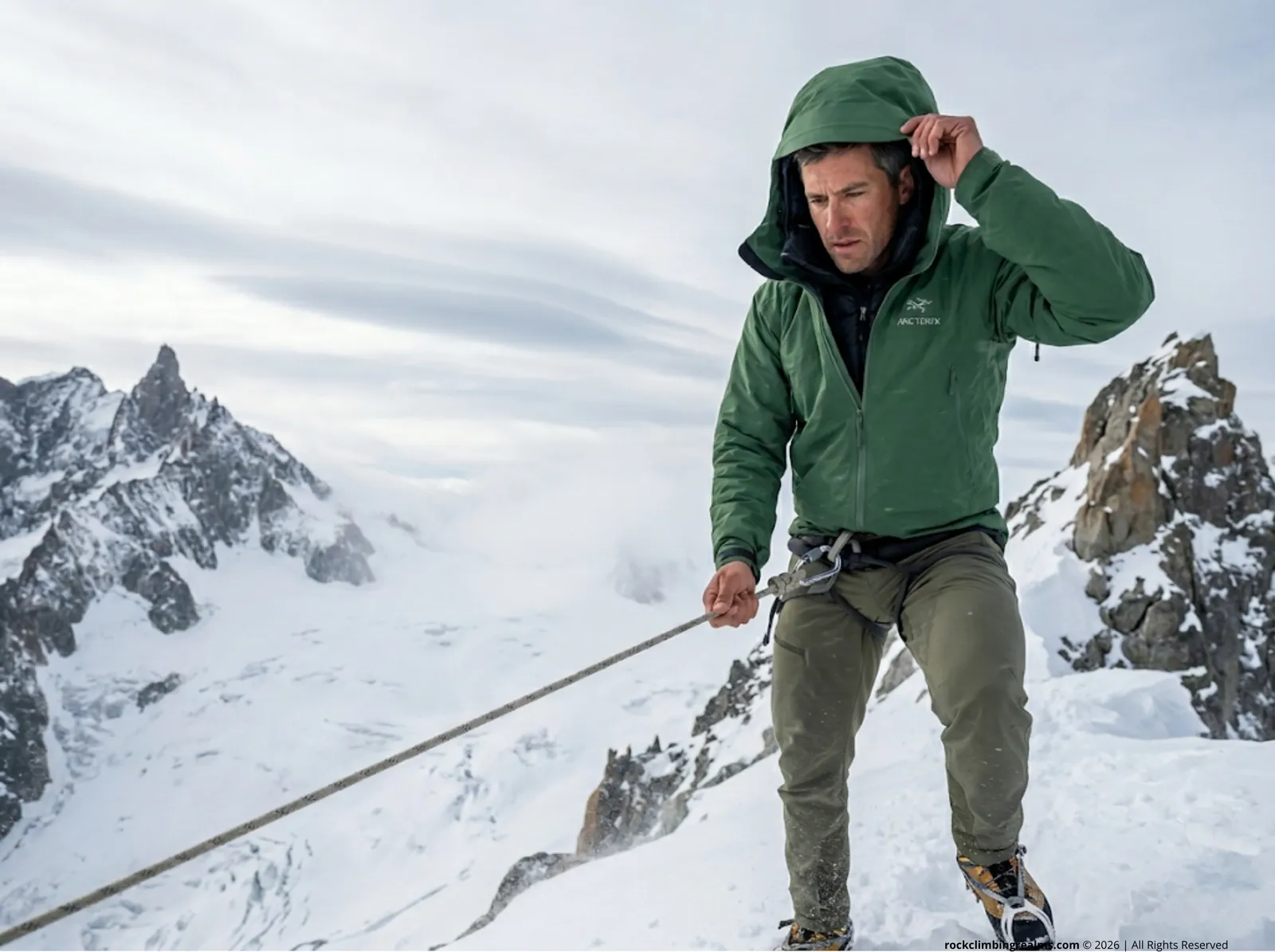
The pump is still running. Five hours into a technical mixed section, sweat is soaking through your base layer, the temperature sits just below freezing, and the crux pitch is still above you. You stop to tie in, the wind cuts through the softshell, and within ninety seconds your core temperature starts a freefall your belayer can read in your posture alone. The layers you chose at the trailhead are now either keeping you functional or watching you slide toward a moderate hypothermia case.
That moment of thermal reckoning is where fifty alpine climbs either confirm your system or expose it. Here is the framework that actually works.
Quick Answer: The fail-safe alpine layering system has three functional zones — the base layer manages moisture next to skin, the active insulation mid-layer maintains thermal equilibrium during movement, and the shell layer protects the microclimate from wind and precipitation. The critical protocol most climbers miss: the belay parka goes over the hardshell, not under it. This prevents the compression of loft that turns expensive down into a liability, and it keeps your weather barrier intact while the oversized parka traps a warm air layer between the two garments.
The Thermodynamic Battlefield: How Your Body Loses Heat in the Mountains
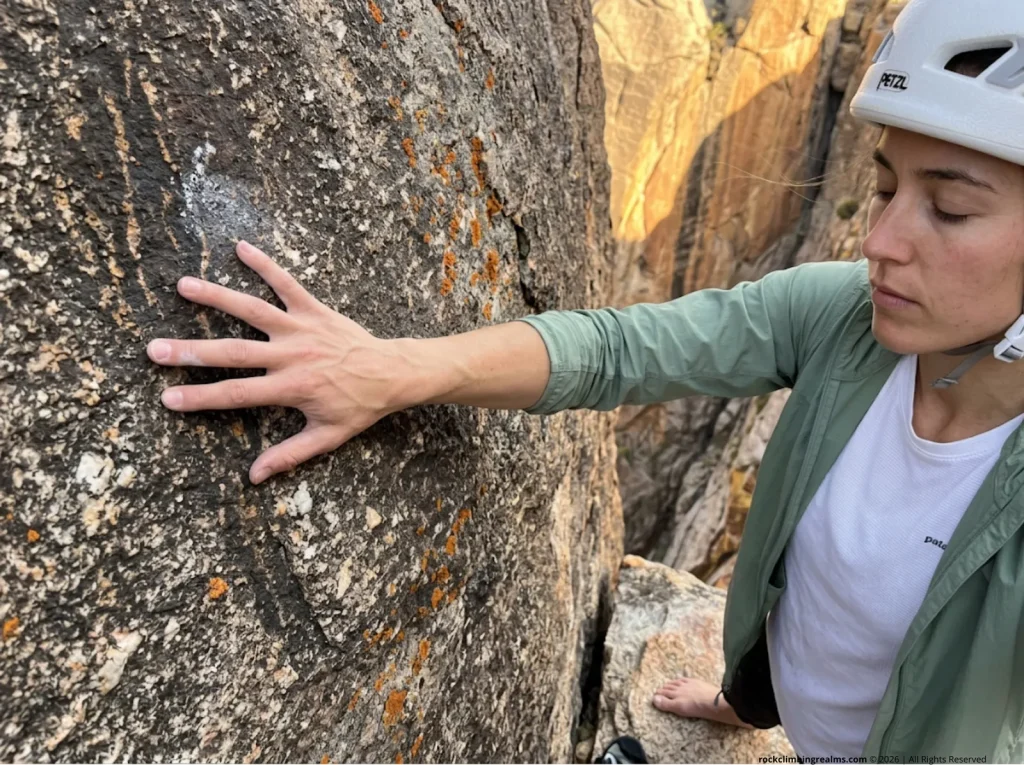
Heat does not care about your send. It moves according to physics, and the alpine environment applies three distinct mechanisms simultaneously.
Conduction is heat transfer through direct molecular contact. Sitting on frozen granite, leaning against a cold rock wall, or gripping a metal belay device — all of these pull heat directly from your body. Water conducts heat approximately twenty-five times faster than air. When your base layer is saturated with sweat and you stop moving, that wet fabric becomes a heat drain that no amount of mid-layer loft can compensate for.
Convection is the dominant stressor in most alpine conditions. Wind strips away the thin boundary layer of warm air next to your skin, and the effect compounds dramatically as wind speed increases. A twenty-mile-per-hour wind at minus ten Celsius produces equivalent cooling to static air at minus twenty-five Celsius. Your softshell or hardshell exists to disrupt this process — but only if the DWR coating on the face fabric is still functioning.
Evaporation is the sneakiest heat loss mechanism because it operates after you stop. When you step onto a belay ledge and your climbing effort drops to zero, the moisture already in your clothing does not stop evaporating. It accelerates. Your metabolic engine, now idling, cannot replace the heat being drawn off by that continuous evaporation. The result is flash-off — a rapid core temperature drop that can reach mild hypothermia within fifteen minutes even when ambient temperatures are not extreme. For a comprehensive breakdown of hypothermia progression and warning signs, the Princeton University Outdoor Action Guide is worth reading before any cold-weather objective.
Pro tip: The transition from active climbing to stationary belay is the highest-risk thermal moment in any alpine day. Train yourself to deploy your belay parka before you feel cold. By the time you notice the chill, you are already behind the thermal curve.
Thermoregulation: What Your Body Does Automatically (and Why You Must Outsmart It)
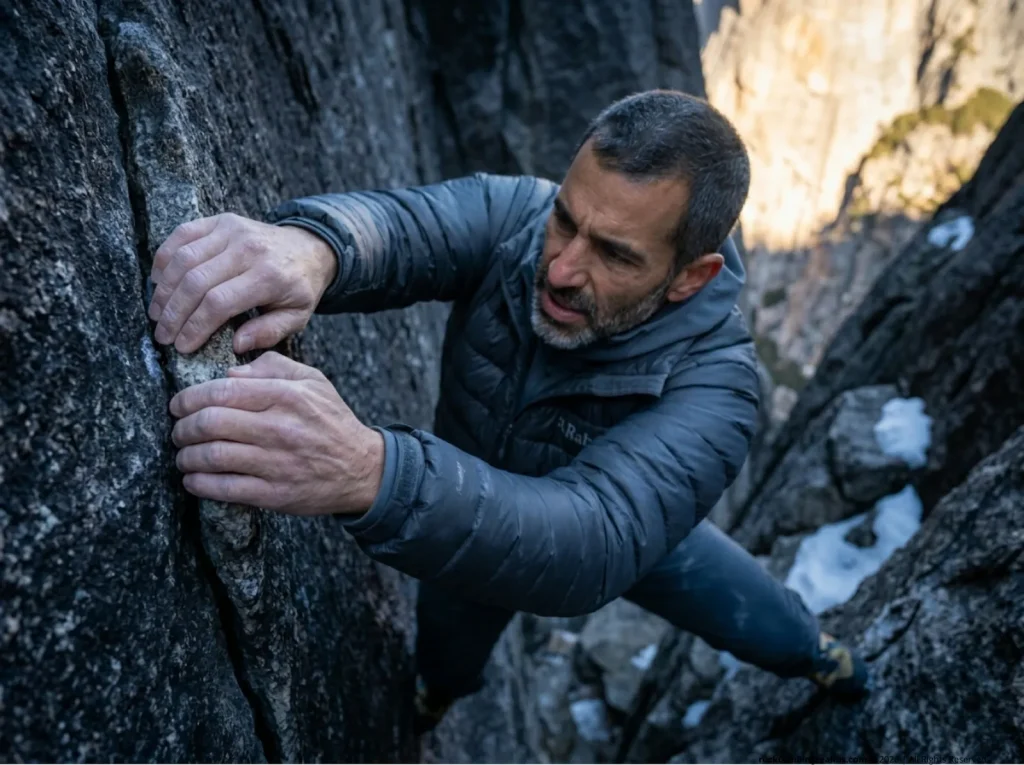
The first cold-defense mechanism is peripheral vasoconstriction — your hypothalamus narrowing blood vessels in your extremities to route warm blood toward your heart and brain. This biological triage is brilliant for survival but catastrophic for climbing performance. When blood flow to your hands and feet decreases, manual dexterity drops sharply.
The second is shivering, which can increase metabolic heat production by up to five times your resting rate. It is not a backup thermal generator — it burns through muscle glucose rapidly and is sustainable for only a few hours without caloric resupply. Moderate hypothermia — core temperature between thirty-two and thirty-five degrees Celsius — presents as intense shivering, muscle incoordination, slow deliberate movements, and early confusion. That confusion on a technical route is exactly the wrong moment for cognitive impairment.
The failure mode most climbers fall into is over-layering during the approach or early pitches. If you start warm, you sweat. If you sweat, you saturate your base layer. If you saturate your base layer and then stop for a belay or weather delay, the flash-off effect pulls heat from your body faster than your system can generate it.
CFM, MVTR, and HH: The Metrics That Actually Matter
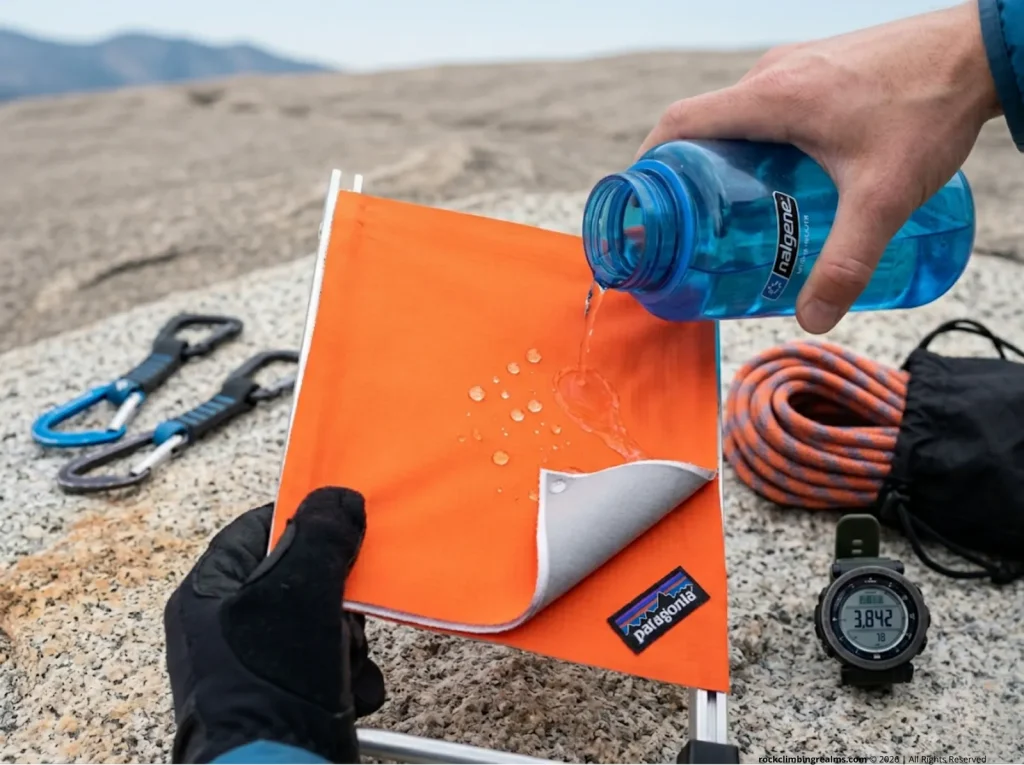
Marketing departments love to talk about breathability and warmth. They avoid the numbers that quantify those claims.
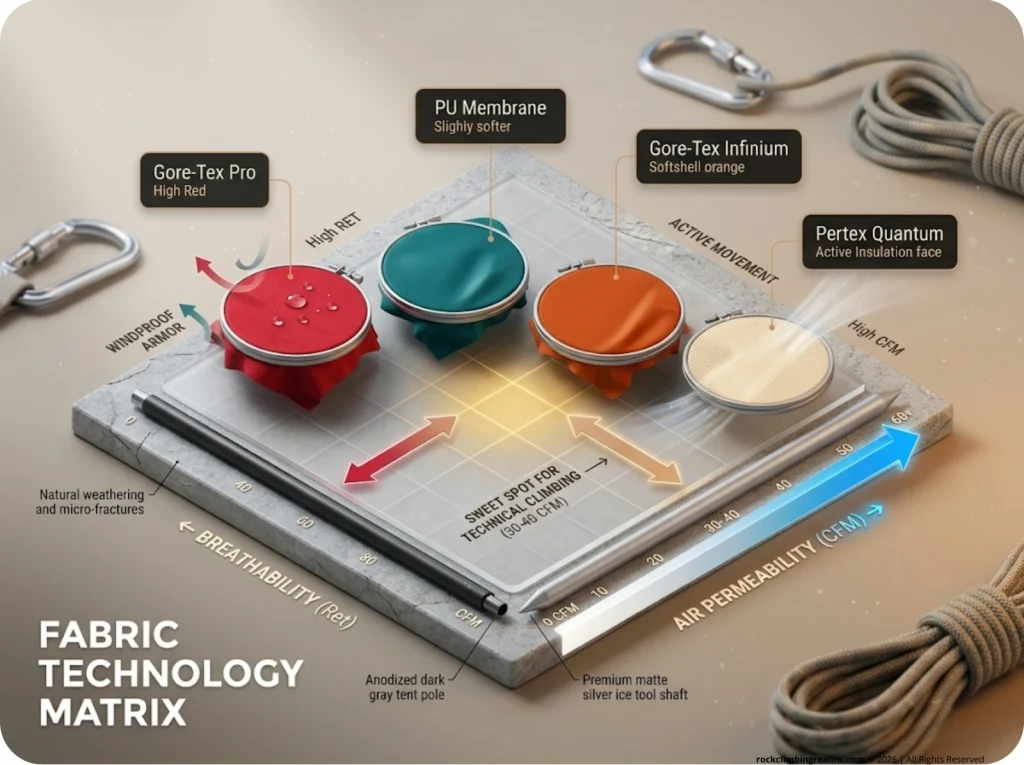
CFM (Cubic Feet per Minute) measures how much air passes through a square foot of fabric at a specific pressure differential. Zero to one CFM is completely windproof — Gore-Tex Pro territory — but it traps moisture if you are working hard. Thirty to forty CFM is the sweet spot for active insulation: enough airflow to move moisture vapor during movement while maintaining enough warmth for low-wind transitions. Above sixty CFM is open fleece — excellent vapor transport, essentially no wind protection.
MVTR (Moisture Vapor Transmission Rate) is the lab measurement manufacturers advertise, and it is an incomplete picture. The European Ret (Evaporative Resistance) standard is more useful for active users. Ret below fifteen is excellent for high-intensity technical leading. Ret between fifteen and twenty-five is good for moderate activity. Anything above forty is essentially a vapor prison for high-output activity.
Hydrostatic Head (HH) measures waterproofing as the height of a water column the fabric can support before leaking. For serious alpine use — kneeling in snow, leaning against wet rock, or wearing a pack with shoulder straps pressing into the fabric — a minimum of 20,000mm HH is required to prevent leakage through the membrane itself.
The Foundation Layer: Why Your Base Layer Determines Everything
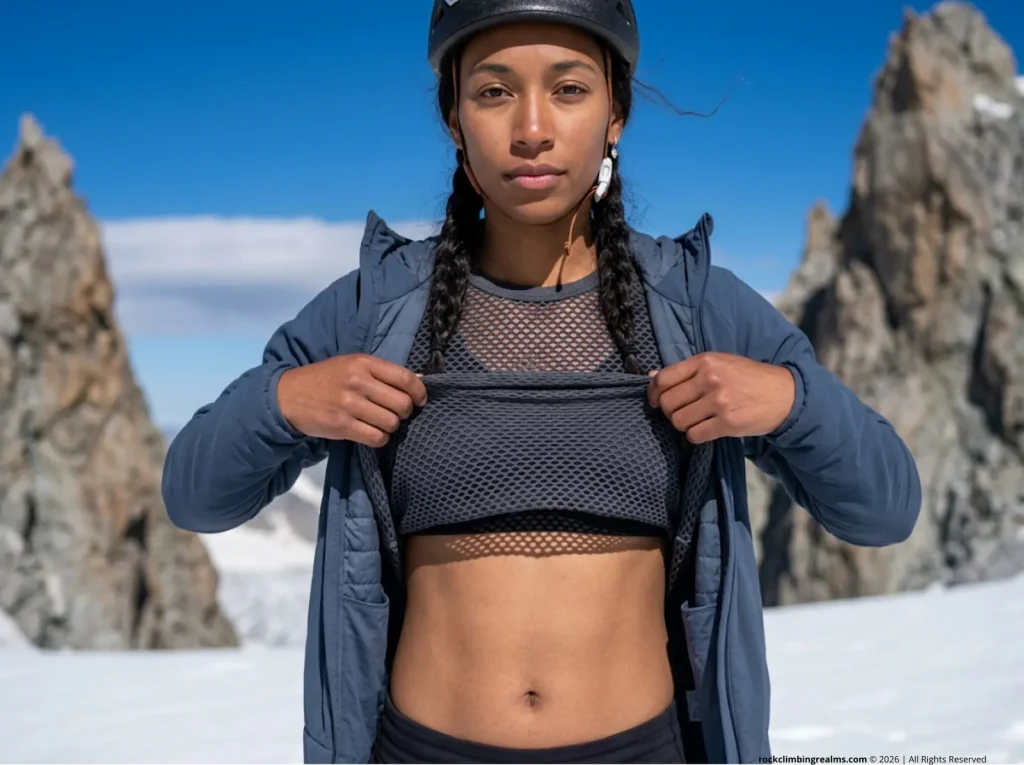
The base layer’s job is simple and brutal: move moisture away from your skin before it can saturate your insulation.
Merino wool absorbs moisture into the fiber structure — up to thirty percent of its weight before it feels damp. That absorption process releases a small amount of heat. Wool also resists odor retention better than synthetic fibers, which matters on multi-day pushes where laundry is not an option. The downside: the same internal moisture that makes wool feel warm when damp requires energy to drive outward, meaning it dries slower than synthetic alternatives.
Synthetic fibers are hydrophobic — they do not absorb water internally. Instead they rely on capillary action along the fiber surface to wick liquid moisture outward. They dry faster and maintain their wicking geometry when saturated, making them the better choice for high-output technical ice climbing, wet maritime environments like the Pacific Northwest or Patagonia, or any objective where your base layer will see repeated saturation cycles.
Fishnet and mesh base layers — the Brynje system is the most established — use large pores that maximize vapor transport. When covered by a shell, the mesh holes trap large volumes of warm air, providing a warmth-to-weight ratio that standard knit fabrics cannot match.
Pro tip: For ice climbing and high-output mixed routes, a synthetic mesh base layer under a softshell or hardshell outperforms every other combination I have tested across fifty-plus alpine days. The vapor transport during a sustained WI4 pitch with a heavy pack is the difference between arriving at the belay with a damp-but-manageable base layer and arriving with a soaked one.
Active Insulation: The Layer That Bridges Output States
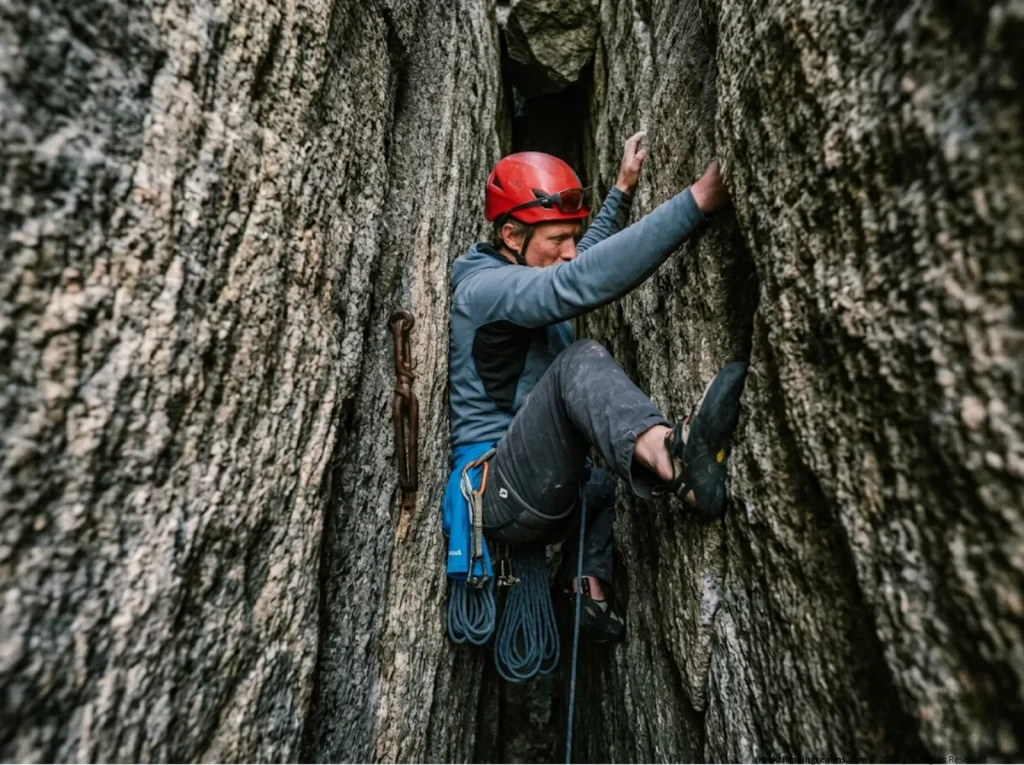
Traditional static mid-layers require you to stop and ventilate to dump excess heat. This creates a binary problem: you are too hot while moving or too cold while stopped. Active insulation solves this by combining high-loft insulation with a high-CFM face fabric, allowing moisture vapor to move through the garment during movement without condensing inside the system.
The two dominant approaches are the Patagonia Nano-Air and the Arc’teryx Proton Hoody. Both fall in the thirty-to-forty CFM sweet spot for technical climbing. Grid fleece — Polartec High-Loft and its equivalents — provides excellent active insulation at lower CFM values and compresses better, making it the preferred mid-layer for multi-day routes.
The Belay Parka Over Hardshell Protocol: The Layering Sequence That Saves Lives
This is the most important protocol in this article, and it is the one most guide services and competitor articles describe incorrectly.
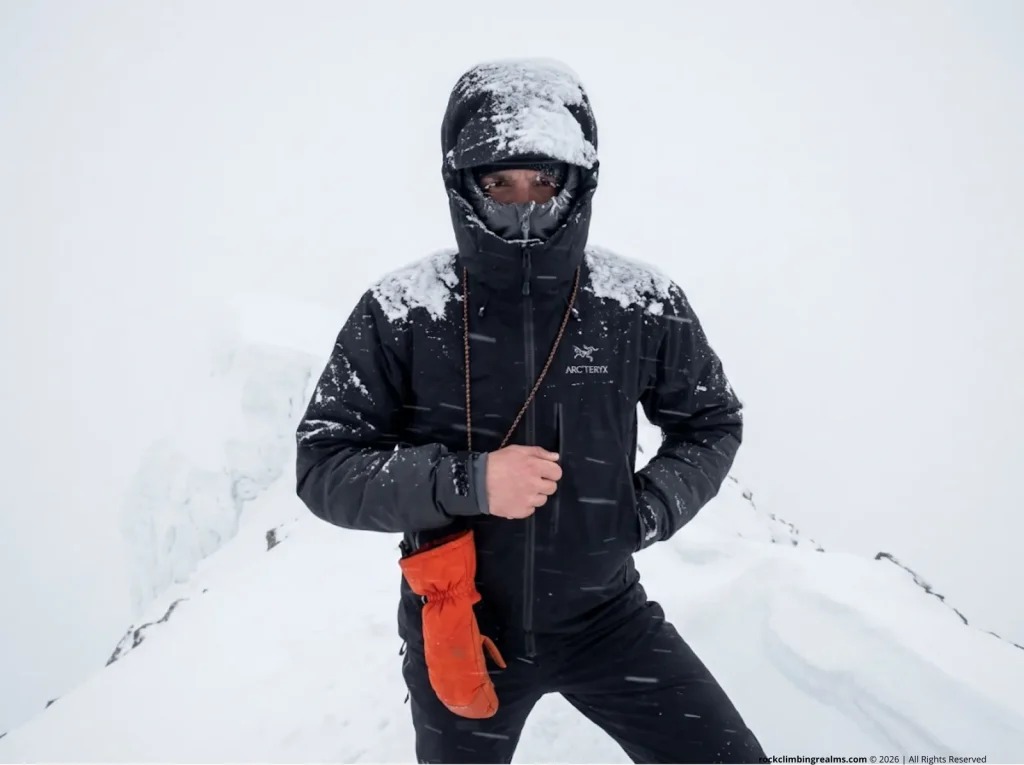
The belay parka is designed to be thrown over all other layers, including the hardshell. Not under it. Here is why.
When you place insulation under the hardshell, two things happen immediately. First, the hardshell compresses the down or synthetic fill, reducing the loft that traps warm air. Second, moisture evaporating from your body and base layer hits the inside of the hardshell first. Without a VBL, that vapor can condense inside the shell if the outer temperature is low enough, wetting out the insulation from the inside — the exact failure mode that turns a belay parka into a wet blanket.
The over-hardshell protocol keeps the weather barrier intact while the oversized belay parka traps a thick layer of warm air between the two garments. The two-garment stack functions as a combined system: the hardshell blocks external wind and precipitation, the parka provides maximum lofted insulation, and the air between them adds a dead air buffer that the body heats continuously.
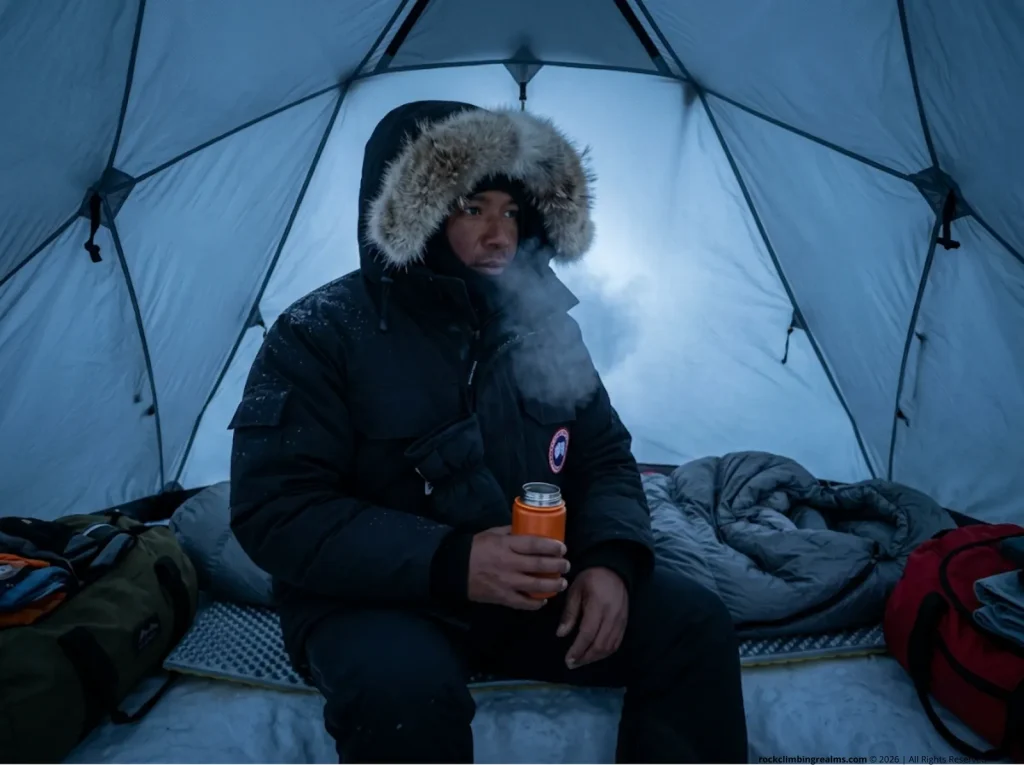
The belay parka must be oversized to accommodate all your climbing layers underneath, have a two-way zipper so you can expose the belay loop without fully opening the jacket, and on multi-pitch ice or mixed routes it must live in a harness-accessible pocket — not buried in the pack. The thirty seconds saved by not digging for it is the difference between staying ahead of the shivering threshold and watching your partner’s hands shake while they try to tie in.
After a twelve-hour day on the Grand Teton’s Owen-Spalding route in early October, I watched two climbers running the same gear list diverge in outcome. One deployed the over-hardshell parka protocol at every belay stance. The other buried theirs at the bottom of the pack. By the summit plateau, the second climber was showing early hypothermia symptoms — stumbling, slurred beta, the classic presentation. Study the Grand Teton climbing guide before your trip if you’re planning to climb the Owen-Spalding or any serious alpine route.
Shell Selection: Matching Armor to Objective Severity
Softshells and hardshells solve different problems, and choosing between them before you leave the trailhead matters more than most climbers realize.
Softshells achieve wind and water resistance through tightly woven fabric without a membrane, maintaining enough air permeability to dump heat during technical movement. For pure technical climbing — granite ridges, moderate ice, sustained mixed terrain — they are the correct default. They are more abrasion-resistant and allow better thermoregulation during hard output than any hardshell.
Hardshells become mandatory when you cross into sustained precipitation, extreme wind, or full alpine storm conditions where the weather can shift within minutes. The critical mistake is the “start in softshell, swap at the weather window” strategy. By the time a weather front arrives, you are already committed. Experienced alpinists check the mountain meteorology forecast and carry the hardshell from the trailhead on any route above the snow line. The UIAA safety standards for climbing equipment provide additional context on what gear performance thresholds actually mean in practice.
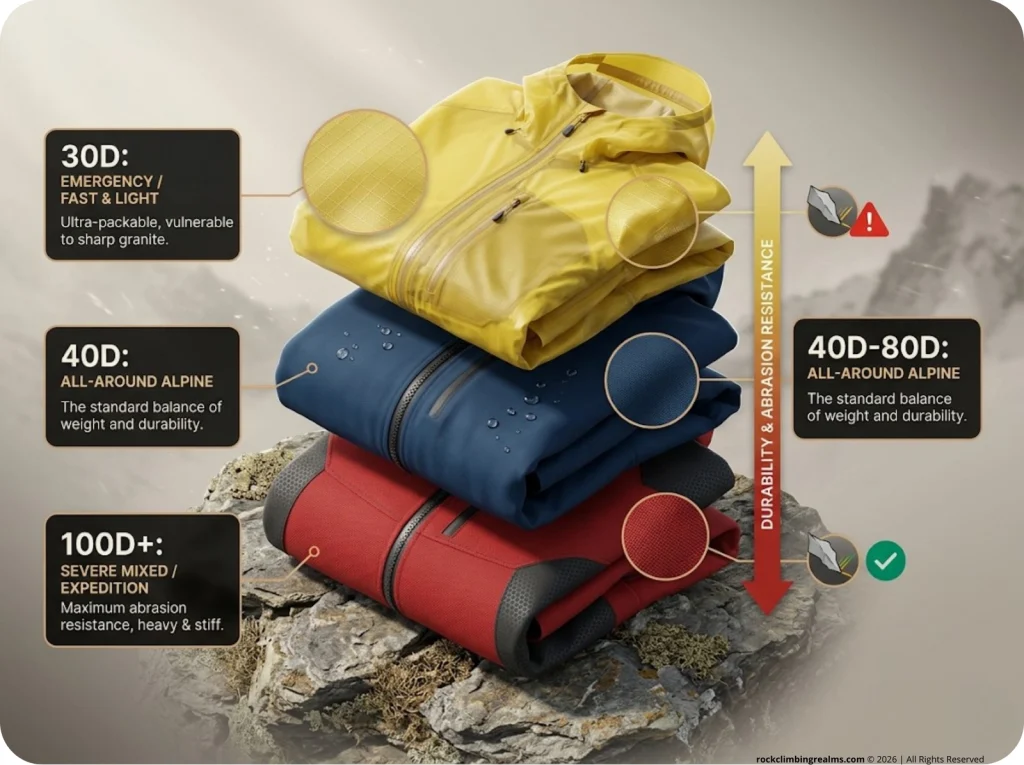
The denier rating of the face fabric determines abrasion survival. Thirty-denier shells are minimalist emergency layers suitable for fast-and-light objectives. Forty-to-eighty-denier is the all-around mountaineering range — the standard for most alpine routes. One hundred-denier shells are for serious mixed climbing and expedition use.
Vapor Barrier Theory: The Extreme Cold Protocol
When temperatures drop below minus twenty Celsius and the objective extends beyond a single day, the standard breathable system hits its limits. No breathable fabric can move vapor fast enough to prevent saturation, and the drying process — which requires metabolic energy you are no longer generating at altitude — becomes physically impossible.
A Vapor Barrier Liner (VBL) seals the microclimate against the skin at one hundred percent relative humidity, blocking all moisture from entering the clothing system. The body produces heat continuously, and at one hundred percent humidity next to skin, that heat is retained rather than consumed by evaporation. VBLs are not comfortable. They are not meant for movement. They are static thermal insurance for the coldest conditions where no other system can maintain core temperature.
VBL socks are recommended below minus ten Celsius to keep boot liners dry. VBL jackets are recommended below minus twenty Celsius for extended days in polar or high-altitude environments. If you’re targeting Denali’s West Buttress, the Denali West Buttress guide has the specific acclimatization and gear protocol details you need before your flight to Talkeetna.
Pro tip: If you are planning an expedition to a peak above 6,000 meters — Denali, Aconcagua, any Himalayan route — VBL protocol is standard practice among climbers who return. Learn it before you need it, not when you are sitting in a tent at 7,500 meters watching your down parka slowly lose loft from interior moisture accumulation. Also monitor yourself for altitude sickness symptoms continuously at that elevation — the cognitive impairment from hypoxia compounds the hypothermia risk significantly.
Scenario Configurations: Three Systems for Three Real-World Objectives
The layering matrix is not a single recipe. It is a decision framework that maps activity level and environmental severity onto specific gear combinations. Climbers refer to the active, high-output configuration as the Action Suit — the primary clothing system worn during technical leads, glacier approaches, and sustained physical effort in the alpine.
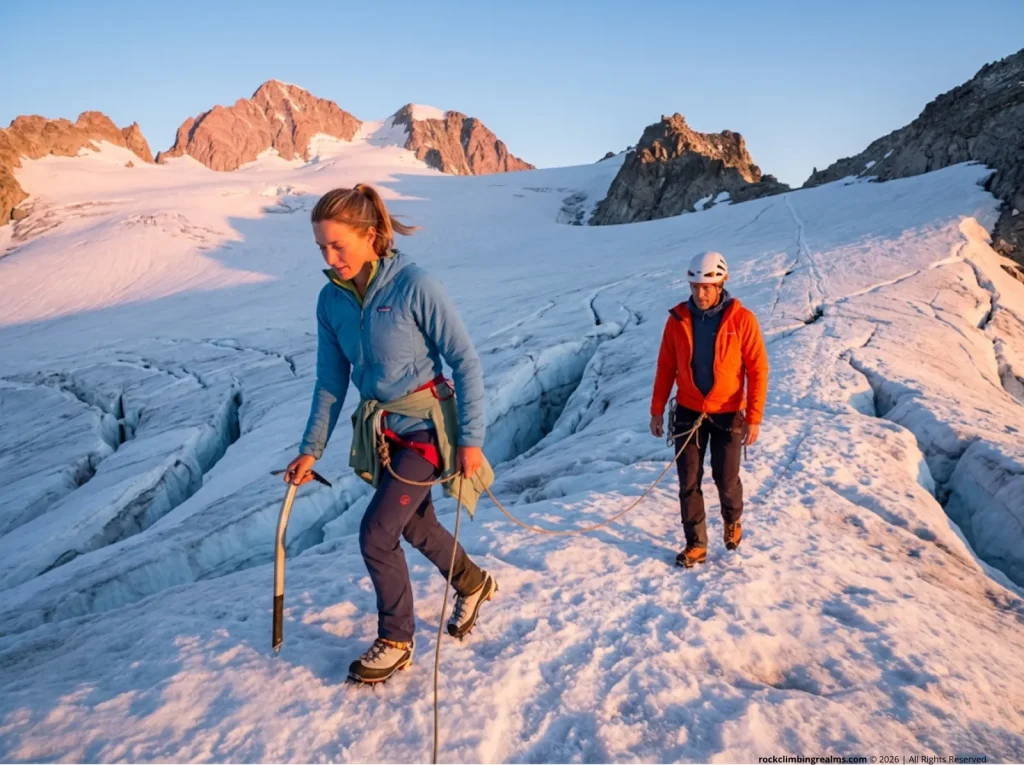
Glacier Approach and Moderate Terrain (Zero to Minus Ten Celsius, High Output): Start cold. Lightweight synthetic mesh or a UPF fifty sun hoodie handles the moisture load. Minimal or no mid-layer. Rope management on a glacier approach demands attention before you leave the trailhead.
Technical Ice and Mixed Climbing (Minus Ten to Minus Twenty Celsius, Moderate Output): Mid-weight synthetic base layer with enough thermal mass for recovery at rest stops. An active insulation hoody — Proton or Nano-Air — handles the thirty-to-forty CFM sweet spot. A highly water-resistant softshell or lightweight hardshell as the outer layer. The heavyweight synthetic belay parka lives in a harness-accessible pocket, deployed at every belay stance via the over-hardshell protocol. Before heading out on technical ice, check the best crampons for ice climbing to make sure your points are sharp and compatible with your boots.
Expedition and High-Altitude Summit Pushes (Minus Twenty to Minus Forty Celsius Plus, Low Output): Heavyweight merino or dual-layer base system for marginal warmth even when damp. Grid fleece plus medium-weight synthetic puffy for active movement. Gore-Tex Pro hardshell at zero CFM for the windproof barrier, non-negotiable when wind chill can reach extreme levels within minutes of exposure. Expedition-grade down parka — eight hundred-plus fill, box-baffle construction — deployed only at the summit and during extended rests.
System Maintenance: Protecting the Investment and the Safety Margin
A layering system that is not maintained is a system waiting to fail at the worst moment.
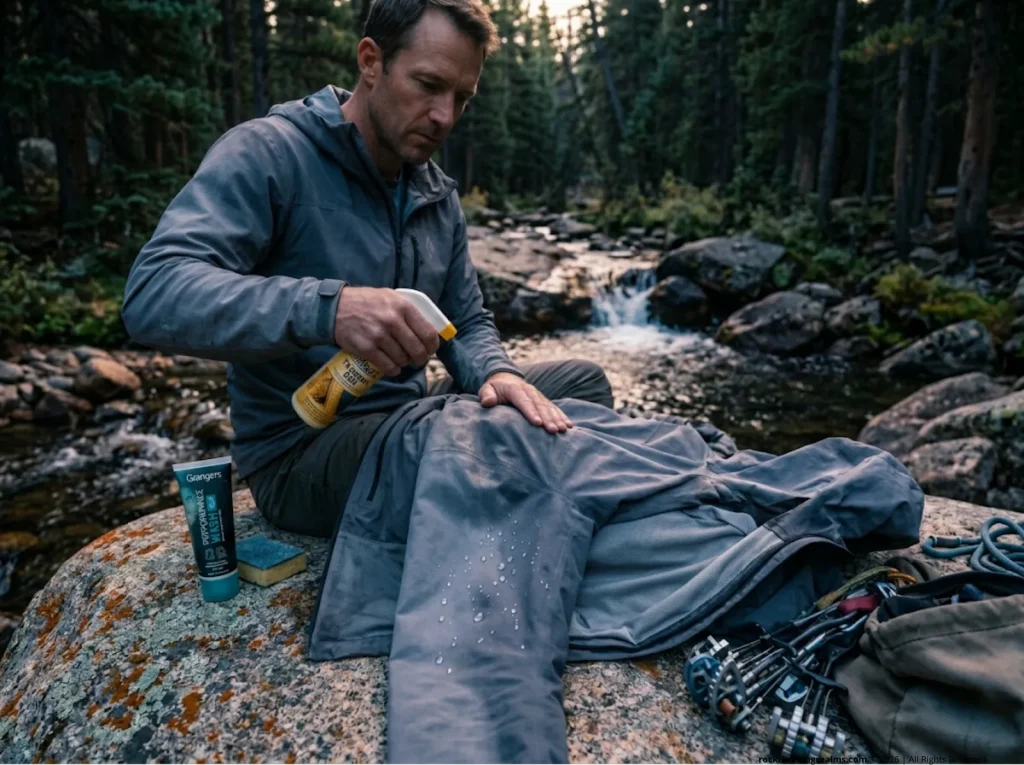
DWR restoration is the most neglected maintenance task in alpine apparel. When DWR fails, the face fabric “wets out,” creating a liquid water layer that blocks all vapor transmission through the membrane, even if the membrane itself is intact. A hardshell with failed DWR conducts heat as efficiently as a wet cotton shirt. Wash shells with non-detergent tech wash products like Nikwax Tech Wash or Grangers Performance Wash — standard laundry detergent degrades DWR.
Down cluster preservation requires loose storage between trips. Down clusters lose their insulative capacity permanently when stored compressed in stuff sacks. Between missions, keep all down-filled gear loose in large cotton bags. Inspect baffle seams annually for torn stitching — a torn baffle allows down to migrate, creating cold spots that may not be apparent until the next cold weather outing. For the full mountaineering gear system approach, the linked guide covers how each component interfaces with the others.
The fifty alpine climbs behind this system are not a flex. They are a collection of moments where the layering decision at the trailhead revealed itself as either correct or as a lesson learned on the mountain. The framework is simple: manage moisture first, maintain thermal fluidity across output states, and deploy the belay parka over the hardshell at every belay stance. Everything else is specific to the objective.
Before your next alpine day, walk through each layer transition. If you can answer what happens to your microclimate when you start moving, when you reach the belay, when weather moves in, and when you reach the summit with specific garments and protocols, your system is engineered.
Now go send something.
FAQ
Do you wear a down jacket under a hardshell in mountaineering?
No. Placing a down jacket under a hardshell compresses its loft, destroying the dead air spaces that provide insulation, and traps moisture against the down where it eventually wets out the clusters. The correct protocol is to wear the belay parka over the hardshell.
Is wool or synthetic better for alpine climbing base layers?
It depends on the moisture regime. In cold, dry environments — high-altitude peaks, continental alpine — merino wool provides marginal warmth even when damp and resists odors on multi-day pushes. In wet, maritime environments or during high-output technical ice climbing, synthetic fibers dry faster.
What is CFM in climbing jackets and why does it matter?
CFM (Cubic Feet per Minute) measures how much air passes through a square foot of fabric per minute. It quantifies how effectively a jacket dumps heat and moisture vapor during high-output climbing. Zero-CFM hardshells eliminate convective loss but trap moisture. Sixty-plus-CFM fleece breathes freely but offers no wind protection. The thirty-to-forty CFM range is optimal for technical alpine climbing.
Safety Notice: Rock climbing and mountaineering are inherently high-risk
activities that can involve physical trauma or fatal incidents. The information on Rock Climbing Realms is for
educational and informational purposes only. Techniques and advice presented here are not a substitute
for professional, hands-on instruction. Conditions and risks vary by location. Always seek guidance
from a qualified instructor before attempting new techniques. By using this website, you agree that you
are solely responsible for your own safety. Any reliance you place on this information is strictly
at your own risk, and you assume all liability for your actions. Rock Climbing Realms and its authors
will not be held liable for any harm, damage, or loss sustained in connection with the use of this information.
Affiliate Disclosure: We are a participant in the Amazon Services LLC Associates Program, an
affiliate advertising program designed to provide a means for us to earn advertising fees by advertising and linking
to Amazon.com. As an Amazon Associate, we earn from qualifying purchases. We are also an official affiliate partner
of Black Diamond Equipment via the AvantLink network. If you click on a Black Diamond affiliate link and make a
purchase, we may earn a commission at no additional cost to you. We also participate in other affiliate programs.
Additional terms are found in the terms of service.