
In this article
The sound of a bad landing isn’t just a thud. It is often followed by the sharp pop of an ankle giving way. Your ankles are the most vulnerable parts of your body in outdoor rock climbing.
When you are climbing in the talus fields of Guanella Pass or the rocky scree of the Buttermilks, the ground is never flat. A single square of foam isn’t enough to keep you safe. In these conditions, one pad is a liability, not a safety net.
Safety in highball bouldering and rough terrain isn’t something you buy; it is something you build through intentional landing management. You have to stop thinking of your pads as simple mattresses. Instead, view them as components of landing zone engineering.
You need to construct a uniform landing surface that erases the dangerous gaps between rocks. This guide will show you how to turn a pile of gear into a level, safe platform. We will cover the basics of foam density, how to level the ground, and how to set up a landing that catches you safely.
Why Is A Single Crash Pad Insufficient For Complex Terrain?
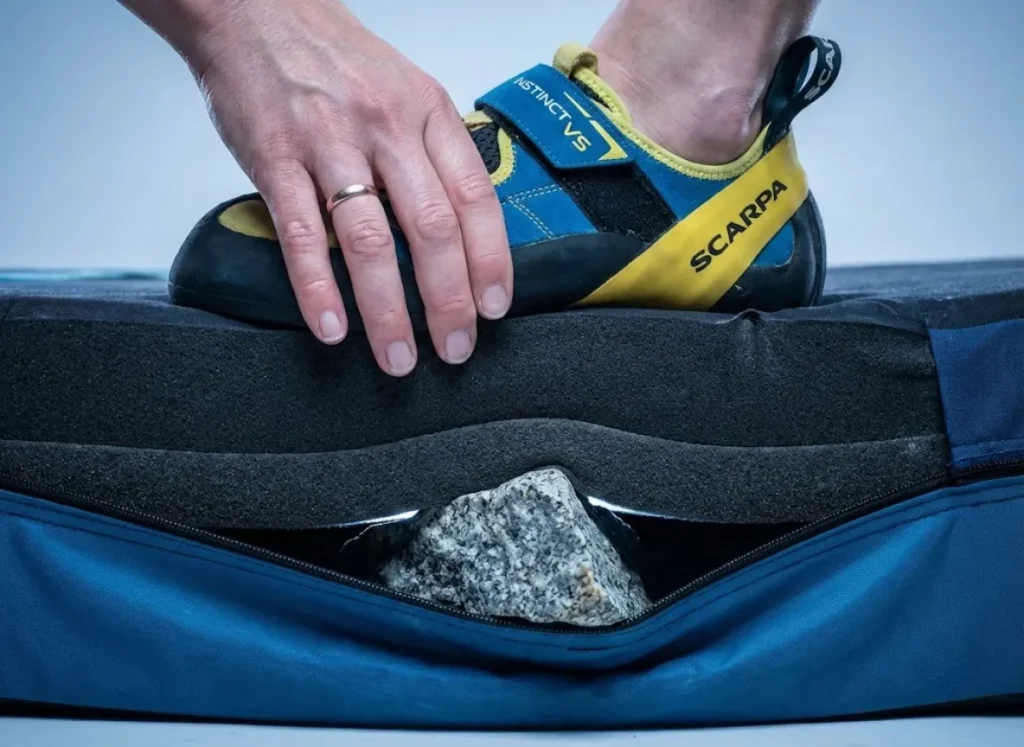
Standard crash pads are built for flat ground. When you put them on uneven terrain or slopes, a single pad can’t handle the variables. We need to look at why a single pad fails so we can understand why linking crash pads is necessary.
How does foam actually stop a fall?
Crash pad systems use specific foam sandwich construction to slow you down. The first type is open-cell foam, like a sponge. It acts as an air cushion. When you hit it, air escapes, and the foam squeezes down to slow your fall gradually.
The second type is closed-cell foam. This layer is hard and acts like a shield. It spreads the force of your landing over a wide area so you don’t feel a sharp impact in one spot. This balance of surface area vs depth is critical.
A single pad fails on jagged rocks because it “bottoms out.” If you fall fast enough, you compress the soft foam all the way down. If there is a sharp rock underneath, you will hit it.
The International Climbing and Mountaineering Federation defines the safety limits for energy absorption, but their tests assume a flat floor. They don’t account for rocks poking into the back of your pad.
This is why we stack pads. We need more pad depth to slow you down and a stiffer layer to block the rocks. This concept is a key part of mastering spotting and crash pad safety outdoors.
What risks do “gaps” and “seams” pose to the climber?
The biggest danger in a stack of pads is the “Gutter Effect.” This is the seam between two pads or the hinge in the middle of a folding pad. It creates a weak spot where your foot can punch through and hit the ground.
Hinge mechanics matter here. A “flat hinge” or “angle hinge” can create gutter hazards. Even worse is the “Bridge Hazard.” This happens when you put a folding pad over a hole between two rocks. If you land on it, the hinge collapses. The pad folds into a V-shape and traps your ankle like a vice.
These traps turn a soft landing into an ankle sprain or worse. Emergency department data highlights current sex and age patterns of rock climbing-related injuries, and many lower leg injuries come from these exact situations.
To fix this, you need to seal the seams and practice seam management. You can do this by putting a continuous layer of foam over the top. You should also utilize offsetting seams so the gaps don’t line up vertically. This attention to detail is vital for mitigating top climbing dangers and life-saving prevention.
What Components Make Up A Safe Modular Landing System?
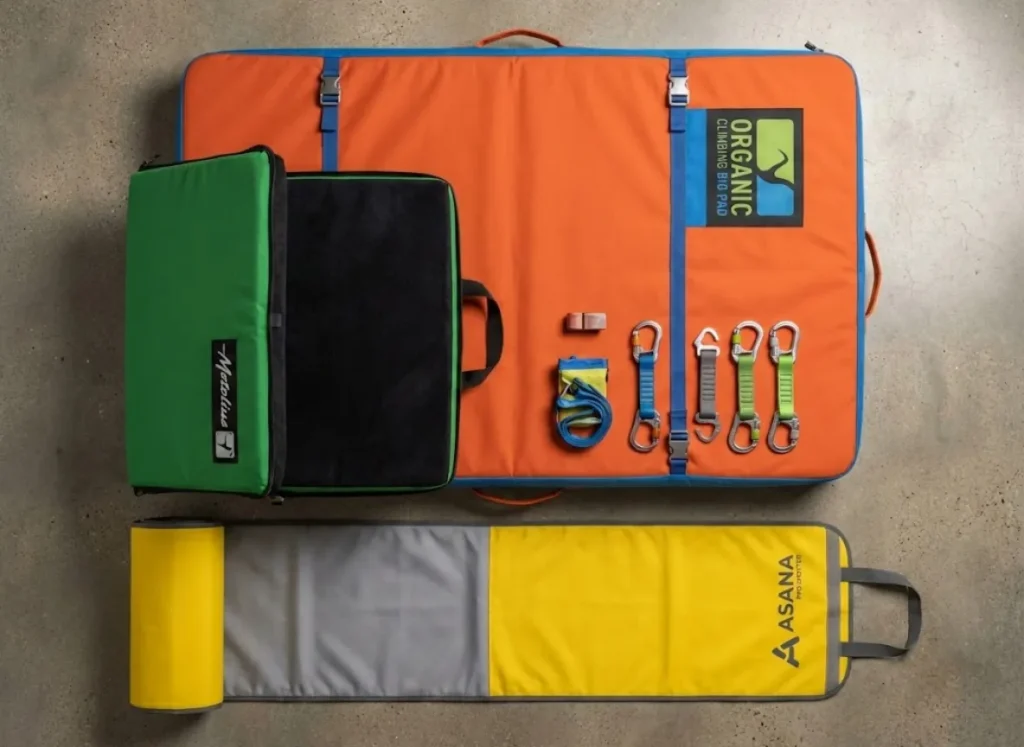
Don’t look at your gear as just a pile of mats. In a proper crash pad quiver, every pad has a specific job. You have a foundation, a connector, and a unifier.
Which pads serve as the foundation versus the connector?
The Foundation (Base Layer) needs to be big and stiff. High-quality pads like the Organic Big Pad, Organic Backfourty, or the BD Mondo work well here. They need to span across large holes in the talus without sagging.
This layer acts as your floor. It must be at least 5 inches thick to keep you away from the uneven ground. It needs to be stiff so it creates a flat surface for the other pads to sit on.
The Connector (Satellite Layer) is your standard-sized pad, like a Metolius Session, Petzl Alto, or Black Diamond Circuit. You use these to build height. You can also use them as “shims” to level out a slope before you put the big base pad down.
The Health and Safety Executive analyzes soft landing systems for working at height, and the principle is simple: more volume absorbs more energy.
When you go to pick your best bouldering crash pad, think about its role. Are you buying a base layer or a connector? Solid “taco hinge” pads like the Flashed Drifter are great for the top because they lack a center seam, while hinged pads are better for stuffing into holes.
Why is a “Blubber” or “Slider” pad the keystone of the system?
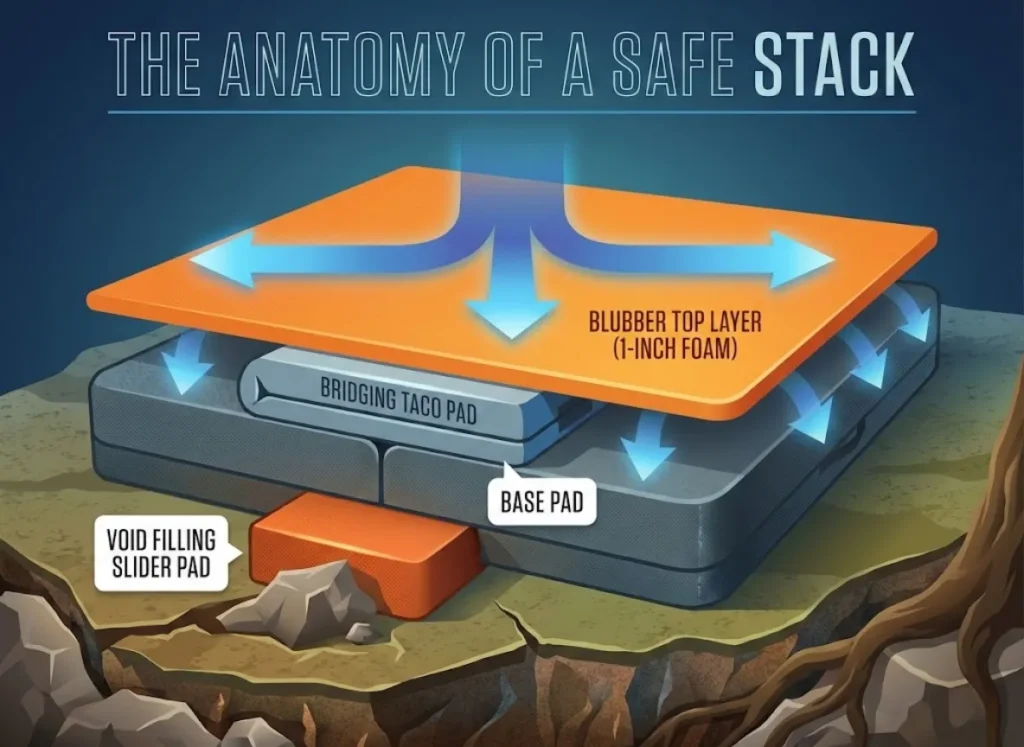
An Organic Blubber Pad (or similar slider pad) is a large, thin sheet of foam, usually about one inch thick. It isn’t meant to catch a fall on its own. Its job is to smooth everything out as a distribution plate.
You drape it over your stack of pads to cover the steps and seams. This stops your ankle from rolling off the edge of a pad. It also makes the connection surfaces feel the same everywhere.
If you land while spinning, the Blubber pad lets your foot slide safely. Without it, your foot might catch on a strap or a lip, causing a twist. Smaller utility pads or sit pads are different. You use them to cover sharp rocks, root systems, or wet terrain that you can’t move.
Carrying a Blubber pad shows you are serious about bouldering safety. Studies in the International Journal of Wilderness explore boulderers’ attitudes and beliefs regarding risk. They found that trusting your landing zone helps you climb better because you are less afraid. Adding this layer is part of an expert framework for how to choose a crash pad system.
How Do You Architect A Safe Landing On Uneven Ground?
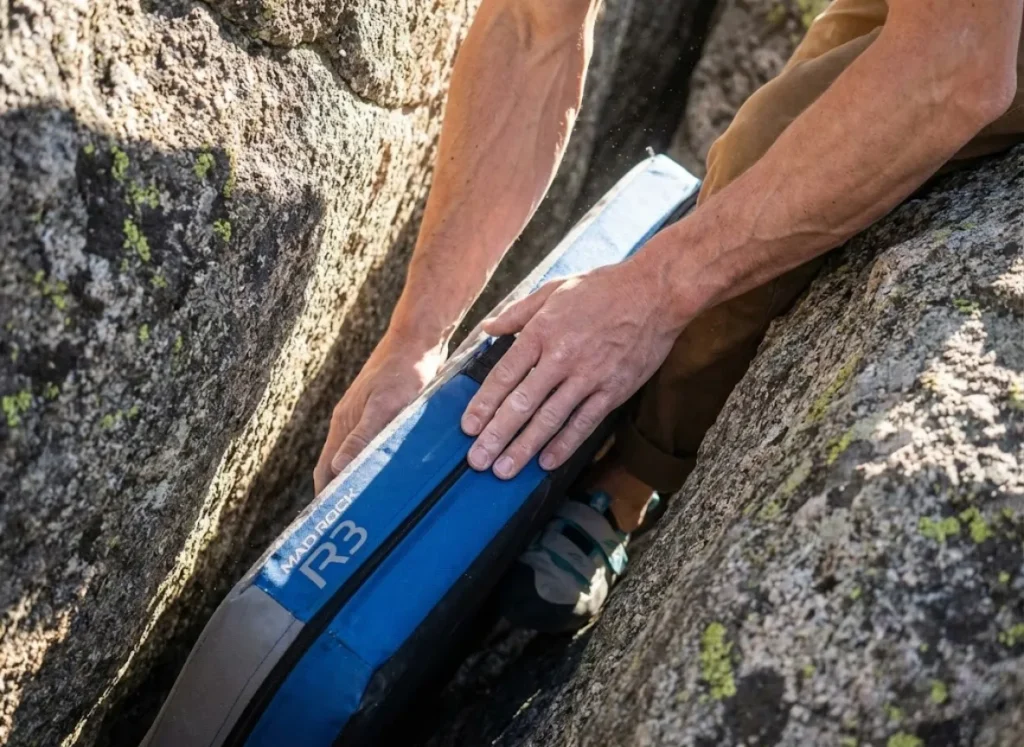
Now that you have the gear, you need to build the landing. The ground is rarely flat, so you have to force it to be. You need to assess the terrain changes and identify fall zones.
What is the “Tetris” method for neutralizing talus?
Phase 1: Fill the Holes. Before you put down your main pads, look for deep holes between the rocks. Fill them with backpacks, rope bags, or folded gap pads. This is crucial in high fall zones.
Phase 2: The Bridge. Place a stiff pad over the filled hole. Make sure it touches the rocks on at least three corners using the “floating pad technique.” It needs to be stable. You don’t want it to wobble like a teeter-totter. This creates a “False Floor” that is level with the area around it.
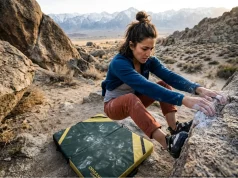
Phase 3: The Platform. Once the bottom is level, lay down your big base pads. Finally, put the blubber pad on top to seal everything together. If you skip the leveling step, your pads might slide apart when you land, opening up a dangerous hole.
Pro-Tip: Use your oldest, most beat-up budget pads as the bottom layer. Let them take the abuse from the sharp rocks and mud. This protects your newer, expensive impact-absorbent pads on top.
This method is also good for the environment. The University of Montana Climbing Management Plan outlines strategies for managing impacts in climbing areas. They prefer climbers to use pads to level the ground instead of moving rocks. This skill fits into mastering crash pad placement.
Why must you strictly follow the “Hard on Soft” stacking rule?
The Golden Rule: Always put the stiffer pad on TOP. If you have a pad with a hard side and a soft side, the hard side faces up. This is the “Hard on Soft layering rule.”
The top stiff layer acts like a shield. It ensures you land on a flat surface. This spreads the impact evenly into the soft foam underneath for proper landing zone force dissipation.
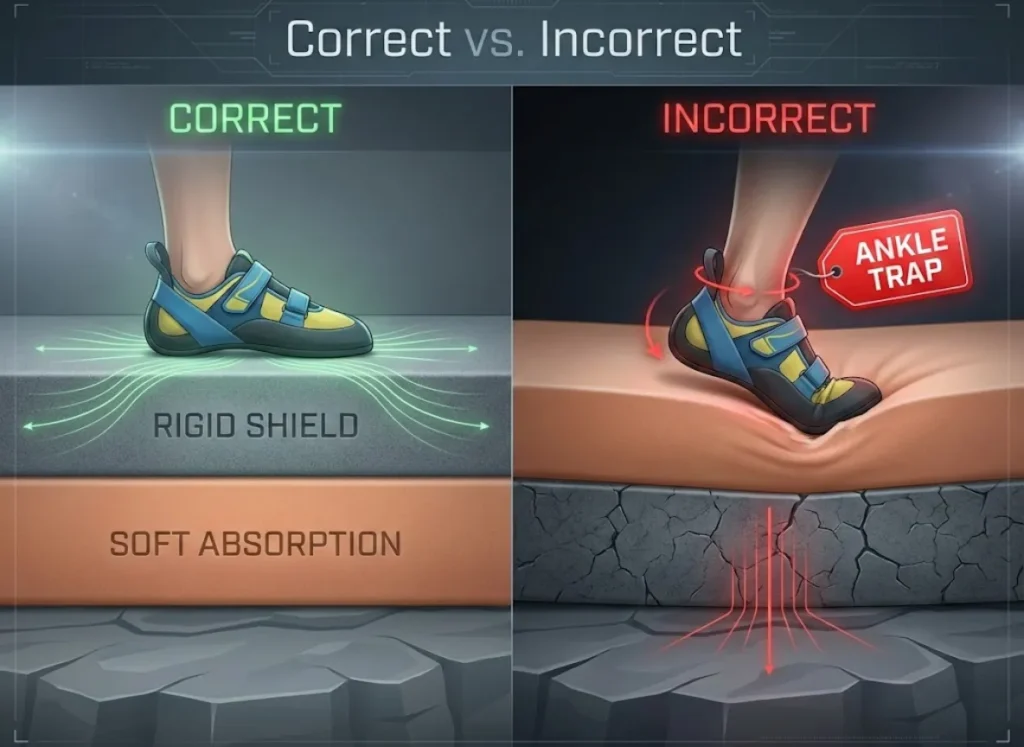
The Inversion Trap: If you put a soft pad on top, you create a trap. Your foot will sink deep into the soft foam instantly. If your foot is twisted, it will hit the hard layer underneath while it is stuck.
This locks your foot in place while your body keeps moving, preventing proper momentum redirection. That twist can snap a bone. The PMC study ‘The art of falling’ identifies specific fall scenarios associated with bouldering injuries. They confirm that rotation during a landing is a major cause of breaks. Avoiding this is a huge part of the science of climbing injuries prevention and treatment.
How Do Logistics And Ethics Intersect With Safety?
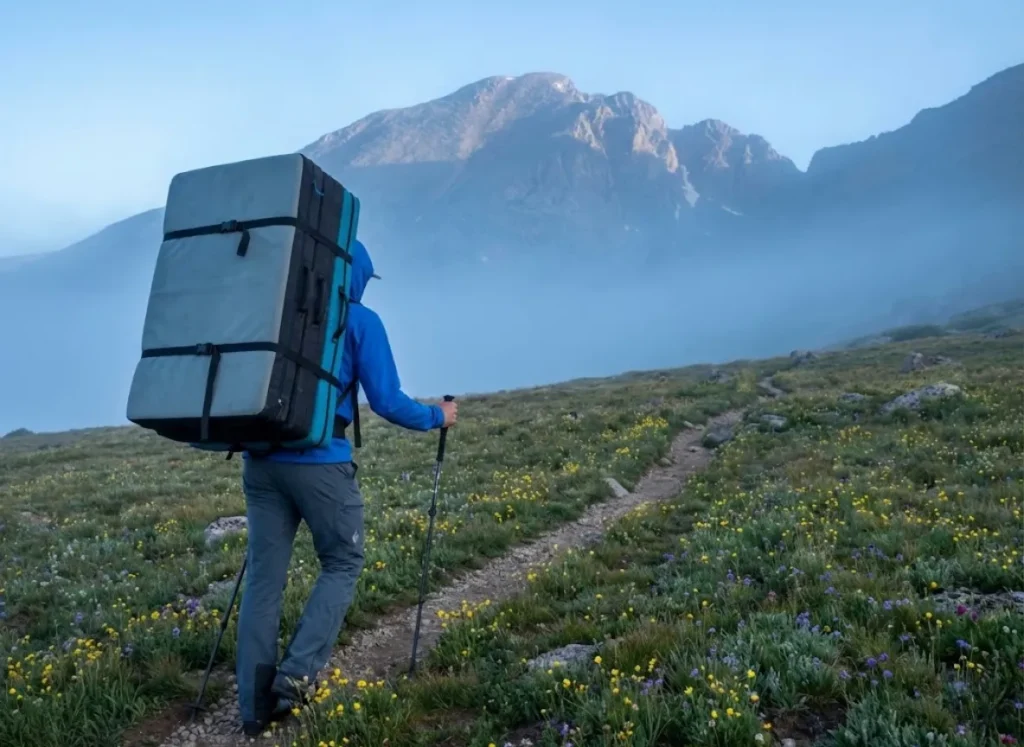
A perfect stack doesn’t help if you can’t carry it to the boulder. You also need to make sure you aren’t hurting the nature you came to enjoy.
How can you transport a multi-pad system effectively?
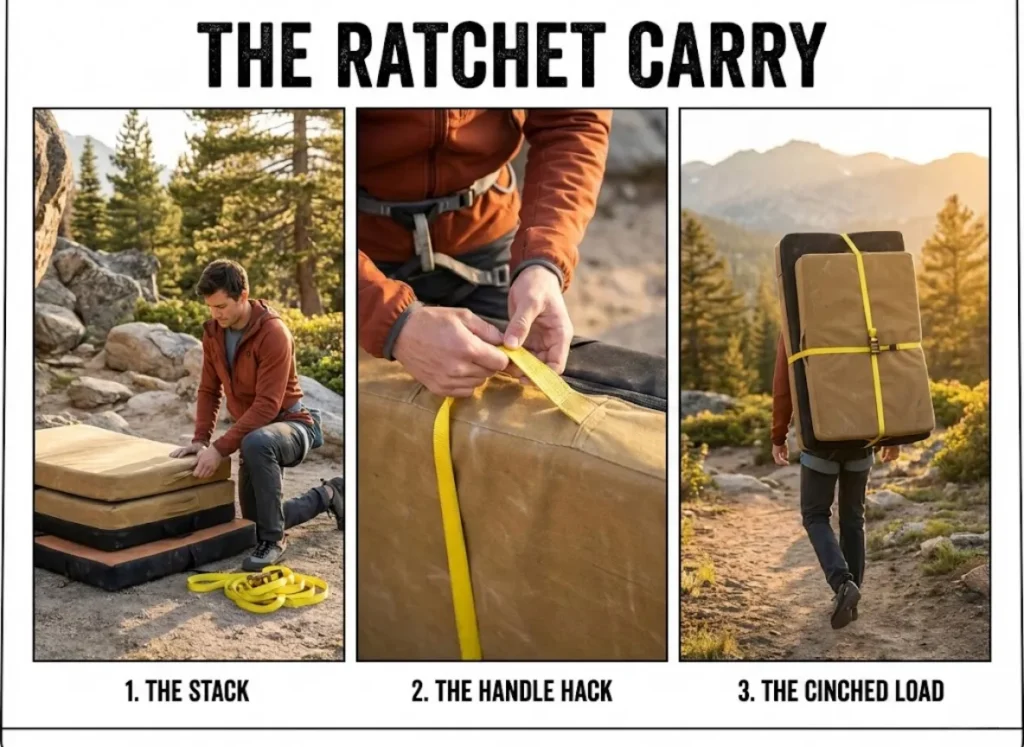
The straps that come with your pads usually won’t fit a stack of three. You should buy 15ft ratchet straps to tie them all together for a secure solo hauling configuration.
The Handle Hack: Run your main strap through the bottom feature handles of the base pad first. Then, run it over the top of the stack. This takes the weight off the shoulder straps and air-mesh waist-belt so they don’t rip.
Pack the heaviest pad closest to your back. This keeps your center of gravity tight. If the weight is too far back, it will pull you over and tire you out.
The Team Carry: If you are trying a really tall boulder, split the gear up. Have the strong hikers carry the big base pads. Have the smaller team members carry the satellite pads. Rebuild the system when you get there. Top pros like Nina Williams or Ethan Pringle often rely on a team to haul the necessary foam for massive projects.
Rocky Mountain National Park regulations provide guidelines on bouldering and gear transport. They state that leaving gear overnight is illegal, so you must be able to carry everything out. Learning to carry gear is part of essential bouldering gear for beginners.
How does “stacking” align with Leave No Trace principles?
Engineering vs. Gardening: Good climbers use foam to cover obstacles. Bad climbers dig up rocks or cut bushes to make a flat spot. We call that “gardening,” and it damages the area.
Always follow LNT principles: “Move the Pad, Not the Rock.” This protects the homes of small animals and keeps the soil in place. This is critical in sensitive areas like Hueco Tanks, Rocklands, or Magic Woods.
If you are climbing on sensitive grass or moss, don’t leave your pads down all day. Stack them on a bare rock when you aren’t climbing. The National Park Service outlines sustainable bouldering practices to mitigate environmental impact. They confirm that a big pad stack spreads your weight out, which can actually be better for the ground than walking around in climbing shoes. This is central to the climber’s guide to Leave No Trace ethics.
Conclusion
Building a landing zone is about more than just piling up mats. It is about creating a safety matrix that keeps you safe. Remember the rules: Hard foam goes on top of soft foam. Use big pads for the base and smaller pads to fill gaps.
Use the “Tetris Method” to make the ground level before you build up height. This lets you take control of the danger.
Before you go out next time, check your foam. Practice building your stack at home. Make sure you have the right setup to land safely.
FAQ – Frequently Asked Questions
How many crash pads do I need for a tall boulder?
For falls over 12 feet, you typically need 4 to 5 pads. You want a landing area of about 100 square feet that is 8 to 10 inches thick. This usually means 2 large base pads, 2 smaller satellite pads around the edges, and a blubber pad to cover the gaps.
Is it better to have soft or hard foam on top of a stack?
Always place hard (stiff) foam on top. A stiff top layer acts like a distribution plate. It keeps your foot from sinking in unevenly and twisting before the soft foam underneath absorbs the energy.
What is the difference between a Slider and a Blubber pad?
A Blubber pad is a large, thin sheet (about 4×6 feet) used to cover a whole stack of pads to hide the seams. A Slider pad is small (about 2×3 feet) and thin. You use it to cover single rocks, fill small holes, or cover the start hold.
How do I stop my stacked pads from sliding apart when I land?
Use a large Blubber pad over the whole stack. This ties the surface together so pads don’t drift apart. Also, make sure the bottom layer is level using the Tetris method. If the stack sits on a slope, it will slide. Use Velcro load flaps to connect pads if they have them.
Safety Notice: Rock climbing and mountaineering are inherently high-risk
activities that can involve physical trauma or fatal incidents. The information on Rock Climbing Realms is for
educational and informational purposes only. Techniques and advice presented here are not a substitute
for professional, hands-on instruction. Conditions and risks vary by location. Always seek guidance
from a qualified instructor before attempting new techniques. By using this website, you agree that you
are solely responsible for your own safety. Any reliance you place on this information is strictly
at your own risk, and you assume all liability for your actions. Rock Climbing Realms and its authors
will not be held liable for any harm, damage, or loss sustained in connection with the use of this information.
Affiliate Disclosure: We are a participant in the Amazon Services LLC Associates Program, an
affiliate advertising program designed to provide a means for us to earn advertising fees by advertising and linking
to Amazon.com. As an Amazon Associate, we earn from qualifying purchases. We are also an official affiliate partner
of Black Diamond Equipment via the AvantLink network. If you click on a Black Diamond affiliate link and make a
purchase, we may earn a commission at no additional cost to you. We also participate in other affiliate programs.
Additional terms are found in the terms of service.