

In this article
The competition timer can feel like a pressure cooker. You are standing on the mats with four minutes to solve a physical riddle, and being strong isn’t always enough—you have to be smart, and you have to be fast.
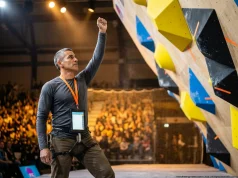
Modern comp-style boulder problems aren’t just about pulling hard on small edges anymore. They are designed like architectural traps. To succeed when the competition clock is ticking, you can’t just look at the boulders. You have to figure out what the route setter was thinking when they put them there, applying a specific route setter’s lens to the wall.
As a guide and instructor, I’ve seen incredibly strong climbers fall off because they misunderstood the puzzle. They were looking for handles, but the wall was asking for balance. To perform well, we need to strip away the confusion and look at the skeleton of the climbing route: the shapes, the physics, and the clock.
What defines the “Modern” Competition Boulder Problem?
Competition style bouldering has changed a lot. It doesn’t look like outdoor rock climbing anymore. It uses massive shapes, macros, and slippery surfaces to force you to move in very specific ways.
How do volumes and macros change the wall?
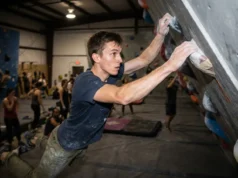
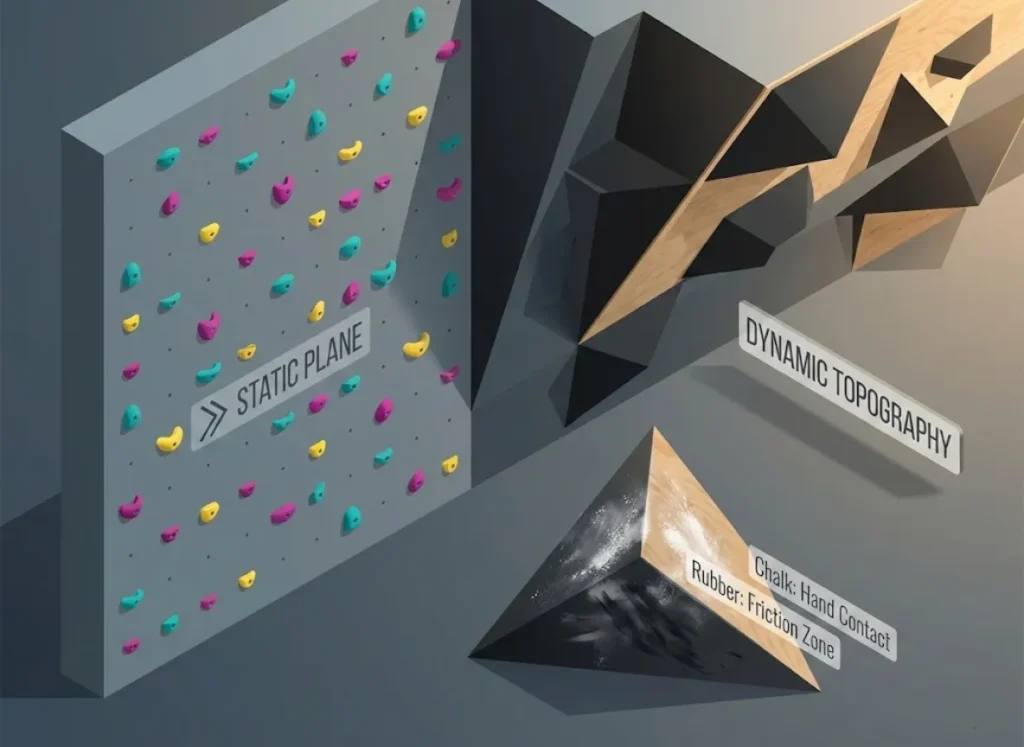
In the old days, holds were just bolted to a flat wall—mostly crimps, pinches, and jugs. Now, we have “volumes” and macros. These are those giant geometric shapes that stick out from the wall. They essentially change the wall topography itself, turning a vertical face into a slab, a corner, or a roof.
The challenge here isn’t grabbing a small edge. It’s understanding how to lean against these big, sloper-style shapes. You have to find the “arete” (the edge of the volume) or the sweet spot where the angle is just right to hold your weight.
Setters often use volumes to block the easy path. They force you into awkward hip positioning just to get around them. Since you can’t really “grip” them, you have to rely on body positioning. If your hips aren’t in the right spot, you will slide off.
This requires a mental shift. Stop looking for handles and start analyzing climbing hold shapes to see how you can lean against them.
Pro-Tip: When reading a volume, look for chalk marks. However, be skeptical—chalk indicates where people touched it, not necessarily where they stayed on it. Look for the black rubber smudges; that is where the feet actually stuck.
Research on the coefficient of friction on climbing surfaces shows that the margin for error is tiny. If you lean just a few degrees the wrong way, you lose friction and fall.
Why are some holds shiny and slippery?
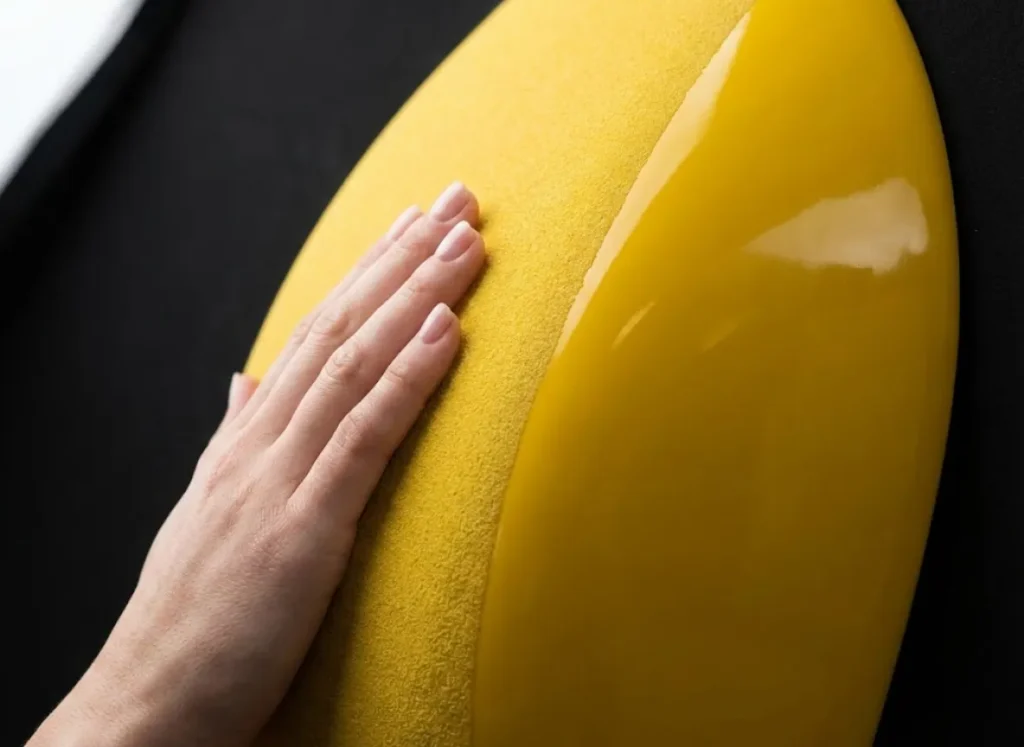
You have probably seen holds that look like two different things mashed together. One side is rough and textured, and the other side is smooth, shiny plastic. These are called dual-tex holds.
Setters use these to force you to move exactly how they want. The shiny side is the no-tex zone—it has zero friction. If you touch it, you slip. This eliminates “cheating” or finding an easier way up the wall.
To read these, you need to look closely. Scan for the shiny reflection that warns you of the danger zone.
This adds a lot of scoring pressure. You know that if your foot placement is off by even a millimeter, you will slip. This fear can make you hesitate or grip too hard, which tires you out.
Expert readers use the texture as a map. The rough part tells you exactly which direction you need to pull. If you try to pull any other way, you’ll hit the slippery plastic.
Studies on the biomechanics of rock climbing technique suggest that these forced movements tire out specific muscles faster. You have to be precise. Use the science of footwork to apply smearing pressure exactly where the texture is, and nowhere else.
How do physics dictate the “Intended Beta”?
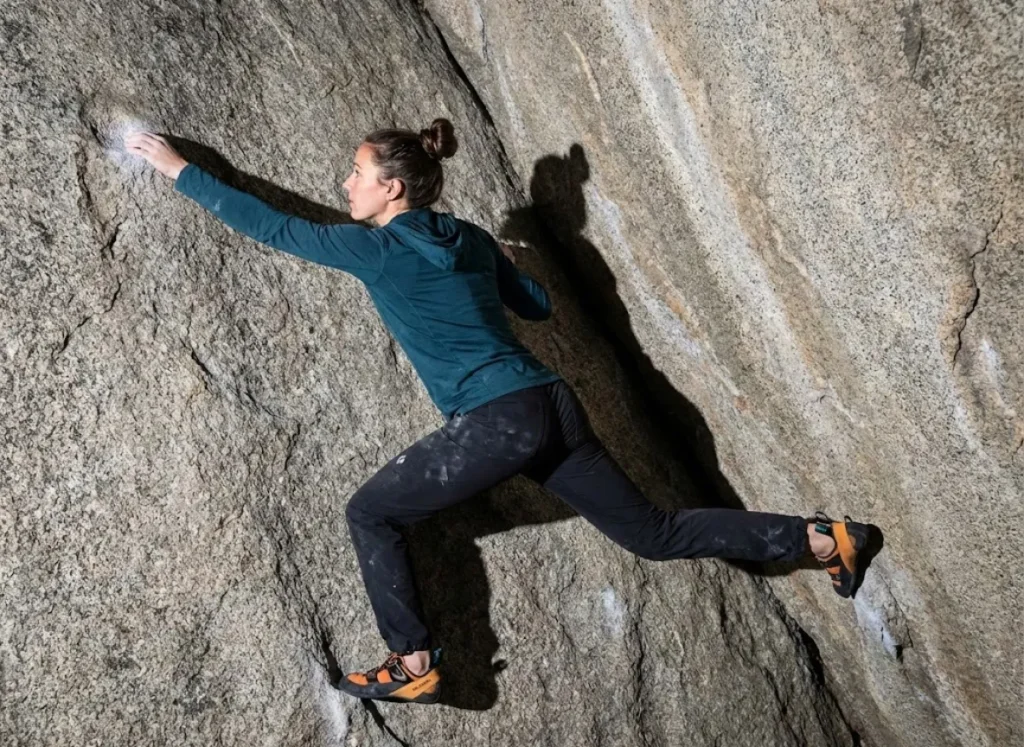
Once you know what holds you are dealing with, you have to figure out how to move between them. This is where basic physics comes in. You need to stop seeing “moves” and start seeing lines of tension through a biomechanical lens.
Using force vectors to find your balance
Every hold works best when you pull it in a specific direction. Usually, that is straight out from the wall or perpendicular to hold angle.
When you look at a route, imagine invisible force vectors coming out of the hold. That line tells you where your body needs to be. For example, if a sidepull is facing left, you need to lean your body far to the right. This creates tension.
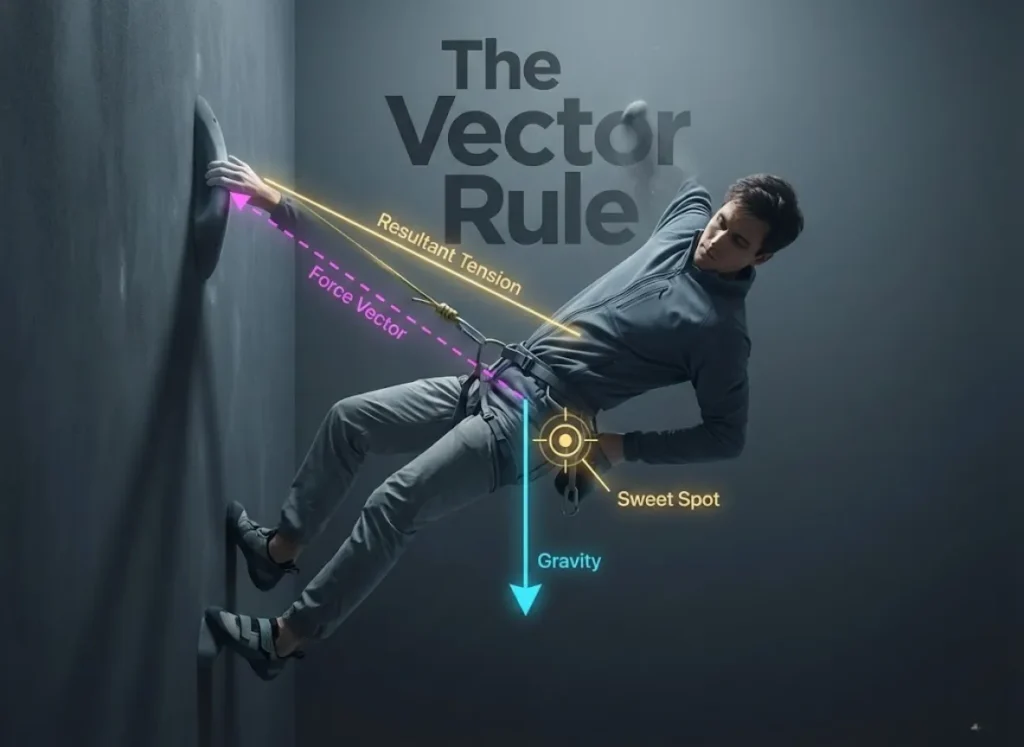
Many climbers fall not because they are weak, but because they are pulling at the wrong angle. This makes the hold feel terrible and wastes energy.
Advanced climbers look for the sweet spot between their hands. Imagine lines coming from both hands; where they cross is usually where your center of gravity needs to be. This helps you predict if you will be stable before you even leave the ground.
Physics models regarding the physics of climbing and slipping show that finding this balance point results in conservation of energy. Of course, knowing where to be is one thing; being strong enough to stay there is another. That is why core exercises for bouldering focus so much on body tension.
What is the “Barn Door” and how do you stop it?
Have you ever reached for a hold and suddenly swung off the wall like a door opening? That is called “barn dooring.” It happens when your body isn’t balanced against the hold you are using.
Gravity pulls on your swinging body and peels you off the wall. You can spot this danger before you climb. Look for moves where you use the same hand and same foot (like right hand, right foot) without a counter-balance. That is a recipe for a swing.
The solution is “flagging.” This means sticking your free leg out sideways to shift your weight back toward the wall. It acts like a counterweight.
If you spot a barn door moment while reading routes, plan to flag immediately. This keeps you calm and prevents that panicked feeling of swinging wild.
Pro-Tip: If you see a sequence that requires a right hand and a right foot on a steep wall, immediately look for a foot hold out to the left. If there isn’t one, the setter is forcing you to flag hard or cut feet.
A systematic review on proprioceptive training confirms that knowing where your body is in space helps control these swings. Learning these techniques in a climbing movement mastery guide will make them second nature.
How can visualization “pre-climb” the route?
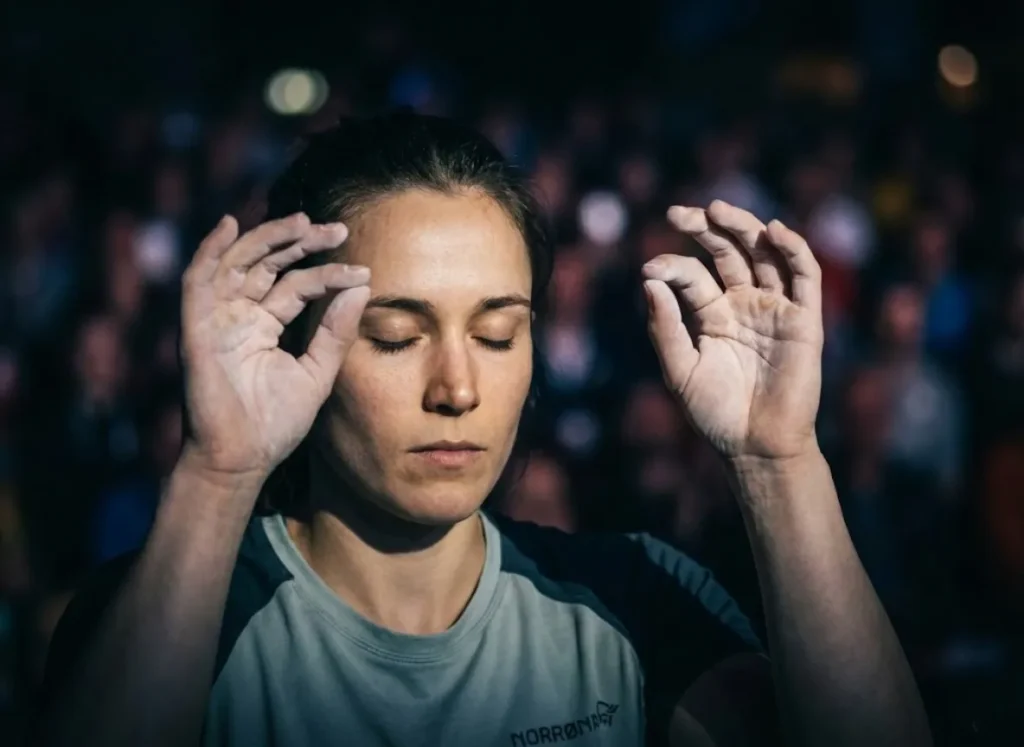
Physics gives you the rules, but your mind has to play the game. Visualization helps you practice the climb without getting tired.
The Adam Ondra approach
You might have seen videos of Adam Ondra, Magnus Midtbø, or content from channels like Rockentry and Catalyst Climbing where they break down the climb on the ground. They are engaging in active reading, not passive reading.
Ondra often uses “active miming.” He acts out the climb on the floor. He shapes his hands like he’s holding the grips, moves his arms at the right angles, and even practices his breathing. This tricks your brain into thinking you are actually climbing. It prepares your muscle memory and proprioception.
The key is to try and feel the moves, not just see them. Imagine the tension in your muscles.
Do this in “real time.” If the climb takes 40 seconds, your visualization should take 40 seconds. By the time you touch the start holds, you have already climbed the route in your head.
Research on motor imagery and sport performance shows that this kind of rehearsal actually improves performance. It is just as important when you are trying to read sport routes onsight outdoors.
Finding a “Cheat” (Beta Break)
The “Intended Beta” is the difficult sequence the setter wants you to do. A “Beta Break” is a smarter, easier way to solve the puzzle that the setter might have missed.
Common breaks include finding a kneebar to rest, or using flexibility to reach a hold statically instead of attempting a dyno or risky dynamic movements.
To find a break, you need a decision tree for cryptic problems. Look at the empty space. Is there a part of a volume that isn’t blocked? Can you perform a heel-hook or toe-hook somewhere unexpected?
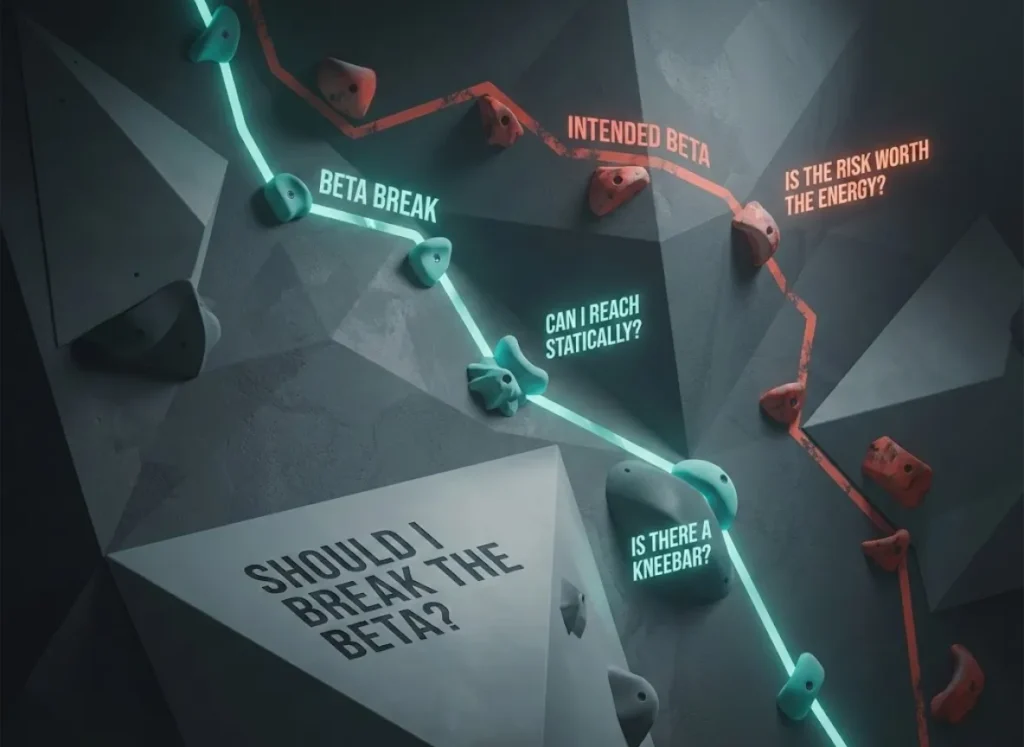
However, be careful. If you try to outsmart the setter and fail, you waste time and energy. You have to weigh the risk. Is it worth trying the weird way to skip the crux, or should you just commit to the intended path?
Medical data regarding climbing injury statistics suggests that finding static solutions is often safer than doing risky jumps. This often involves understanding heel hook vs. toe hook mechanics to use leverage instead of raw power.
How do you manage the 4-minute competition clock?
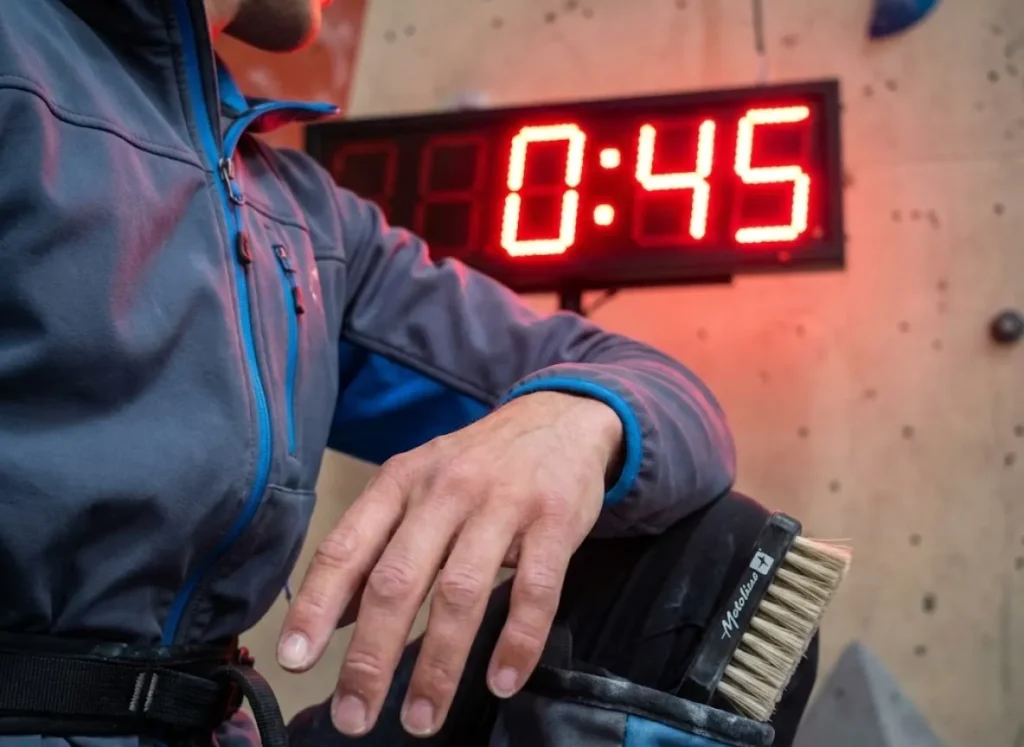
You can analyze all day, but in a competition, you only have four minutes. Strategic time management is a skill just like finger strength.
The ideal timeline
Think of the 4 minutes as a strict schedule, following the standard format used by USA Climbing and the International Federation of Sport Climbing (IFSC).
- 0:00 – 0:40 (Reading): Don’t touch the wall yet. Brush the holds, look at the angles, and visualize.
- 0:40 – 1:30 (The Flash): This is your best attempt. You are fresh and fully rested. Give it 100% effort.
- 1:30 – 2:30 (Rest): If you fall, you must rest. Do not jump right back on. You need to let your energy recover.
- 2:30 – 3:30 (Correction): Try again with better specific beta from your beta bank.
- Last 30 seconds: This is the desperation zone. Try to avoid being here.
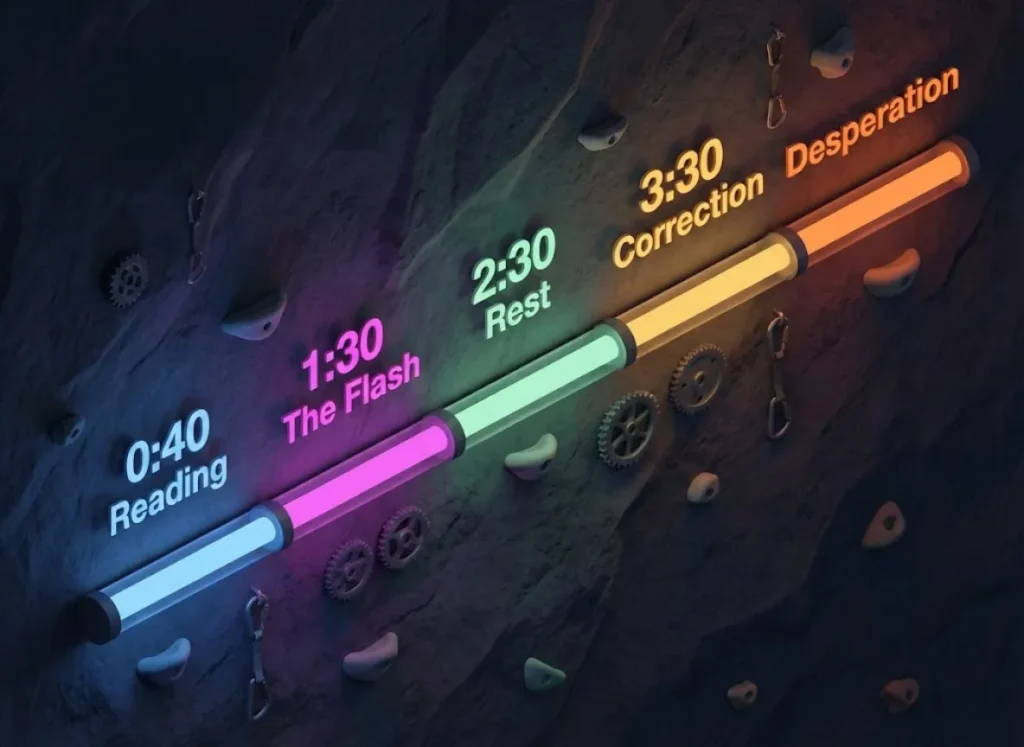
Studies on time management strategies in bouldering finals show that climbers who take proper rests are more likely to succeed. Understanding the guide to IFSC formats will help you stay calm under this pressure.
Why the “Flash” matters so much
A “Flash” means climbing the route on your very first try. In competitions, this is gold.
If two climbers both secure a Top, the one who did it in fewer attempts wins. A flash is the best possible score.
This means that reading time is “cheaper” than climbing time. It is better to spend an extra 20 seconds on the ground ensuring you know the moves than to rush, fall, and add an attempt to your score.
Every time you fall, you hurt your score. So, treat that first attempt like it is the only one you get. Official sport climbing scoring rules highlight how important this is. Adopting this mindset is a huge part of bouldering competition training.
Wrapping Up
Reading a competition boulder is about translation. You are translating visual clues—big volumes, shiny plastic—into physical actions.
- Volumes: Don’t pull; lean and oppose.
- Dual-Tex: Spot the shine and trust the texture.
- Visualization: Act it out. If you haven’t mimed it, you haven’t read it.
- Time: Don’t rush. A good read is worth more than a bad attempt.
Ready to test your reading skills? Next time you’re at the gym, pick a problem you’ve never seen. Set a timer for 4 minutes and treat it like a final. This comp-simulation is excellent training. Don’t touch the holds until the clock hits 0:40. Share your “Flash” success stories (or learning moments) in the comments below.
FAQ – Frequently Asked Questions
What is the Observation Period?
In big competitions, all the top climbers get 2 minutes together to look at the boulder problems before the round starts. You can touch the start holds and look closely, but you can’t climb.
How do I stop barn dooring?
The best way is to flag. Stick your free leg out to the side to balance your weight. If your hand and foot are on the same side of your body, you are at risk of swinging, so get that flag ready.
Why do setters use slippery holds?
They use them to force you to climb perfectly. If the hold is slippery on one side, you can’t use it to cheat the move. You have to grab the textured part exactly how the setter intended.
Should I watch other climbers?
If the rules allow it (like in a local redpoint comp), yes! watching others saves you energy because you can see the solution. In On-Sight finals or isolation (iso), you aren’t allowed to watch.
Safety Notice: Rock climbing and mountaineering are inherently high-risk
activities that can involve physical trauma or fatal incidents. The information on Rock Climbing Realms is for
educational and informational purposes only. Techniques and advice presented here are not a substitute
for professional, hands-on instruction. Conditions and risks vary by location. Always seek guidance
from a qualified instructor before attempting new techniques. By using this website, you agree that you
are solely responsible for your own safety. Any reliance you place on this information is strictly
at your own risk, and you assume all liability for your actions. Rock Climbing Realms and its authors
will not be held liable for any harm, damage, or loss sustained in connection with the use of this information.
Affiliate Disclosure: We are a participant in the Amazon Services LLC Associates Program, an
affiliate advertising program designed to provide a means for us to earn advertising fees by advertising and linking
to Amazon.com. As an Amazon Associate, we earn from qualifying purchases. We are also an official affiliate partner
of Black Diamond Equipment via the AvantLink network. If you click on a Black Diamond affiliate link and make a
purchase, we may earn a commission at no additional cost to you. We also participate in other affiliate programs.
Additional terms are found in the terms of service.