
In this article
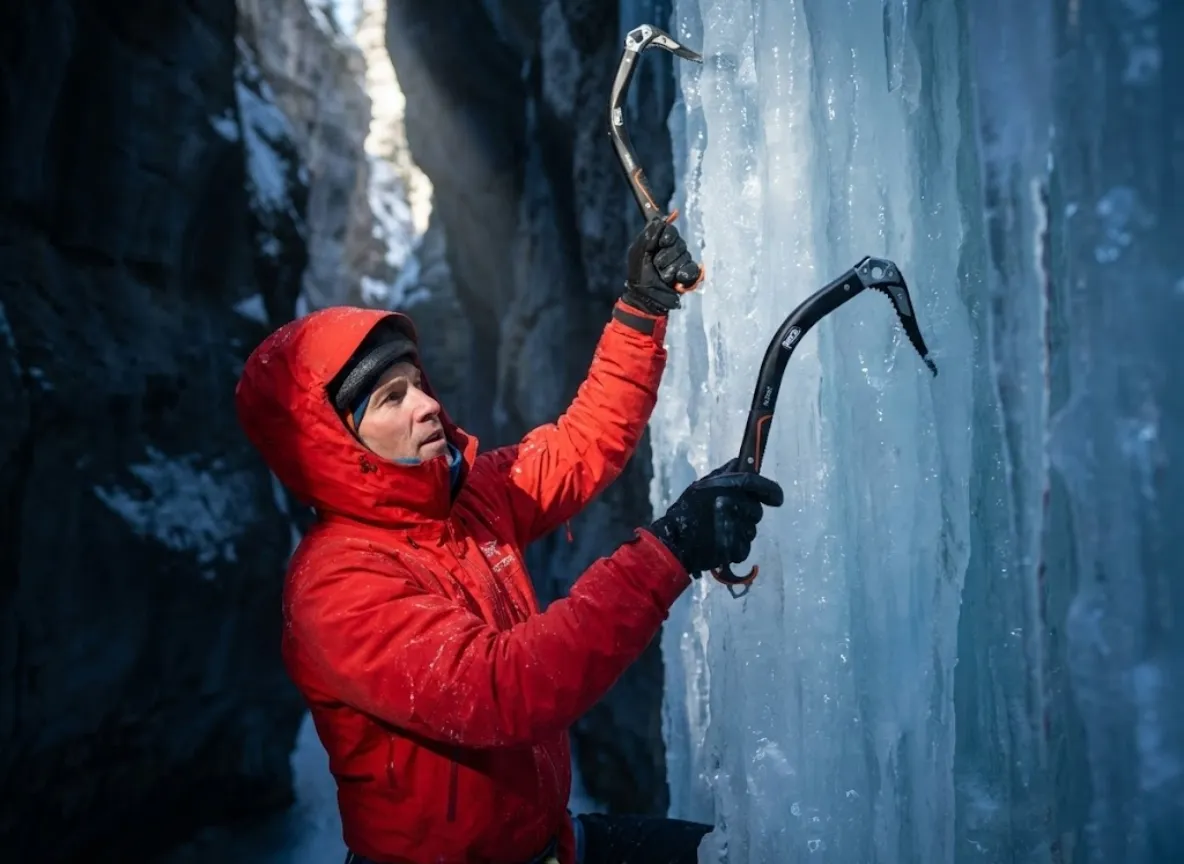
The sound is unmistakable to any experienced alpinist: a sharp, dry crack followed immediately by the rattle of debris raining down on your belayer. You didn’t swing incorrectly. You simply swung into a material that had completely changed its personality.
When temperatures drop below -15°C (5°F), waterfall ice stops acting like plastic and starts acting like glass. I have spent decades on technical ice, from the massive pillars of Cody, Wyoming to the freezing gullies of the Canadian Rockies. Over the years, I’ve learned that “hoping” the ice holds is not a strategy. True safety comes from applying materials science and ice fracture mechanics to your movement.
This guide moves beyond basic technique to help you build a secure placement every time. We will look at why polycrystalline ice gets brittle, why hitting it makes it explode, and how to choose the right gear to stop that unstable crack propagation.
What Happens Inside Cold Ice?
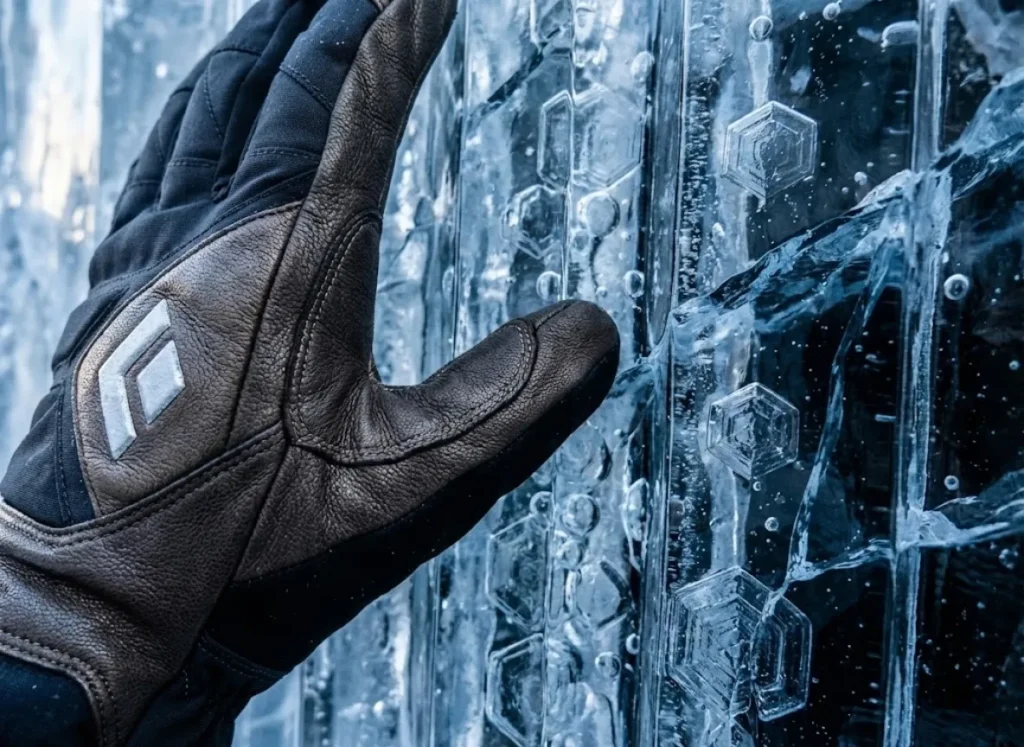
Ice becomes brittle when it gets cold because the internal “wiggle room” between crystals disappears, locking the structure in place.
Why does ice have a “grain” and why does it break?
Most ice on earth, from Antarctic glaciers to your ice cube tray, exists as Ice Ih. In this crystal lattice, oxygen atoms stack up in a specific hexagon pattern, held together by intermolecular hydrogen bonds. This creates a rigid framework that is very strong in some directions but weak in others.
This directional weakness is similar to wood grain. The strength of a single crystal ice unit changes depending on which way you hit it. In waterfall ice, we are dealing with polycrystalline ice where crystals usually grow in long columns (known as columnar ice) perpendicular to the rock. This creates a specific grain that you have to work with, not against.
When you strike perpendicular to these long columns, you are hitting the crystals where they are stiffest. At warmer temperatures (around -2°C or 28°F), tiny defects inside the lattice can move around via dislocation glide. These defects act like shock absorbers. They allow the ice to stretch and mold around your pick through dislocation creep, absorbing the energy of your swing.
But as temperatures drop, the heat energy required to move those defects vanishes. They get pinned in place. The ice loses its ability to flow or stretch. Since it can’t absorb energy by bending, it has to release it through brittle failure. This is the science behind decoding ice formations and conditions during your approach. If ice looks “wet,” it can likely stretch. If it looks matte or dry, the micro-structure is locked tight.
For more details on how ice mechanics change with temperature, you can read about the structure and mechanical behavior of ice by Erland M. Schulson.
How Does Speed Cause Shattering?
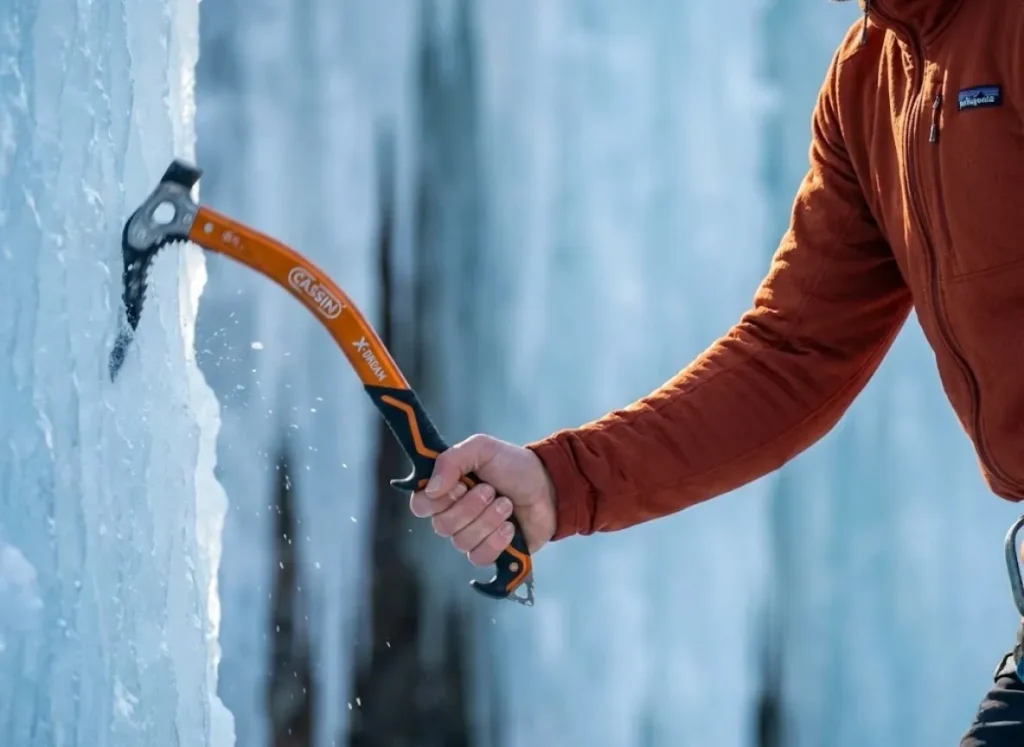
Whether ice breaks or sticks often depends on the loading rate—how fast you hit it—not just how cold it is.
The battle between stretching and snapping
The difference between a solid “thunk” (stretching) and a scary “shatter” (breaking) isn’t fixed at a specific temperature. It changes based on the strain rate. This is a competition between the ice trying to move out of the way and the ice cracking.
Researchers have found that for every temperature, there is a speed limit, often called the ductile-to-brittle transition (or nil-ductility transition in applied mechanics). If you compress the ice slower than that limit, it molds to the tool. If you go faster, it shatters. In a lab at -10°C, this safe speed is actually quite slow.
When you swing an ice tool, the tip is moving very fast (around 8-12 meters per second). This creates an impact that is much faster than the freshwater ice can handle. As the temperature drops to -20°C (-4°F), the window for a safe swing almost closes completely. Even a gentle hit creates a strain rate that exceeds the brittle-failure stress threshold.
You are fighting a difficult battle against continuum mechanics. The colder the ice, the slower your swing needs to be to prevent shattering. This explains the advice given when learning ice climbing foundational moves: swing with less force in extreme cold. You are trying to keep the impact speed low enough that the ice doesn’t instantly snap.
Pro-Tip: In temps below -20°C, stop swinging from the shoulder. Use a “tap-tap-tap” method using only wrist movement to chip a small hole for the pick. Once the pick is seated, give it a firm tug. This keeps the impact speed lower than a full swing.
For specific data on how being trapped or “confined” changes how ice breaks, see the study on the effect of confinement on brittle compressive fracture.
Why Does Hitting It Make It Pull Apart?
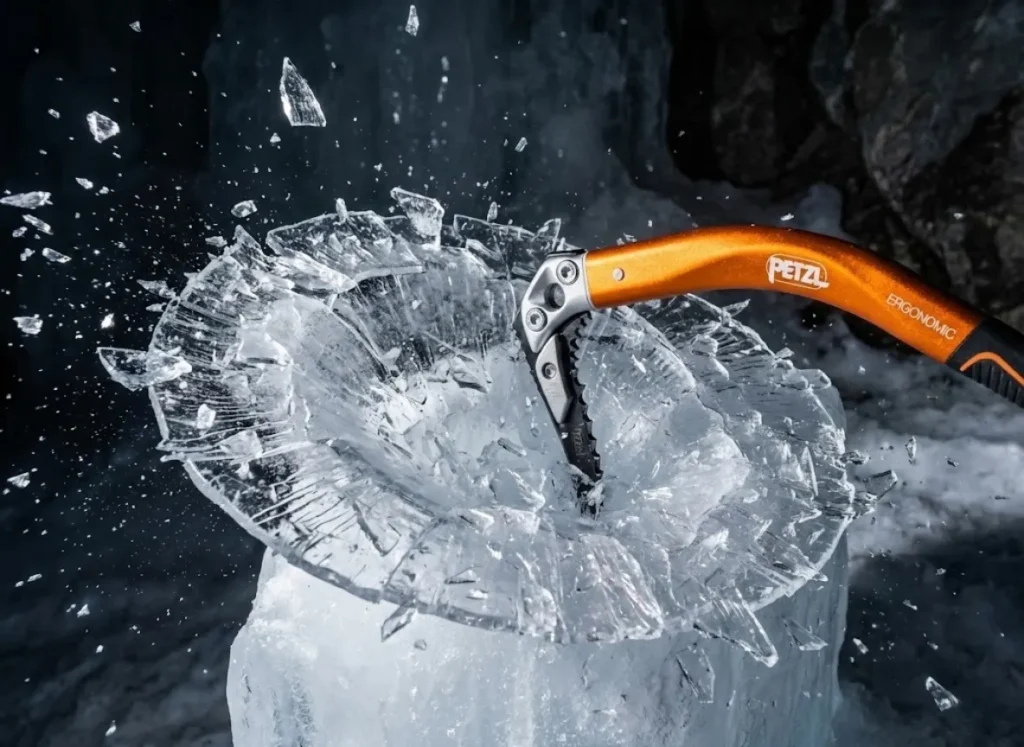
Hitting the ice creates pressure, but microscopic flaws turn that compressive strength into a splitting force that rips the ice open.
How “Wing Cracks” create dinner plates
Ice is never perfect. It is full of micro-cracks, grain boundaries, and crack nucleation sites. When your pick strikes, it creates massive pressure. However, this pressure pushes sideways against those angled flaws.
If the pressure is high enough, the sides of those tiny internal cracks slide against each other. Imagine pressing your hands together and sliding them past one another. This grinding, technically called frictional sliding or Coulombic faulting, creates a “wedging” effect at the tips of the crack. This generates intense crack-tip stress intensity.
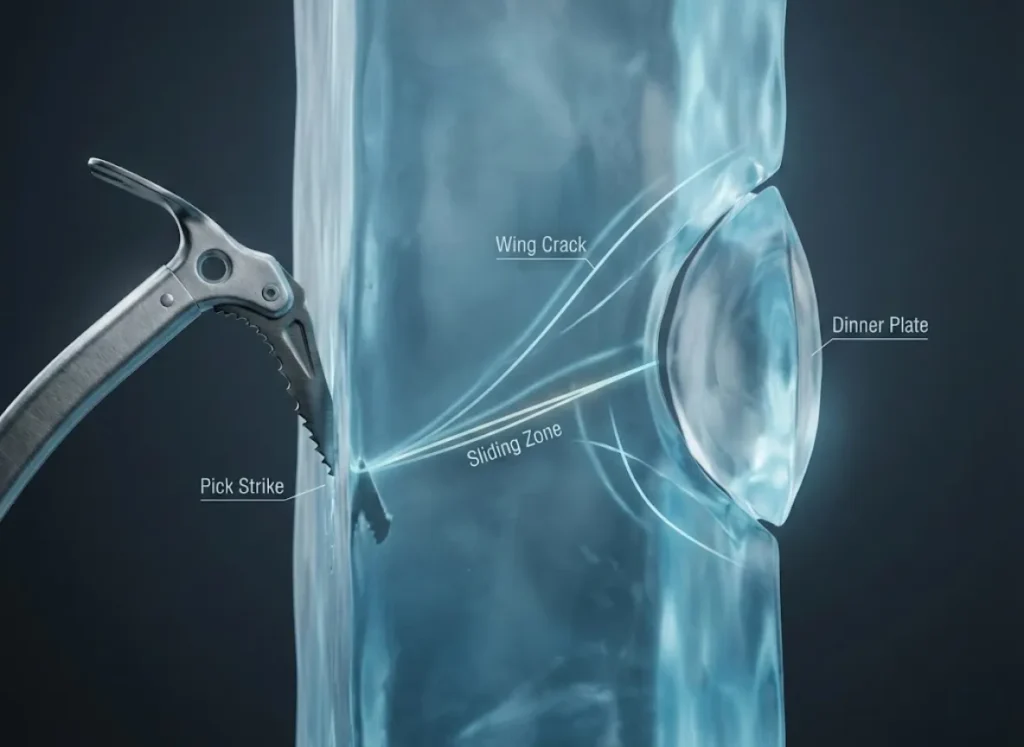
Since ice has very low tensile strength and fracture toughness, this tension rips open new cracks. These are called wing cracks (or sometimes comb cracks). They don’t just go straight down. Because your tool acts like a wedge, these cracks curve toward the surface of the waterfall—the path of least resistance.
When these curved cracks connect, they pop off a lens-shaped saucer of ice. Climbers call this dinner plating. It happens because the stored elastic strain energy has to go somewhere, so it blasts the ice outward.
Understanding this crack propagation is vital for decoding ice climbing grades. Routes where this happens often are rated as more serious because it is harder to get good protection.
For drawings and proof of this sliding-wing crack model, review the literature on brittle compressive failure of confined ice.
How Can Gear Selection Help?
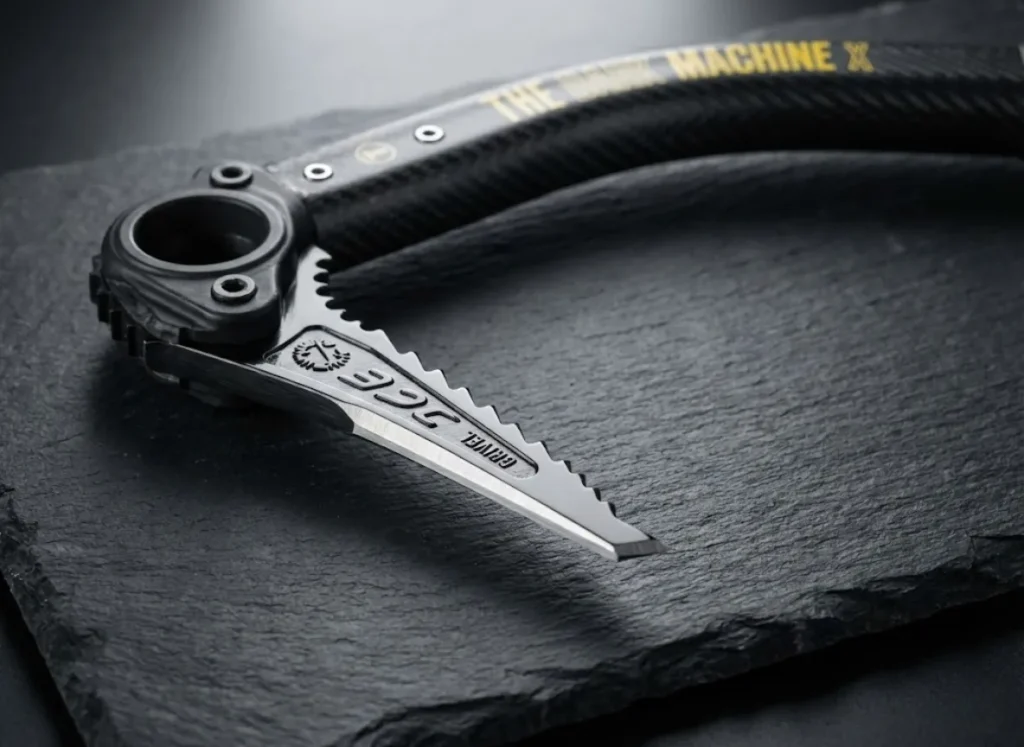
You can stop shattering by displacing less ice (thinner picks) and using materials that absorb vibration.
Why pick geometry and vibration matter
To get a pick into the ice, you have to move the ice out of the way. The amount of ice you move is directly related to your pick geometry. A standard 4mm pick has to move 33% more ice than a thin 3mm pick.
In brittle ice, moving that extra material acts like a fat wedge. It pushes the ice too far, triggering those wing cracks we talked about. Therefore, using ultra-thin (B-rated) picks is the best mechanical way to prevent shattering. You are asking the ice grains to move less, so the material is less likely to exceed its yield strength.
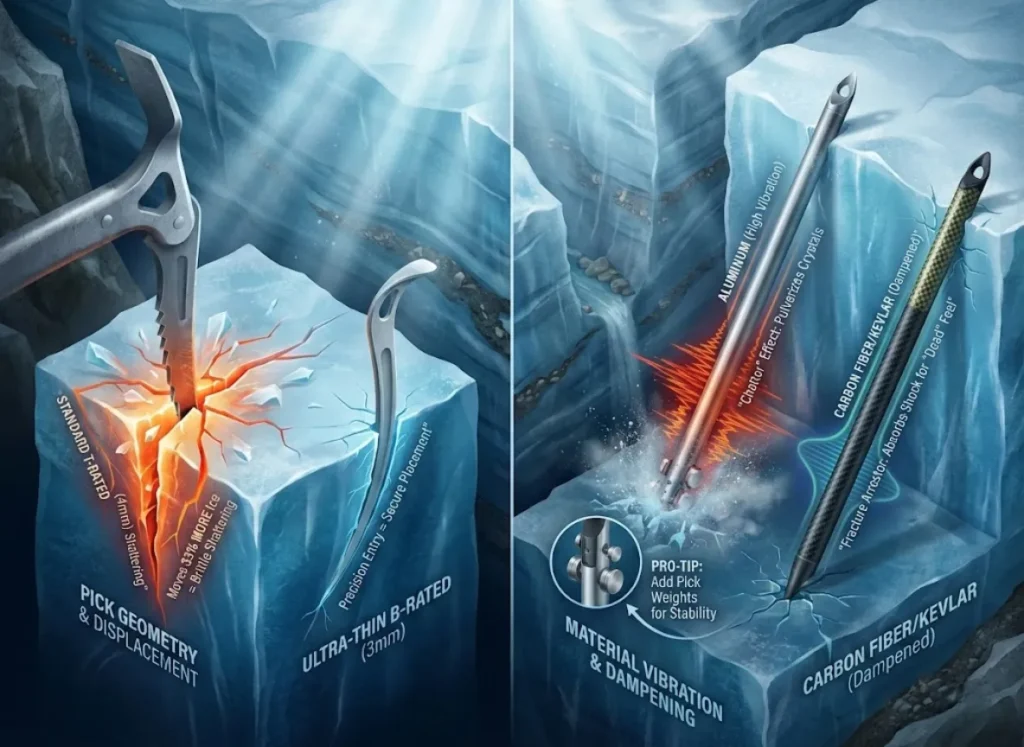
Beyond the shape of the pick, vibrational frequency matters. High-frequency vibration (“chatter”) at the tip acts like a tiny jackhammer. It pulverizes the ice crystals, making it hard to get a stick.
Materials like carbon fiber or Kevlar act as a fracture arrestor for these vibrations. Aluminum, on the other hand, tends to ring and vibrate. When a tool absorbs the shock, it stops the energy from bouncing back into the ice. This creates a “dead” feel that leads to a secure placement without secondary cracking.
Pro-Tip: If you cannot afford carbon fiber tools, add “pick weights” to the head of your aluminum tools. The heavy head adds stability and helps absorb vibration, allowing the tool to bite with a slower swing.
This damage mechanics concept should be your main focus when selecting the right ice axe for extreme cold. The comparative analysis of CFRP and steel vibration characteristics confirms that composite materials are much better at stopping these vibrations.
The Bottom Line
Understanding why ice breaks allows us to adapt to the freeze-thaw cycle:
- The Structure: Cold ice locks up because it loses the heat energy needed for dislocation creep.
- The Break: “Dinner Plates” happen when hitting the ice turns into a wedging force that splits it apart via tensile cracks.
- The Speed: High loading rates from fast swings are more likely to shatter the ice. Slow down when it’s cold.
- The Gear: Thinner picks displace less ice, and composite handles stop the vibration that ruins placements.
Next time the mercury drops, don’t just swing harder. Check your pick thickness, slow your swing, and work with the fracture characteristics of the ice.
FAQ – Frequently Asked Questions
Why does ice seem to get harder as it gets colder?
As the temperature drops, the Young’s Modulus (stiffness) of ice increases. The internal defects that usually allow the ice to move get stuck. This makes the ice feel stiffer and harder, acting more like rock mechanics than plastic deformation.
What causes the dinner plate effect when climbing?
Dinner plating is caused by wing cracks that curve back toward the surface. When your tool acts as a wedge, it pushes the ice apart. The ice eventually snaps and pops off a saucer-shaped chunk to release the pressure.
Are T-rated picks better for cold ice than B-rated picks?
Generally, no. T-rated (Technical) picks are thicker (usually 4mm) to be stronger for dry tooling. This thickness moves more ice and causes more brittle fracture. B-rated (Basic) picks are thinner (~3mm) and slide into brittle ice much easier.
How can I stop ice from shattering in extreme cold?
Use thinner picks and keep them very sharp. Adding weights to the head of your tool can also help. The extra weight allows you to let the tool do the work with a slower swing, which prevents the ice from snapping due to high strain rates.
Safety Notice: Rock climbing and mountaineering are inherently high-risk
activities that can involve physical trauma or fatal incidents. The information on Rock Climbing Realms is for
educational and informational purposes only. Techniques and advice presented here are not a substitute
for professional, hands-on instruction. Conditions and risks vary by location. Always seek guidance
from a qualified instructor before attempting new techniques. By using this website, you agree that you
are solely responsible for your own safety. Any reliance you place on this information is strictly
at your own risk, and you assume all liability for your actions. Rock Climbing Realms and its authors
will not be held liable for any harm, damage, or loss sustained in connection with the use of this information.
Affiliate Disclosure: We are a participant in the Amazon Services LLC Associates Program, an
affiliate advertising program designed to provide a means for us to earn advertising fees by advertising and linking
to Amazon.com. As an Amazon Associate, we earn from qualifying purchases. We are also an official affiliate partner
of Black Diamond Equipment via the AvantLink network. If you click on a Black Diamond affiliate link and make a
purchase, we may earn a commission at no additional cost to you. We also participate in other affiliate programs.
Additional terms are found in the terms of service.