
In this article
The wind on the divide screams at 40mph, stripping the heat from your layers as you stare at the blank granite face. Three feet of void separate you from the jug at the lip, and static lock-off strength has failed you; the geometry of the rock demands momentum. This is the “barrier skill” that separates intermediate plateaus from advanced ascents.
To cross this void, you must abandon the safety of three points of contact and trust the ballistic physics of the dyno.
As a certified guide, I’ve watched countless climbers freeze at this exact moment. Whether you are a new climber in a climbing gym or an experienced boulderer projected on a famous dyno, the fear is real. Many possess the strength to hold the target, but they lack the mechanism to reach it. Dynamic movement is not reckless abandon; it is a calculated equation of physics, physiology, and risk management. This guide will move you from being a passenger of gravity to its pilot, covering the biomechanics of the launch, the precision of the latch phase, the protocols for falling mechanics, and the drills necessary to rewire your nervous system.
What Are the Physics of the Dynamic Impulse?
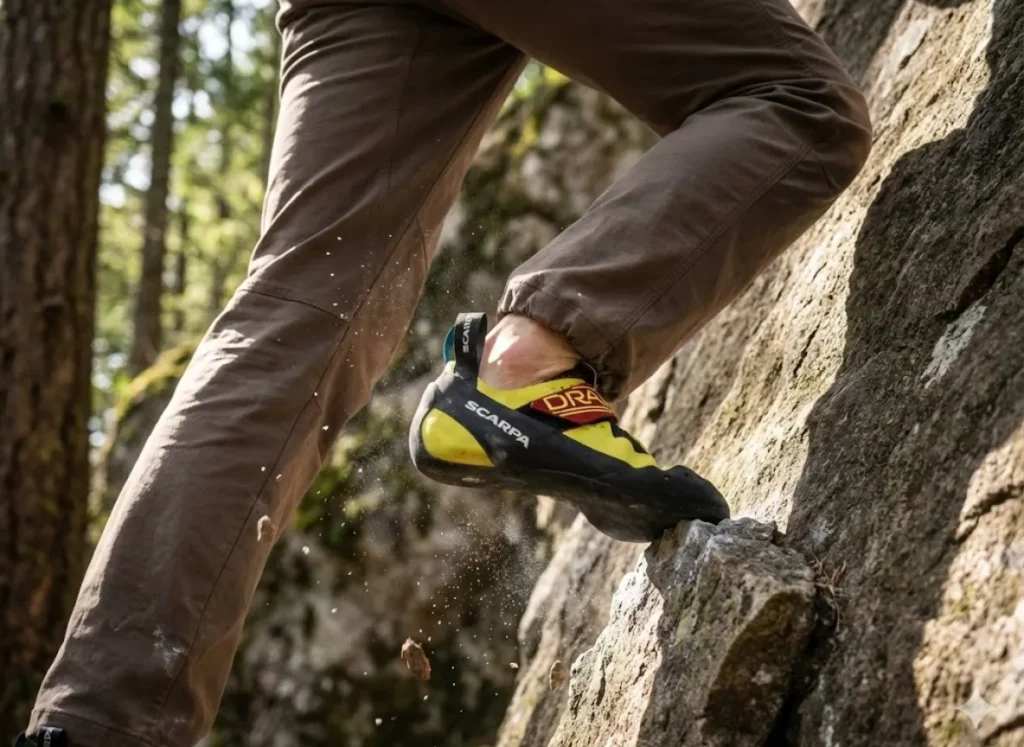
Demystifying the movement requires breaking it down into biomechanical laws. We must shift your focus from “jumping harder” to “moving efficiently,” understanding the physics of the pounce.
How do you generate the initial launch force?
The launch relies on the Triple Extension mechanism: the simultaneous, explosive extension of the ankles, knees, and hips.
This leg drive mimics a vertical jump. You must generate Ground Reaction Force (GRF) by pushing through your toes against the rock. This creates an equal and opposite upward force. Crucially, efficient dynos utilize the Stretch-Shortening Cycle (SSC). Think of the rubber band analogy: you stretch the system (dip) to snap it back with greater force. This wind-up stores elastic potential energy in your tendons immediately before firing. Without this pre-load, you are jumping on dead batteries.
Pro-Tip: Don’t “pump” up and down multiple times before launching. Excessive bouncing wastes ATP and desensitizes the muscle spindles (the amortization phase), actually reducing your explosive power. One smooth dip and fire is optimal.
Vector alignment is equally critical. Adopt a power stance where your hips are low and away from the wall. Remember the adage: the lower you go further you throw. This hips-to-wall position directs your force diagonally towards the target. If your hips are too close to the wall, your force vector goes straight up, and you will peel backward away from the rock.
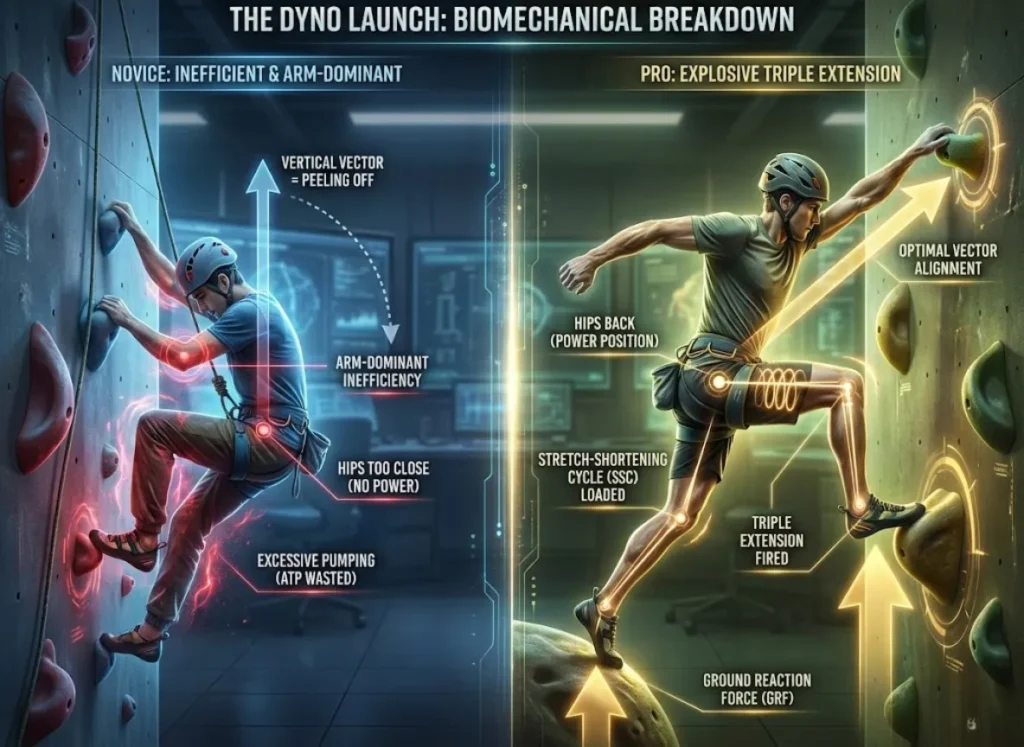
Understanding the physiological demands of rock climbing reveals that power (force x velocity) in the glutes and quadriceps is the primary engine here. An arm-dominant style is inefficient; you need a leg-dominant style. This is why building power through strength exercises like squats and deadlifts translates directly to dyno capability.
Why must the arms remain straight during the launch?
The arms act as Class 3 Levers and “taut cables” designed to transmit force, not generate the primary lift.
Think of your arms as cables connecting a towing vehicle (your legs) to the load (your center of mass). If the cables are slack (bent elbows), the vehicle accelerates without moving the load until the slack snaps tight, jarring the system. By keeping your straight arms, you rely on skeletal and connective tensile strength. This conserves muscular energy for the catch.
Bending the arms early is a massive energy leak. Engaging the biceps during the explosion phase absorbs the power generated by your legs rather than transmitting it to your center of mass. This creates a disconnect in the chain of momentum. As highlighted by bouldering pioneer John Gill and dynamic master Johnny Dawes, the arms only switch roles from “cables” to “rudders” once you are airborne to adjust your orientation.
Understanding the physics of rotational motion and torque helps explain the “pendulum radius” effect, or physics of levers. Straight arms create a longer lever. This translates your initial swing into greater vertical velocity at the moment of release. This concept is fundamental to mastering complex bouldering moves where geometry dictates success.
How Do You Execute the Technical Phases?
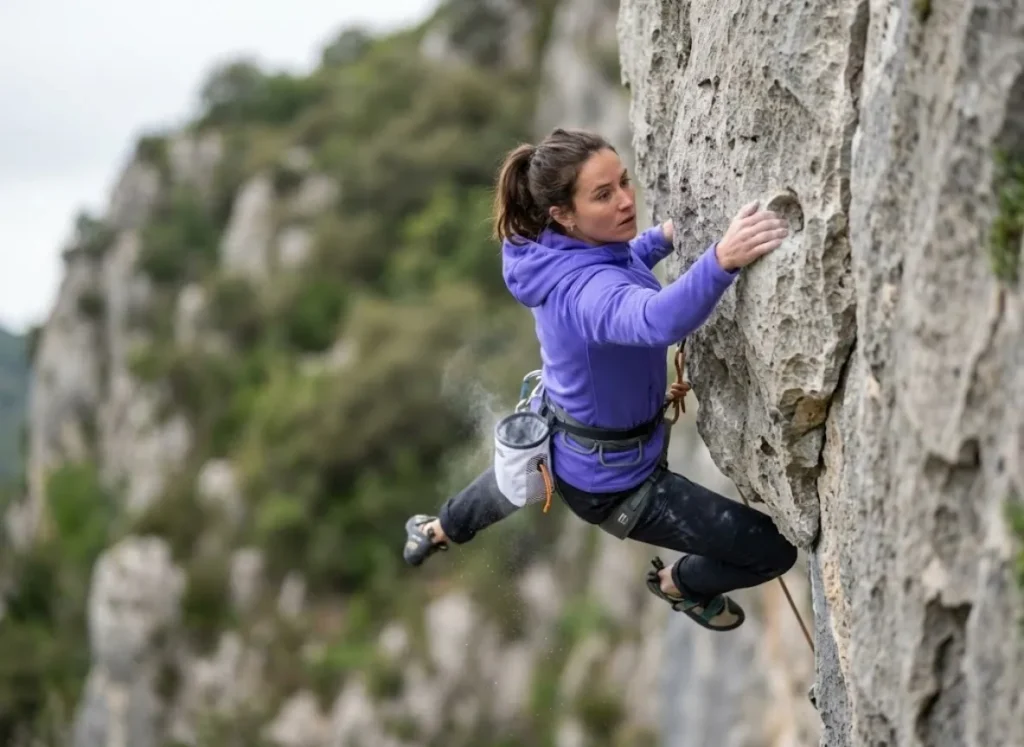
Once airborne in the flight phase, the physics of the launch gives way to the physics of the catch. Rotational forces will immediately threaten to peel you off the wall if your timing is off.
What is the “Deadpoint” and how do you time it?
The “Deadpoint” is the exact apex of the parabolic arc where your vertical velocity momentarily reaches zero.
Latching the hold at this precise millisecond is critical because you are effectively weightless. This minimizes the impact force on your fingers and tendons. If you grab too early (while still rising) or too late (while falling), your body mass exerts a jarring load on your grip, often resulting in a slip.
Precision requires a Visual Lock. You must visualize the jump and fix your gaze on a specific pixel of the target hold—a crystal or ridge—rather than the general shape. Your hand will follow your eyes. While big dynos like the Rainbow Rocket or a double dyno involve all-points-off the wall, deadpoints usually maintain one foot on.
In both cases, proprioception—your body’s ability to sense its position in space—guides “blind” catches. Breathing is the trigger. A sharp, martial-arts style exhalation on the launch braces your core.
A biomechanical analysis of the crimp grip position suggests that tendon loads are manageable at the deadpoint, but spike dangerously if timing fails. Therefore, rock climbing finger training techniques should focus on contact strength to handle these rapid loading phases.
How do you control the swing after the latch?
Control comes from Contact Strength (RFD) and opposing angular momentum through core tension.
Contact strength is the neurological ability to recruit maximum finger flexor strength in milliseconds. You have to grab the hold harder than you think. However, the fingers only connect you to the wall; the core handles holding the swing. As soon as you latch, you must execute the “Scorpion” maneuver. This involves engaging the lower back and driving your heels aggressively backward and apart.
This counter-motion fights the outward swing and aids in the conservation of angular momentum. If your Center of Mass (CoM) is not vertically aligned with your hand, gravity creates torque—the “barn door” effect. To resist this, you may need to “flag” a leg far to the side.
Pro-Tip: If you feel your feet cutting loose, squeeze your glutes instantly. This rigid tension connects your shoulders to your hips. A useful cue is squeezing your neck with your shoulders to stabilize the upper spine.
Failing to control the swing leads to shock loading. This is the primary cause of finger flexor tendon pulley injuries, specifically to the A2 pulley. If you are cutting feet and the full body weight snaps onto the fingers, the tissue often fails. To prevent this, you must master core exercises for bouldering that mimic these specific anti-rotational demands.
How Do You Manage Risk and Failure?
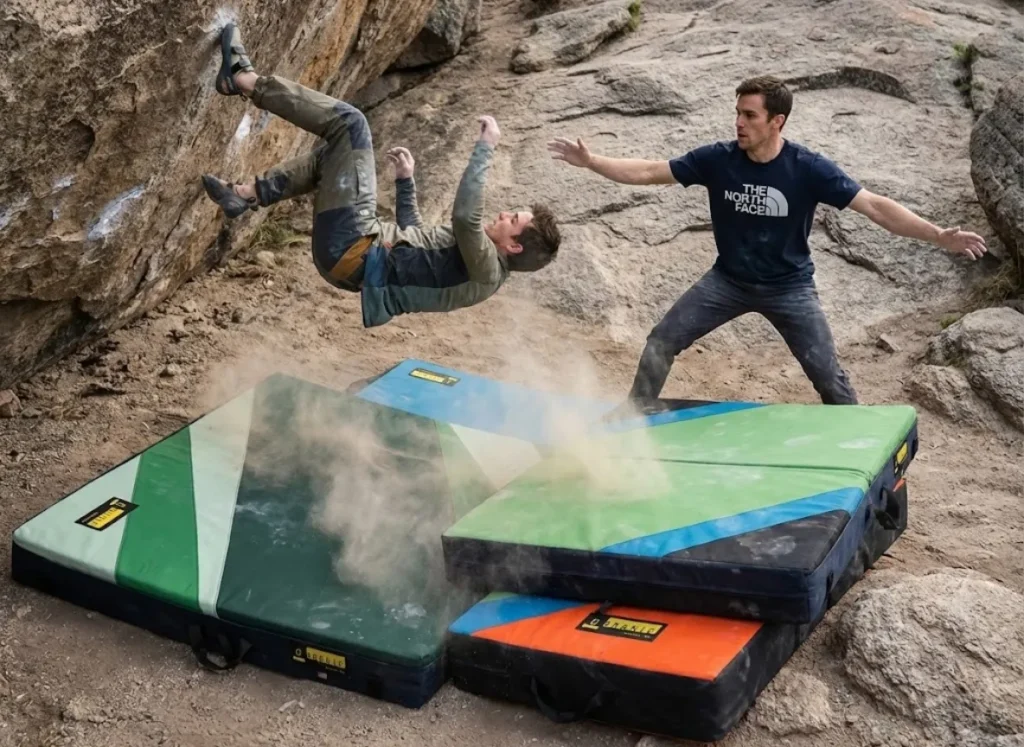
The research highlights a critical “Safety Gap” in dynamic climbing. Professional competition climbers may take massive falls onto foam pits, but outdoor climbers face granite slabs and uneven landings.
What is the “Safe Miss” protocol?
The Safe Miss protocol relies on the “Push-Away” technique to convert a vertical scrape into a parabolic fall.
When you realize mid-air that the target is out of reach, your instinct may be to claw at the wall. This is dangerous. It leads to the cheese-grating effect, where you slide down abrasive surfaces, causing trauma to the chin, knees, and ankles. Instead, you must trigger a Trajectory Correction.
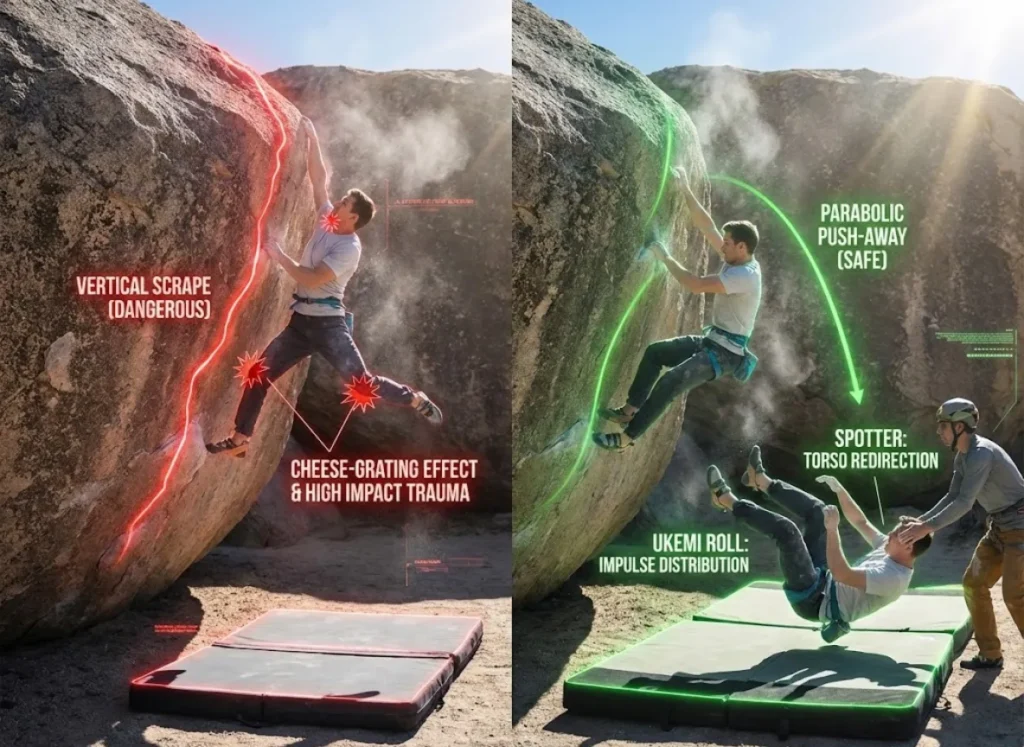
Forcefully push off the wall with your hands or feet. This impulse pushes you away from the hazard and into the clear air over your crash pads. Upon landing, employ Ukemi—the art of falling. Tuck your chin, round your back, and roll. This distributes the impact force over a longer time period and larger surface area, adhering to the impulse-momentum theorem and impact force principles.
Spotter placement shifts here. They are not catching you; they are performing “torso redirection” to ensure you land on the pads, not the rocky floor. Because horizontal velocity is involved, pad placement must extend significantly further out than for static climber problems. For detailed instructions on setup, review how to safer bouldering: master spotting & crash pads.
When should you not dyno? (The Geological Risk Matrix)
Not all geology welcomes a dynamic load. Use a “Go/No-Go” decision matrix based on rock type and hold quality.
Limestone pockets present the highest risk. Dynamically loading a mono or bi-finger pocket can lead to catastrophic lumbrical tears or tendon rupture. If the target is a pocket, such as those found in Castle Hill, the dynamic approach is often a “No-Go.” Conversely, rounded sandstone (like Fontainebleau or Rocklands) is generally safer for tendons but poses a high risk for skin abrasion. Friction is key here.
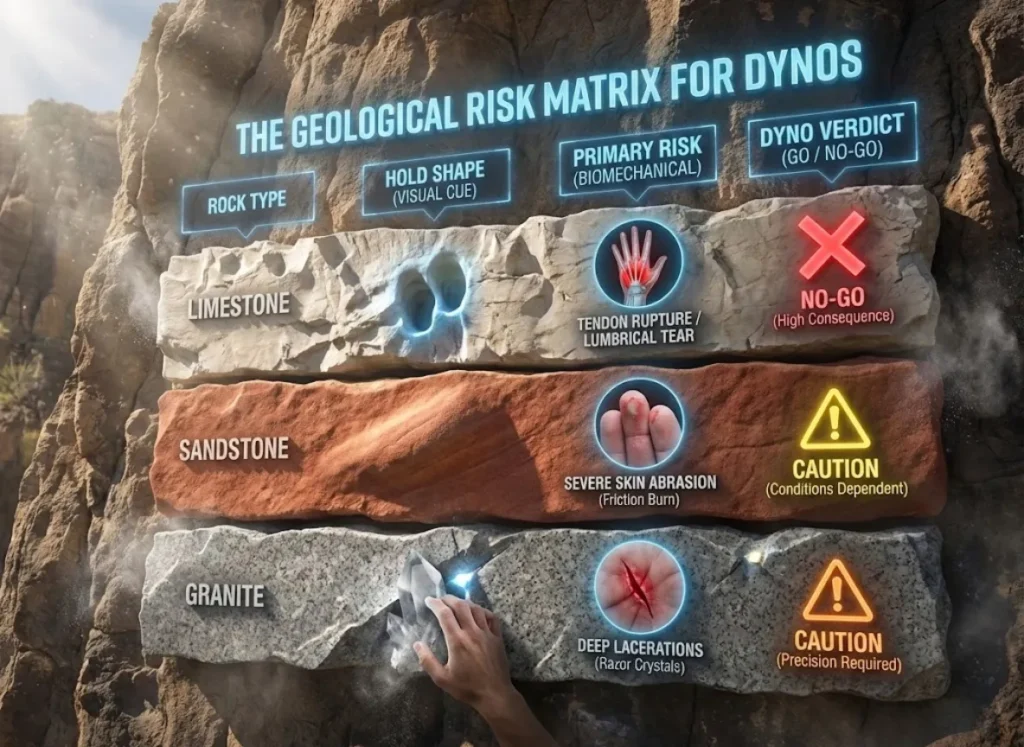
Granite edges require caution. The crystals are sharp, and a dynamic misfire on Bishop granite can result in deep lacerations. Stiff shoes are often required to protect the toes during the high-impact launch on small footholds.
You must also account for the coefficient of friction in rock climbing. Chalk increases friction by roughly 18% on limestone, which is critical for sticking hard dynos. On sandstone, humidity plays a larger role. Understanding climbing rock types helps you predict how the hold will react to explosive force and avoid dynamic failures.
How Do You Train for Explosive Power?
Safety parameters are set and physics are understood. Now, we condition the body to generate the required explosive power using progressive drills.
What drills improve coordination and power?
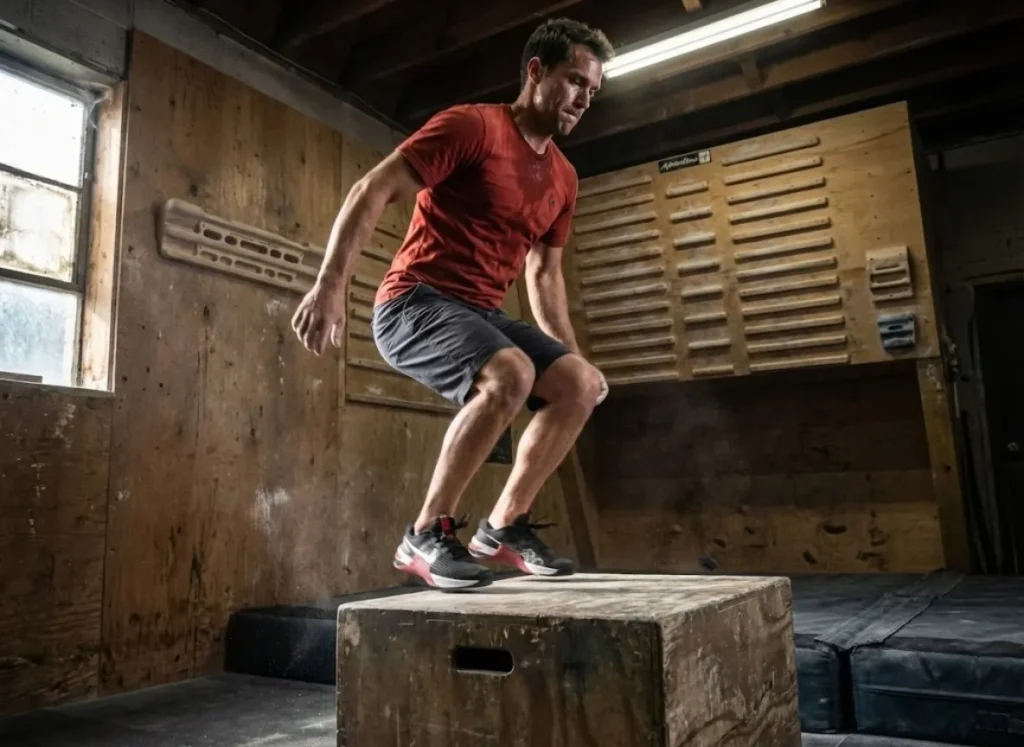
The “Step-and-Tap” and plyometric Box Jumps are the gold standard for rewiring the CNS for climbing power.
The Step-and-Tap Drill isolates trajectory training. Launch towards a target hold, but instead of grabbing it, simply tap it with your hand and focus on a controlled landing. This removes the anxiety of the catch, allowing you to focus entirely on the leg drive and hip trajectory.
Box Jumps are essential off-the-wall training. They train the Central Nervous System (CNS) for rapid Triple Extension and soft landings. Effects of plyometric training on vertical jump studies confirm that this translates directly to vertical displacement on the wall.
For coordination, practice “Paddle” Dynos. These involve bumping your hand to an intermediate hold to redirect momentum before latching the final target. This breaks one large, impossible move into two smaller, manageable impulses.
Morphology matters. A short-climber modification is to utilize “High Feet” to maximize the extension phase of the legs, often making them a dynoing climber by necessity. Tall climbers, or those not vertically challenged, often need to “Flag” to avoid scrunched starts. A 3-week dyno-power training plan is effective: Week 1 for Mechanics (Step-and-Taps), Week 2 for Power (Box Jumps), and Week 3 for Flow (combining moves). This fits well into a complete rock climbing workout routine.
Conclusion
Mastering the dyno is about more than showing off; it is about expanding your toolkit to solve problems that static strength cannot. Remember the fundamental equation: Triple Extension + Straight Arms = Flight.
Safety remains a skill you must practice. Master the “Push-Away” and Ukemi roll to survive the inevitable failure recovery. Let geology dictate your strategy using the Risk Matrix to avoid injury. Finally, build your engine with Plyometrics and Step-and-Tap drills.
Next time you’re at the gym, dedicate 15 minutes to the Step-and-Tap drill on a V0. Build the instinct in safety so you can pilot your momentum effectively on outdoor climbs.
FAQ – Frequently Asked Questions
What is the difference between a dyno and a deadpoint?
A dyno typically involves a ballistic jump where momentum is the primary mover, often resulting in all points off the wall (like the Double Dyno). A deadpoint is a controlled dynamic move where you use momentum to reach the apex of motion, but usually keep one foot on the wall for stability.
How do I stop swinging off the hold when I catch a dyno?
You must minimize Angular Momentum by aiming your Center of Mass directly under the target hold. Upon latching, engage the Scorpion move (arched back, driving heels back) and stiffen the core to resist the barn-door rotation.
Can short climbers be good at dynos?
Yes, but they must adapt their beta by using High Feet to maximize the extension phase of the legs. Short climbers should also master paddling (bumping hands via intermediate holds) to cover distance that taller climbers might reach in one go.
Why do I keep scraping my shins when I fail a dyno?
You are likely clawing at the wall in panic rather than committing to the fall. Use the Push-Away technique to shove your body outward, clearing the wall’s texture and converting the fall into a safe roll on the pads.
Safety Notice: Rock climbing and mountaineering are inherently high-risk
activities that can involve physical trauma or fatal incidents. The information on Rock Climbing Realms is for
educational and informational purposes only. Techniques and advice presented here are not a substitute
for professional, hands-on instruction. Conditions and risks vary by location. Always seek guidance
from a qualified instructor before attempting new techniques. By using this website, you agree that you
are solely responsible for your own safety. Any reliance you place on this information is strictly
at your own risk, and you assume all liability for your actions. Rock Climbing Realms and its authors
will not be held liable for any harm, damage, or loss sustained in connection with the use of this information.
Affiliate Disclosure: We are a participant in the Amazon Services LLC Associates Program, an
affiliate advertising program designed to provide a means for us to earn advertising fees by advertising and linking
to Amazon.com. As an Amazon Associate, we earn from qualifying purchases. We are also an official affiliate partner
of Black Diamond Equipment via the AvantLink network. If you click on a Black Diamond affiliate link and make a
purchase, we may earn a commission at no additional cost to you. We also participate in other affiliate programs.
Additional terms are found in the terms of service.