In this article
The burning sensation in your shins usually starts around minute forty. By hour four, the steel shank feels like it is sawing through your tibia. The six pounds of dead weight on your ankles has turned a routine removal into an endurance test.
In 2026, the era of “toughing it out” with heavy iron is over. Modern professional tree care operates at the intersection of biological stewardship and biomechanical engineering. The gear you strap to your legs dictates not just your daily productivity, but the length of your career.
I have spent the last decade hanging from ropes and standing on spurs, testing everything from vintage steel irons to modern carbon composites. This guide moves beyond the basics found on general retailer sites like Sherrilltree or TreeStuff. We will explore why rigid fiberglass cuffs have replaced leather cuffs as the industry standard and decode the cost-to-benefit ratio of Aluminum versus Titanium. We will also draw a hard line on ethics: tree climbing spikes are strictly for removals and aerial rescue equipment, never pruning.
How to Choose the Right Tree Climbing Spikes: An Expert’s Framework

Selecting the right setup distinguishes between “old school” pain and modern performance. Whether you call them tree climbing crampons, spurs, or climbers, requiring you to understand your equipment as a biomechanical interface is critical.
1. The Biomechanical Interface: Why “Cuff” Style Matters More Than Metal
Most arborists obsess over the metal shank, but the shin cuff determines your comfort. When you stand on a gaff, your weight creates a lever arm that drives the top of the shank into your leg. Soft leather pads or basic L-pads allow this force to point-load directly onto the tibia, causing the infamous “shin bang.”
Rigid cuffs are the solution. Often referred to as a shin cup, they distribute that leveraged force across the entire calf muscle rather than a single pressure point. This structure supports the kinetic chain, allowing you to lean back and rest without exhausting your stabilizer muscles. While traditional Velcro wrap pads offer some cushioning, they lack the structural support of a molded shell.
This shift toward ergonomic rigidity is backed by safety standards. The ASTM F887 specifications outline the structural integrity required for these personal climbing systems, ensuring that comfort metrics never compromise safety.
2. Gaff Geometry: Long, Short, or Hybrid?
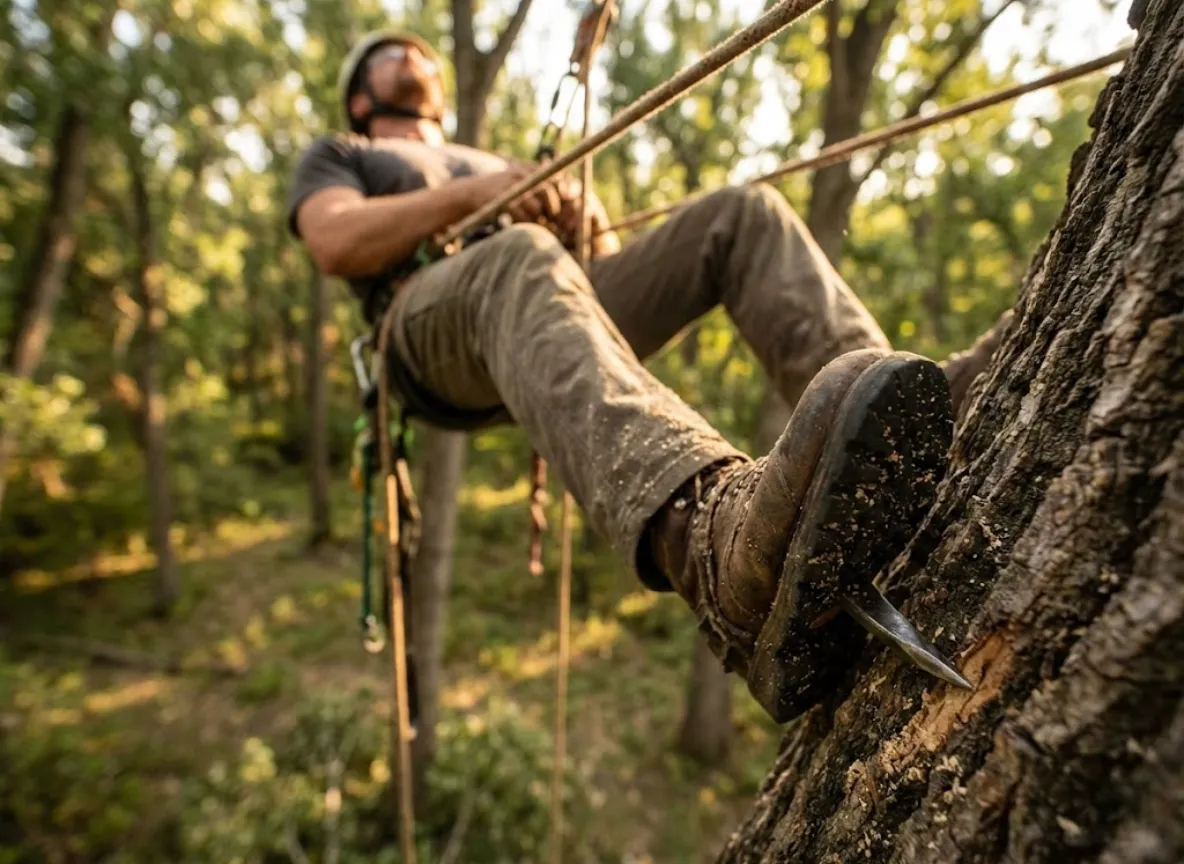
The gaff is your only point of contact with the spar, so geometry dictates security. Tree gaffs, typically around 2.75 inches, are necessary for maximum penetration through the thick rhytidome (bark) of Cottonwoods and Pines to reach solid wood. If your gaff is too short, it will shear off the bark, causing a “cut-out.”
Pole gaffs are shorter, around 1.75 inches. They are biomechanically more efficient because they create a shorter lever arm, reducing strain on the ankle. However, they are dangerous on thick-barked trees due to the risk of gaffing out. The modern compromise is the 2.25-inch hybrid gaff (sometimes called Euro gaffs), often seen on Edelrid Talon or Distel climbers, designed for versatile urban forestry.
Pro-Tip: If you work primarily in thick-barked conifers, do not compromise with hybrid gaffs. The extra half-inch of the Tree Gaff is the difference between a solid stance and a slip that puts a gaff in your calf.
This mechanical grip is aggressive, which brings us to the ethical mandate. Selecting the right point of contact is futile if the climber violates the fundamental ethics of sustainable arboriculture. The TCIA explicitly warns that spikes create wounds that invite pathogens. Unlike the recreational gear discussed in our tree climbing equipment comparison, which prioritizes non-invasive friction hitches, spikes are tools of destruction or rescue only.
3. Material Science: Weight vs. Durability
Your choice of material is a trade-off between upfront cost and daily climber fatigue. Steel is the traditional workhorse, famously used in classic Klein climbers and Bashlin models. It is heavy (often 6+ lbs per pair), indestructible, and cheap, but the high total set weight accelerates fatigue.
Aluminum has become the standard for production tree work. It drops the weight to around 5 lbs and offers high stiffness. However, aluminum climbers have a finite fatigue life, typically 5 to 10 years depending on usage.
Titanium is the elite choice, offering the durability of steel with the weight of carbon fiber, plus inherent vibration damping. Carbon fiber—seen in the Gecko Carbon Fiber—is the specialist: ultralight and stiff, but susceptible to impact damage and UV degradation over time.
Understanding these material behaviors is critical, as they are all subject to the rigorous ASTM F887 testing requirements. These spikes are a critical part of your essential tree climbing gear, and trusting the metallurgy is non-negotiable when you are eighty feet aloft.
Our Selection Process: How We Built This Guide
We prioritize objectivity over brand loyalty. We analyze tools based on biomechanics, field durability, and safety data.
Evaluation Framework: Every spur was scored against ASTM F887 compliance, shank rigidity, cuff ergonomics, and “shin bang” mitigation.
Product Selection: We aggregated long-term field reports from forums like ArboristSite, fatigue cycle data, and comparative weight analysis of current 2026 models like the Gecko Aluminum 3.0.
Affiliate Note: We may earn a commission if you purchase through our links, at no extra cost to you. This supports our independent testing.
The Best Tree Climbing Spikes of 2026: Our Top Recommendations for Every Need
Our Top Pick for The Production Specialist

Our Top Pick for The Career Climber
Our Top Pick for The Budget Conscious
Conclusion
The era of suffering through a tree removal with inadequate gear is behind us. To avoid medial tibial stress syndrome, known as “Shin Bang,” you must prioritize rigid fiberglass or plastic cuffs over soft leather pads.
Material choice is your next critical decision. Aluminum climbers offer the best balance of price and performance for most climbers, while Titanium is the ultimate investment for career longevity. Steel is viable only if it features an ergonomic offset shank.
Pro-Tip: Always fit your spurs with your work boots on. The stirrup width must accommodate your boot’s heel without pinching, or you will lose circulation halfway up the tree.
Remember the Golden Rule of Arboriculture: never use spikes for pruning. They are tools for tree removal operations or rescue only. Invest in a system that protects your body, and you will extend your climbing career by a decade.
FAQ – Frequently Asked Questions
Can I use climbing spikes for trimming or pruning trees?
No, utilizing spikes on a live tree for pruning is a violation of ANSI Z133, ANSI A300, and ISA standards. The gaffs puncture the cambium layer, xylem, and phloem, causing permanent live tissue damage and opening vectors for pathogens. Use friction savers and spikeless rope techniques for pruning.
What is the difference between Tree Gaffs and Pole Gaffs?
Tree gaffs are longer (~2.75) to penetrate thick bark and reach solid wood, providing a secure hold on species like Pine or Cottonwood. Pole gaffs are shorter (~1.75) and are designed for hard, bark-less utility poles or thin-barked trees. The Notch Gecko Aluminum 2.0 includes both types.
How do I sharpen my climbing gaffs?
Use a flat mill file to hone the underside and outer bevels manually. Never use a mechanical grinder, as the heat generated will ruin the steel’s temper and compromise the gaff’s strength. Always check your work with a standardized gaff gauge to ensure gaff sharpness is safe for climbing.
How long do aluminum climbing spurs last?
While steel is virtually indefinite, aluminum spurs have a fatigue life and typically last 5 to 10 years of professional use before stress fractures may occur. Annual inspection is mandatory, paying close attention to the stirrup transition area for hairline cracks.
Risk Disclaimer: Rock climbing, mountaineering, and all related activities are inherently dangerous sports that can result in serious injury or death. The information provided on Rock Climbing Realms is for educational and informational purposes only. While we strive for accuracy, the information, techniques, and advice presented on this website are not a substitute for professional, hands-on instruction or your own best judgment. Conditions and risks can vary. Never attempt a new technique based solely on information read here. Always seek guidance from a qualified instructor. By using this website, you agree that you are solely responsible for your own safety. Any reliance you place on this information is therefore strictly at your own risk, and you assume all liability for your actions. Rock Climbing Realms and its authors will not be held liable for any injury, damage, or loss sustained in connection with the use of the information contained herein.
Affiliate Disclosure: We are a participant in the Amazon Services LLC Associates Program, an affiliate advertising program designed to provide a means for us to earn advertising fees by advertising and linking to Amazon.com. As an Amazon Associate, we earn from qualifying purchases. We also participate in other affiliate programs. Additional terms are found in the terms of service.