In this article
The landowner’s voice was flat over the phone: “I’m closing the crag. Forever.” Three days after a climber’s 40-foot ground fall, the certified letter from the insurance company had arrived. It didn’t matter that the climber had signed a waiver, or that the bolts were maintained by the local climbing organization. The owner of Mad River Gorge was done—and climbers in Ohio would lose access for the next twenty years.
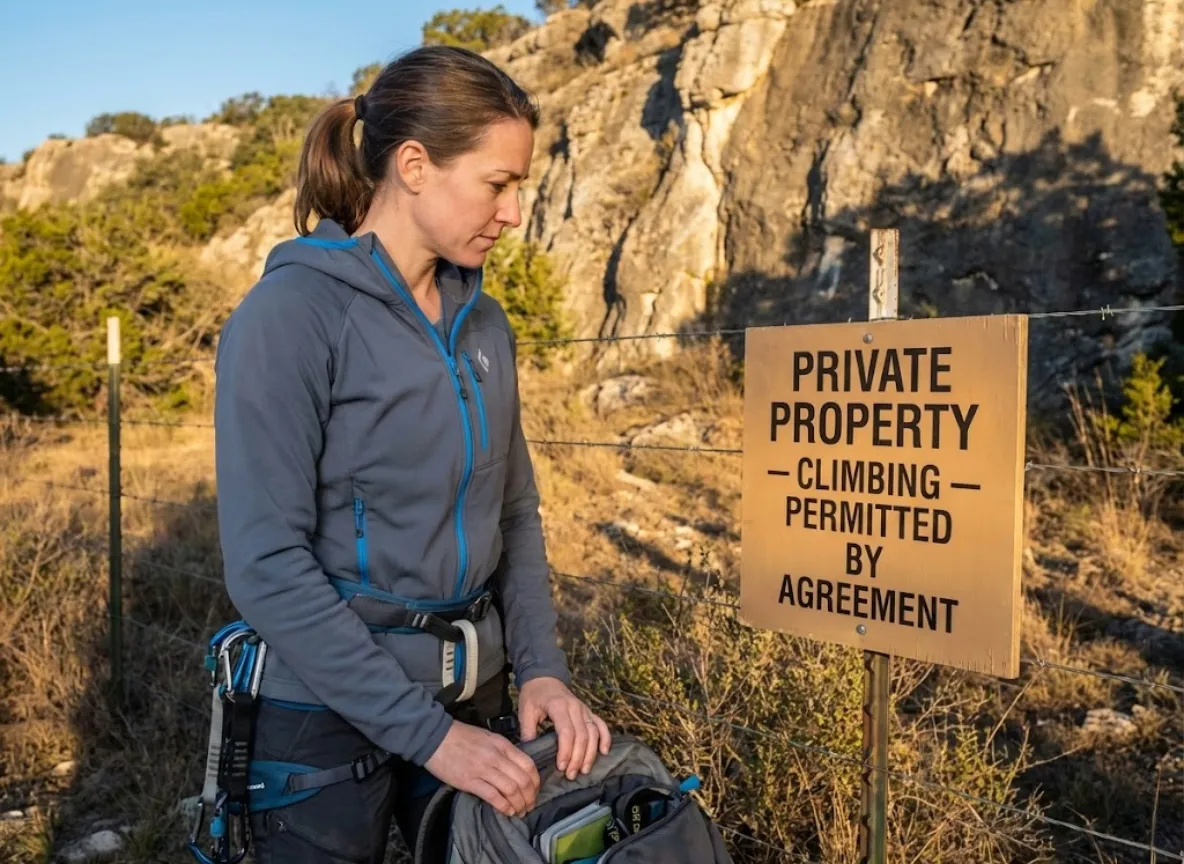
I’ve spent years working alongside the Access Fund and local climbing organizations, watching crags open and close based on legal nuances that most climbers never consider. The truth? Your ability to climb on private land often comes down to a single legal mechanism that most people have never heard of: the Recreational Use Statute.
Here’s the complete breakdown of how liability laws work for climbers, where they fail, and how you can protect both yourself and the landowners who make your sends possible.
⚡ Quick Answer: In all 50 states, Recreational Use Statutes (RUS) protect private landowners from negligence liability when they allow public access to their land for free. But this protection has limits—charging fees, restricting access to certain people, or failing to warn about known hazards can strip that immunity. Understanding these laws is essential for any climber who values access to private property.
The Legal Shield: How Recreational Use Statutes Work

The Core Bargain—Free Access for Immunity
Every U.S. state has enacted some version of a Recreational Use Statute, modeled after the 1965 Model Act. The fundamental bargain is straightforward: the state grants landowners immunity from ordinary negligence claims in exchange for opening their property to the public without charge.
This isn’t a small deal. Under normal premises liability rules, a property owner owes different levels of duty of care depending on who enters their land. Business customers get the highest protection. Friends get moderate protection. Trespassers get almost none.
The RUS essentially treats recreational users—including climbers—as trespassers regarding duty of care. The landowner owes you almost no obligation to maintain safety. They only need to avoid intentionally harming you or setting traps.
Pro tip: Before approaching any landowner about climbing access, research your state’s RUS first. Knowing what understanding climbing ethics and access rules protections exist lets you have an informed conversation—and shows you’ve done your homework.
Here’s where it gets complicated. In Minnesota (Minn. Stat. § 604A), the statute specifically requires that access be granted to the “general public.” A private “handshake” arrangement where you’re the only climber allowed? That might not be covered at all.
States That Explicitly Protect Climbing
Not all Recreational Use Statutes are created equal. Some states explicitly list rock climbing as a protected activity. Others use vague “recreational purpose” language that courts must interpret.
Hawaii (HRS Chapter 520) provides the gold standard. The legislature specifically amended the definition of “recreational purpose” to include both rock climbing and bouldering. No ambiguity. No courtroom debates. Climbers are covered, period.
Texas tells a similar success story. HB 687 passed 143–0, explicitly adding rock climbing to the state’s liability protection framework. The Access Fund and local coalitions pushed hard for this amendment, knowing that Texas ranchers own vast swaths of potential climbing terrain. Without clear protection, areas like Hueco Tanks on private ranches would remain locked.
California (Civ. Code § 846) lists climbing among its protected activities. The iconic Jailhouse Rock crag was secured through a permanent conservation easement—a legal instrument that essentially locks in RUS protection for the long term.
Colorado and Wyoming use broader “recreational purpose” language without specifically mentioning climbing. This creates uncertainty. Courts must decide whether climbing fits the definition, and landowners don’t like uncertainty when their assets are on the line.
The “Consideration” Trap—When Fees Kill Immunity
The fastest way to void RUS protection? Collect money.
Even small “maintenance donations” can transform a recreational user into a business invitee under the law. Suddenly, the landowner owes you a reasonable duty of care—the same standard they’d owe paying customers.
In strict “no charge” states like Minnesota and Arkansas, this threshold is absolute. One dollar collected, and the blanket liability shield disappears.
Wisconsin offers a rare exception. Landowners there can collect up to $2,000 annually without losing immunity. This allows small contributions for trail maintenance without catastrophic legal consequences.
Courts have even found “consideration” in non-monetary forms. In California, if a landowner receives ANY benefit in exchange for access—even something as vague as “goodwill”—immunity may be challenged. Colorado’s statute explicitly states that lease payments from a public entity don’t count as a “charge” from the user’s perspective.
When the Shield Fails—The “Willful or Malicious” Exception
Defining “Willful” Misconduct
RUS protection has a critical vulnerability. The statutes never protect against “willful and wanton conduct.” In courtrooms across the country, this exception has become the battlefield.
“Willful” means conscious disregard for safety. “Malicious” means intent to harm. If a landowner KNOWS about a dangerous condition—a booby trap, an unstable rockfall zone, damaged fixed anchors—and fails to warn users, the liability protection fails.
The distinction between ordinary negligence (carelessness—protected) and willful conduct (knowledge plus inaction—unprotected) is the knife’s edge that landowners walk every day.
The Case That Changed Everything—Nelson v. United States
A cyclist was injured on a washed-out trail at the Air Force Academy. The Academy knew about the damage but didn’t repair it or post warnings.
The 10th Circuit, applying Colorado law, ruled this constituted “willful or malicious failure to guard or warn” against a known dangerous condition. The judgment: $7.3 million.
The immediate impact was devastating. Private landowners across Colorado’s famous 14ers—Mount Lincoln, Mount Democrat, and others—closed access entirely. Their reasoning was simple: if knowledge of ANY hazard without a warning sign could trigger that kind of liability, the risk wasn’t worth it.
The legislative response? Colorado SB 23-103 attempted to redefine “willful” to require actual malicious intent—not just knowledge of a hazard. The debate over that bill continues to shape how essential protective gear for rock environments works in practice: even the best protection means nothing if you can’t access the crag.
Minnesota’s “Public Use” Bombshell—Ouradnik v. Ouradnik
This case should terrify anyone who thinks a friendly handshake arrangement protects their landowning host.
A father allowed his son to use a deer stand on private property. The stand failed, causing injury. The father claimed immunity under Minnesota’s Recreational Use Statute.
The Minnesota Supreme Court disagreed. The statute’s purpose, they ruled, was to encourage opening land to the general public. Because the father only invited a specific family member—not the public at large—he couldn’t claim the statutory immunity.
The implication for climbing is profound. A landowner who allows ONLY their friends or a specific climbing club access—while excluding the general public—may accidentally void their RUS protection in states with similar “general public requirement” provisions.
Paradoxically, to gain immunity in Minnesota, owners may need to allow everyone access. The private, controlled arrangement that seems safer? It might be the legal trap.
Access Agreements and Legal Instruments
Revocable Licenses vs. Permanent Easements
When landowners do grant access, the legal structure matters enormously.
A revocable license is permission that can be withdrawn at any time. Bridal Veil Falls in Colorado operates this way—San Miguel County holds a license from Idarado Mining Company. Break the rules, and access disappears instantly.
A conservation easement is the opposite: a permanent property right that locks in access for decades or forever. Jailhouse Rock in California was secured this way, creating long-term stability that both climbers and landowners can rely on.
Landowners often fear something called “prescriptive easement”—the idea that if climbers use a trail for years without permission, they might gain permanent legal rights to it. Most RUS statutes explicitly state that recreational use does NOT create such rights, but the fear persists. This is why formal “permission” structures are legally safer than simply ignoring climber traffic. For more context on understanding threats to climbing access, the distinction between these instruments is critical.
Waivers That Actually Protect—Indemnification vs. Hold Harmless
Most climbers sign liability waivers without reading them. But understanding the two key clauses could save your host from ruin.
A hold harmless clause means the climber agrees not to sue the landowner for injuries. That’s the basic protection most people imagine when they think “waiver.”
An indemnification clause goes further. The climber agrees to PAY the landowner’s legal fees if the landowner gets sued by a third party—like the climber’s family or insurance company seeking reimbursement through subrogation. This is the clause that actually protects the landowner’s wallet from the burden of attorney’s fees.
Pro tip: A robust cooperative liability waiver must include BOTH clauses. RUS immunity doesn’t cover defense costs. Without indemnification, a landowner can “win” their case and still go bankrupt from understanding release and indemnification agreements legal fees.
The Muir Valley model in Kentucky demonstrates best practices. Every visitor must sign an online “Acknowledgment of Risks, Assumption of Risk and Responsibility, and Release of Liability” before entry. It’s thorough, it’s enforceable, and it’s kept that world-class crag open for years.
The Role of LCOs (Local Climbing Organizations)
Local climbing organizations serve as the critical bridge between individual climbers and landowners. They’re the adults in the room.
The Red River Gorge Climbers’ Coalition (RRGCC) owns land and manages relationships with private landowners across Kentucky. The Ohio Climbers Coalition (OCC) brokered the Mad River Gorge reopening after two decades of closure. The American Alpine Club (AAC) partners with the Access Fund on grants and anchor replacement programs.
The Access Fund provides the Climbing Conservation Loan Program (CCLP)—a revolving fund administered by their land trust that allows LCO leaders to purchase threatened land when liability concerns push owners to sell. These organizations also distribute risk management education, signage templates, and Leave No Trace ethics for climbing areas resources that help landowners feel confident in granting access.
Why Landowners Close Crags (And How to Prevent It)
Liability Fear vs. Actual Litigation
Here’s the uncomfortable truth: most crag closures stem from liability FEAR, not actual lawsuits.
The Nelson case amplified anxiety far beyond its actual precedent. Insurance companies—not courts—often drive decisions. A single incident can trigger policy cancellation or premium spikes that make continued access financially impossible.
One Reddit commenter captured the landowner perspective bluntly: “Many owners would just say ‘no, I don’t want the liability.’ If climbers can’t be gracious, manage, and police themselves, they don’t deserve access.”
The frustrating gap? There’s no publicly available data on actual litigation rates against climbing-area landowners. This information vacuum allows fear to flourish.
The “Entitlement” Factor
Landowners frequently cite climber BEHAVIOR—not just liability—as their reason for closure.
Mad River Gorge closed for 20 years not only because of an accident. The area had become a dumping ground. Reopening required removal of 125,000 pounds of trash and 200 abandoned tires by organized climber volunteers.
Criminal trespass on adjacent private property to reach crags—or confusing land boundaries entirely—is a leading cause of access loss. “The yellow line indicates the property line,” one Mountain Project post warns. “Do not go beyond this line. There have been serious access issues because of people crossing.”
The pattern is clear: climbers worry first about legality, then discover protective statutes, then identify exceptions—and eventually realize their behavior may be the deciding factor. For action steps, consider proactive stewardship beyond Leave No Trace.
Success Story—Mad River Gorge Reopens
The good news? Organized advocacy CAN reverse closures.
Mad River Gorge closed in the 1990s following a fatal accident and subsequent liability fears. It remained locked for over 20 years. Then the Ohio Climbers Coalition partnered with the Access Fund and Clark County Parks to develop a “climbing management plan” specifically addressing the county’s specific landowner concerns.
The cleanup effort was massive. The negotiation was patient. And in 2017, climbers returned to one of Ohio’s premier limestone areas.
The lesson? Recovery is possible—but it takes years. Prevention is always more efficient than restoration.
Protecting Yourself and the Land (Best Practices)
Before You Climb—Due Diligence
Research your state’s RUS before you leave home. Does it explicitly include climbing? What are the fee restrictions? What exceptions apply?
Verify land ownership. Is this public lands, private land with formal permission, or uncertain status? Many climbing apps and forums contain outdated or incorrect information about climbing access rights.
Check for posted rules. Areas like Muir Valley and private ranches require signed waivers BEFORE entry. Showing up without completing the paperwork is a fast way to create access problems for everyone.
Pro tip: Understand your personal liability coverage. Does your homeowner’s insurance or AAC membership cover climbing accidents on private property? This is a documented personal insurance gaps situation—most policies are vague. Contact your insurer directly.
Respecting Boundaries and Agreements
Stay on designated trails. Remember: the Nelson case involved a TRAIL, not the climbing itself. The approach is often where liability flashpoints occur.
Observe property line markers. If you encounter new crags on private land, contact your local LCO or the Access Fund—do NOT bolt or establish routes without landowner permission. Unauthorized route developers create liability concerns that make future formal access agreements nearly impossible.
Treat revocable licenses as fragile. Any rule violation could trigger instant closure. The Bridal Veil Falls model demonstrates this reality: access exists at the landowner’s pleasure, not as any climber’s right.
Supporting the Organizations That Secure Access
Join and donate to the Access Fund—the premier land trust and advocacy organization. Join your local LCO (RRGCC, OCC, Carolina Climbers Coalition, and dozens more).
Participate in volunteer trail days, cleanup efforts, and anchor replacement projects. These hours matter. When negotiating with nervous landowners, LCOs can point to concrete stewardship that builds trust.
The Mad River reopening took over 20 years. The organizations that made it happen—and the trad climbing ethics and crag care responsibilities they promote—deserve your support before access is lost, not only after.
Conclusion
Three things will determine whether you’re climbing on private land next season.
First: Recreational Use Statutes protect landowners from negligence claims—but only when access is FREE and open to the public. Any fee, any restriction, and that protection can evaporate.
Second: The “willful misconduct exception” is the Achilles’ heel. The Nelson case proves that knowledge of a hazard plus failure to warn equals potential multi-million dollar liability, regardless of RUS protection.
Third: Your own responsibility matters as much as the law. Mad River Gorge closed for 20 years not just because of an accident, but because climbers trashed the place. Access is earned through stewardship, not entitlement.
Before your next climb on private property, take 10 minutes to research your state’s RUS. Know whether your host has legal protection—and if they don’t, know that your conduct and your waiver signature are their only shields. The landowner who lets you climb isn’t just opening a gate. They’re accepting a risk that most neighbors would refuse. Respect that.
FAQ
Can I climb on private land without permission?
No. Entering private property without permission is criminal trespass, regardless of whether established climbing routes exist. Always verify that landowner permission exists through formal agreements, posted rules, or direct communication before climbing.
Do climbing waivers actually work for private land?
Yes, with limitations. A properly drafted liability waiver with both hold harmless and indemnification clauses protects against negligence claims and defense costs. However, waivers cannot protect against gross negligence or willful misconduct, and enforceability varies by state.
Can a landowner be sued if a climber falls on their property?
It depends on the state’s RUS, whether access fees were charged, and whether the landowner knew of specific hazards. If access was free, open to the public, and the landowner didn’t willfully ignore a known danger, RUS typically provides strong protection. If any condition fails, traditional premises liability applies.
Does my climbing insurance cover accidents on private land?
This is a documented personal insurance gaps issue. Most climbing liability insurance policies are vague on private land coverage. Contact your insurer directly to confirm whether accidents on private property fall within your policy.
What should I do if I discover a new crag on private land?
Do NOT bolt or establish routes. Contact your local LCO or the Access Fund to initiate proper landowner outreach using their access negotiation toolkits. Establishing routes without permission creates liability risks that can make future formal access agreements nearly impossible—and may result in closure of nearby established areas.
Risk Disclaimer: Rock climbing, mountaineering, and all related activities are inherently dangerous sports that can result in serious injury or death. The information provided on Rock Climbing Realms is for educational and informational purposes only. While we strive for accuracy, the information, techniques, and advice presented on this website are not a substitute for professional, hands-on instruction or your own best judgment. Conditions and risks can vary. Never attempt a new technique based solely on information read here. Always seek guidance from a qualified instructor. By using this website, you agree that you are solely responsible for your own safety. Any reliance you place on this information is therefore strictly at your own risk, and you assume all liability for your actions. Rock Climbing Realms and its authors will not be held liable for any injury, damage, or loss sustained in connection with the use of the information contained herein.
Affiliate Disclosure: We are a participant in the Amazon Services LLC Associates Program, an affiliate advertising program designed to provide a means for us to earn advertising fees by advertising and linking to Amazon.com. As an Amazon Associate, we earn from qualifying purchases. We also participate in other affiliate programs. Additional terms are found in the terms of service.