In this article
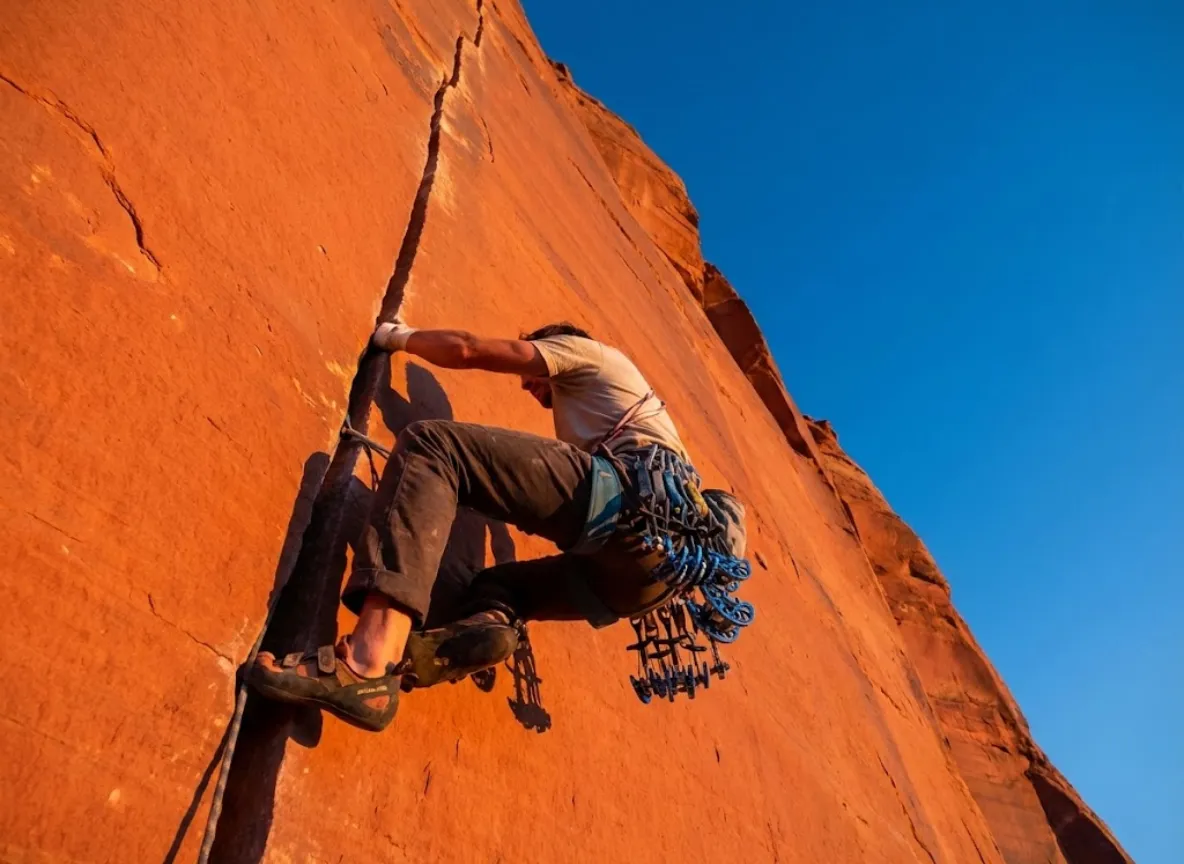
The red dust of Indian Creek Canyon works its way into everything—your pores, your cam lobes, and eventually, your psyche. Standing at the base of the Wingate Sandstone in the Southern Canyonlands, looking up at a fracture that splits the cliff for 150 feet without deviating an inch in width, requires a shift in perspective.
This is not the variable, chaotic geometry of granite you might be used to in the Valley. It is a world of unrelenting parallel lines where physical fitness matters less than pain tolerance and neuromuscular adaptation.
For decades, this valley in Southeastern Utah was the unregulated frontier of traditional climbing in the American Southwest. Today, the reality has shifted. The 2026 Bears Ears Management Plan has codified the Creek as a protected resource within the Bears Ears National Monument (BENM), transforming the climber from a visitor into a responsible steward.
This guide bridges the gap between the gym and the desert. We will detail the hyper-specific rack required to protect these splitter cracks, the friction techniques needed to ascend them, and the new regulatory framework you must navigate to keep these legendary rock walls open.
What Defines the Unique Geology and Management of Indian Creek?

Indian Creek is defined by the vertical fracturing of Wingate Sandstone which demands specialized jamming techniques and gear. This geology is governed by the strict conservation mandates of the BLM Monticello Field Office, which prioritize resource protection over recreation.
How does the Wingate Sandstone dictate climbing style and ethics?
Wingate Sandstone is an aeolian (wind-deposited) formation. This geological origin defines the climbing style: vertical fracturing creates perfectly parallel cracks ranging from hairline fractures to body-sized chimneys.
Unlike granite, which offers pods and constrictions for passive protection like nuts, these parallel fractures require active camming devices to generate holding power against smooth walls. Because the rock lacks face holds, you must rely exclusively on “hand jamming”—using the body as a wedge. This creates a high barrier to entry if you rely solely on face-climbing strength as a sport climber.
The cementing agents binding the quartz grains—calcite and clay—are hydro-sensitive. This means the rock loses significant structural integrity when wet. Climbing on damp Wingate Sandstone risks catastrophic gear failure where cams shear through the rock, and causes permanent damage to the route known as “scarring.”
Scientific analysis of sandstone mechanical weakening indicates shear strength can drop by 15-75% when saturated. Therefore, the “24-to-48 Hour Rule” is non-negotiable. If the soil at the base is damp or the rock is cool to the touch, climbing is structurally unsafe and ethically prohibited. You must become proficient in identifying sedimentary rock vulnerabilities and porosity before approaching these walls.
Pro-Tip: Test the soil a few inches down at the base of the cliff. Surface sand dries quickly in the wind, but if the subsurface soil clumps together, the rock above is likely still compromised deep inside the crack.
What are the new regulatory mandates for climbers in Bears Ears?
The era of ad-hoc route development is over. Under the 2026 management updates, establishing new routes that require fixed anchors now necessitates a formal proposal and permit from the BLM Monticello Field Office.
Visual Resource Management standards now include a strict 2026 matte hardware mandate. This minimizes visual glint and impact on the scenery along the Indian Creek corridor. Additionally, dynamic raptor closures are enforced seasonally, typically March through August, to protect nesting Golden Eagles and Peregrine Falcons. These boundaries adjust based on annual biologist surveys.
Access to popular walls like Supercrack Buttress, Donnelly Canyon, and Battle of the Bulge often relies on easements through the private Dugout Ranch. The “Plan of Development” for recreation involves scrutiny regarding impacts on “Monument Objects,” including cultural site avoidance.
Violation of these protocols, particularly unauthorized drilling or ignoring closures, threatens the co-management framework established with Tribal Nations. To navigate this properly, you should master the Desert Climber’s Ethics Codex, which outlines the broader behavioral expectations beyond just following the law.
How Do You Build the Specialized “Creek Rack” and Kit?
A functional Indian Creek rack requires pooling resources to acquire an “octuple rack”—6 to 10 cams of the exact same size per pitch. You will also need stiff footwear and mandatory tape gloves to handle the abrasion of crack climbing.
What does a functional Indian Creek protection rack look like?
Due to the parallel crack consistency, a single pitch may require 6 to 10 cams of the exact same size. For example, a route like Incredible Hand Crack might require eight Black Diamond C4 #1s. This necessitates a “Social Rack” strategy where partners pool their gear to create a communal “Creek Rack.”
A standard tick-list rack includes 4-6x of sizes 0.5 through #3, with specialized emphasis on the “perfect hand” sizes (#1 and #2). Experienced Creek climbers often mix brands to exploit micro-differences in range. For instance, a Wild Country Friend #2 is slightly wider than a Black Diamond Camalot #2, bridging the gap between sizes.
Passive protection like nuts and hexes is largely dead weight here. Parallel cracks offer no constrictions for them to seat. You need a deep understanding of active protection mechanics to trust your life to smooth sandstone walls. For off-width sizes (BD #4 and larger), you will need “Big Bro” expandable tubes or large camming devices, though fewer are usually required per pitch.
Black Diamond C4 vs. Wild Country Friend
A comparative analysis of cam sizing, color coding, and optimal racking strategies.
Black Diamond Z4
#0.1 / #0.2 (Green / Yellow)
Optimal Range: 8.4 – 13.8 mm
Wild Country Zero
0.1 / 0.2 (Grey / Yellow)
Range: 8 – 13 mm / 10 – 16 mm
Strategic Insight
Z4s offer better flexibility; Friends have narrow heads. The Z4 single stem design shines in horizontal placements in this size.
BD C4 #0.3
Color: Blue
Optimal Range: 13.8 – 23.4 mm
WC Friend 0.4
Color: Silver
Optimal Range: 15.8 – 26.3 mm
Strategic Insight
The WC 0.4 is slightly larger than the BD 0.3, perfectly covering the notorious “rattly” gap where a 0.3 is too small but a 0.4 is too big.
BD C4 #0.4
Color: Grey
Optimal Range: 15.5 – 26.7 mm
WC Friend 0.5
Color: Purple
Optimal Range: 20.6 – 34.5 mm
Strategic Insight
Critical overlap zone. The WC 0.5 is significantly larger than the BD 0.4. It acts as a “fat” 0.4 or a “tight” 0.5.
BD C4 #0.5
Color: Purple
Optimal Range: 19.6 – 33.5 mm
WC Friend 0.75
Color: Green
Optimal Range: 25.8 – 43.0 mm
The “Creek Crux” Size
Having both brands here is a common pro tactic. It provides micro-adjustability for thin hands cracks where a few millimeters make the difference between a bomber placement and a tipped-out cam.
BD C4 #0.75
Color: Green
Optimal Range: 23.9 – 41.2 mm
WC Friend 1
Color: Red
Optimal Range: 31.7 – 53.6 mm
Strategic Insight
The WC #1 is a crucial bridge piece, sitting comfortably between the BD #0.75 and BD #1. Excellent for those awkward “off-fingers” or “tight hands” slots.
BD C4 #1
Color: Red
Optimal Range: 30.2 – 52.1 mm
WC Friend 2
Color: Yellow
Optimal Range: 41.5 – 69.3 mm
Strategic Insight
The most common “moderate” size. This is the gold standard for “hands”.
BD C4 #2
Color: Yellow
Optimal Range: 37.2 – 64.9 mm
WC Friend 3
Color: Blue
Optimal Range: 52.7 – 88.9 mm
Strategic Insight
WC #3 is essentially equivalent to a BD #3. Note that the WC colors shift here (Blue for WC #3 vs Yellow for BD #2).
BD C4 #3
Color: Blue
Optimal Range: 50.7 – 87.9 mm
WC Friend 4
Color: Silver
Optimal Range: 66.8 – 112 mm
Strategic Insight
BD #3 is the standard for “Supercrack” size. The Friend 4 is considerably larger, covering fist to off-width transition.
BD C4 #4 / #5 / #6
Grey / Purple / Green
Optimal Range: 66 – 195 mm
Strategic Insight
Black Diamond dominates the large cam market. There are no direct Wild Country Friend equivalents for these sizes in the standard lineup.
Which footwear and personal protection are mandatory?
Your hands and feet are the primary points of failure. High-top climbing shoes with a stiff midsole, such as the La Sportiva TC Pros or Scarpa Maestro Mid, are essential to protect ankles from “gobies” (abrasions) in wide cracks.
Shoes should have a “flat last”—meaning the toes lie flat—rather than a downturned aggressive profile. This allows them to twist into thin cracks without crushing your toes.
“Tape Gloves” are mandatory PPE. You must construct durable hand protection using high-thread-count Eurotape or use rubberized crack gloves. Without them, the coarse sandstone will flay your skin, ending your trip early. We recommend learning how to construct durable tape gloves before you arrive at the crag.
WAG Bags (Waste Alleviation and Gelling) are also a critical part of your kit. Human waste cannot be buried in the desert due to a lack of biodegradation. Packing it out is a strict condition of access.
Pro-Tip: If you are climbing thin cracks (fingers to thin hands), bring a pair of low-profile slippers like the Unparallel UpMocc. The bulky toe box of a high-top shoe often physically won’t fit into the constriction of a 5.11 finger crack.
How Do You Execute a Safe Expedition Logistics Plan?
Safe logistics in Indian Creek require complete resource autonomy. You must haul all water, adhere to strict waste management, and understand that climbing grades are based on hand morphology rather than hold size.
Where can you camp and how do you source water?
Indian Creek is a dry district with no potable water sources. You must haul all water from Monticello (South) or Moab (North), budgeting at least 1 gallon per person per day.
Camping is strictly regulated. Creek Pasture and Superbowl offer limited reservable group sites via Recreation.gov, while individual sites are highly competitive. Hamburger Rock provides scenic, high-bench camping but is strictly First-Come, First-Served (FCFS), often filling up by Thursday afternoon in peak seasons.
Dispersed camping is restricted to designated zones like Bridger Jack Mesa, which requires high-clearance vehicles to access the rough approach road. You must adhere to “containment” principles: no grey water dumping, strict fire pan usage, and packing out all trash. For those on a budget or looking for solitude, navigating dispersed camping rules is a vital skill for finding legal spots outside the main corridor near Newspaper Rock.
How does the grading system work relative to hand size?
Grades in Indian Creek are morphological. The difficulty is determined by your physical dimensions relative to the crack width, not just hold size.
A “5.10” route typically denotes a “Perfect Hand” jam (Camalot #2 size) for an average adult male. If your hands are smaller, this same crack might be a loose, strenuous off-width. Conversely, a “5.11” finger crack might be a secure “5.10” lock for someone with slender fingers, flipping the traditional difficulty hierarchy.
This is the “Creek Tax”—the ego-check gym climbers face. A 5.12 sport climber may struggle on 5.10 cracks due to a lack of jamming technique. Progression should begin with classics like Donnelly Canyon (5.10-) or routes at Six Shooters South to dial in systems.
It is critical to “chase size,” not grades. Build a tick list based on the crack widths that fit your body. This requires interpreting subjective climbing grades through the lens of your own anatomy rather than the number in the guidebook.
Final Thoughts
Indian Creek demands a different approach than any other crag in North America. The geology requires you to respect the fragility of wet sandstone. The gear requires a massive “Creek Rack” and specific PPE. The stewardship requires adherence to the new Bears Ears Management Plan, from matte hardware to WAG bags.
The technique requires you to set aside your ego and learn to jam. Prepare your rack and your mindset before you go. Explore our full library of Desert Conservation Guides to ensure your impact remains as invisible as your matte hangers.
FAQ – Frequently Asked Questions about Indian Creek Climbing
How long do you really have to wait to climb after it rains in Indian Creek?
You must wait a minimum of 24 to 48 hours after rain, or until the soil at the base is completely dry. Climbing on wet sandstone weakens the rock by up to 75%, causing cams to shear and ruining routes forever.
Is there cell service in Indian Creek?
There is virtually no cell service within the canyon itself. Climbers should download offline maps (Mountain Project or Google Maps) in Moab or Monticello and consider carrying a satellite communication device for emergencies.
Do I need a permit to climb in Indian Creek?
You do not currently need a permit for day-use climbing on existing routes, but overnight camping requires fees or reservations. However, establishing new routes with fixed anchors (bolts) now requires a formal permit from the BLM.
What is the best season to climb at Indian Creek?
The prime seasons are Spring (March–April) and Fall (October–November). Winter can be climbable on sunny, south-facing walls, while Summer is dangerously hot and generally avoided.
Risk Disclaimer: Rock climbing, mountaineering, and all related activities are inherently dangerous sports that can result in serious injury or death. The information provided on Rock Climbing Realms is for educational and informational purposes only. While we strive for accuracy, the information, techniques, and advice presented on this website are not a substitute for professional, hands-on instruction or your own best judgment. Conditions and risks can vary. Never attempt a new technique based solely on information read here. Always seek guidance from a qualified instructor. By using this website, you agree that you are solely responsible for your own safety. Any reliance you place on this information is therefore strictly at your own risk, and you assume all liability for your actions. Rock Climbing Realms and its authors will not be held liable for any injury, damage, or loss sustained in connection with the use of the information contained herein.
Affiliate Disclosure: We are a participant in the Amazon Services LLC Associates Program, an affiliate advertising program designed to provide a means for us to earn advertising fees by advertising and linking to Amazon.com. As an Amazon Associate, we earn from qualifying purchases. We also participate in other affiliate programs. Additional terms are found in the terms of service.