In this article
The wind whips at your helmet as you stare at the crux of the route, your heartbeat thumping in your ears. You reach for your trusty #2 cam, the piece that has caught you on countless falls over the last decade. But as you clip the rope, your eyes catch the fuzz on the sling—a sun-bleached, frayed evidence of years of exposure. In that split second, a question overrides your focus on the move: Is this piece of gear still a lifeline, or has it become a liability?
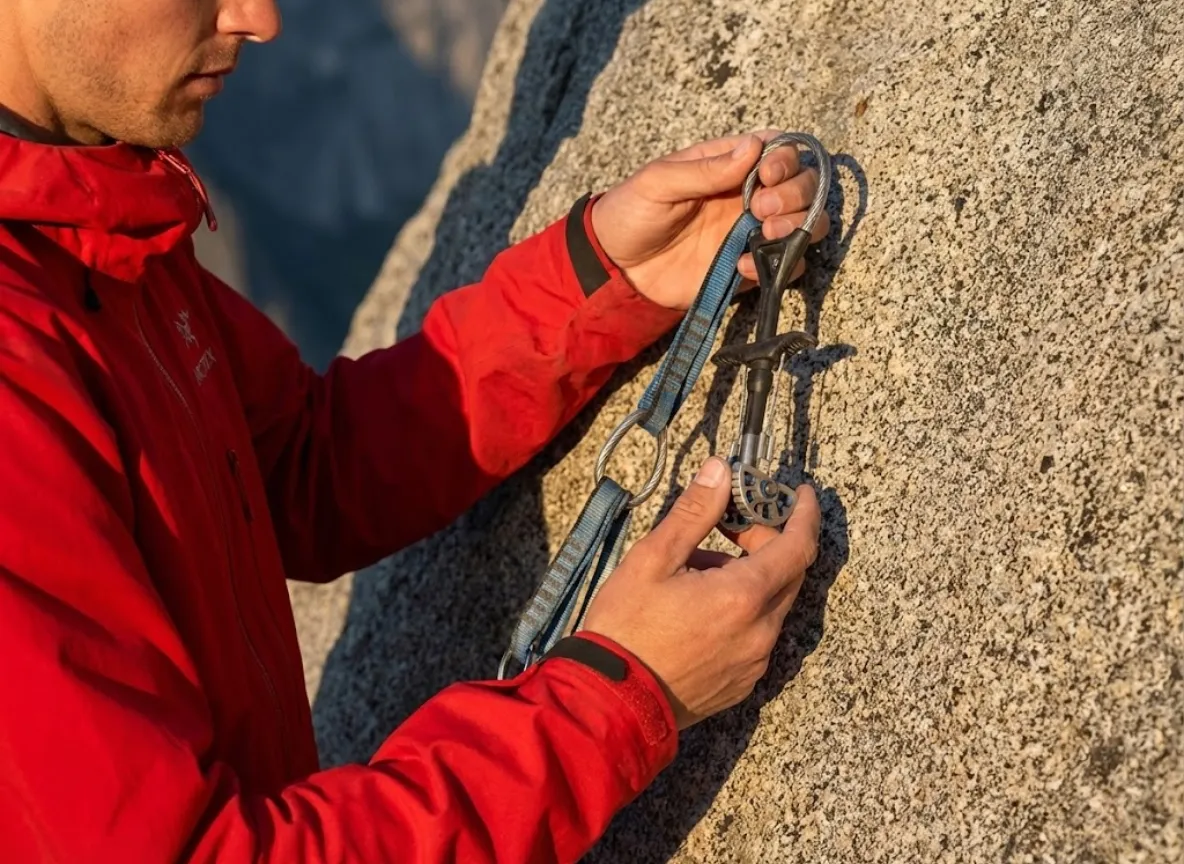
This isn’t just about saving money; it’s about the physics of trust. While the hardened steel axles and aluminum lobes of a camming device can endure for decades, the textile sling is a ticking clock. It constantly battles UV radiation, abrasion, and chemical degradation. This is the reality of rock climbing trad gear stewardship.
As a climbing guide, I inspect hundreds of active protection units annually. I have seen the difference between honest wear and structural compromise. This guide is your forensic toolkit and logistical battle plan. We will move beyond the vague advice of “check for wear” and equip you with the Standardized Cam Re-slinging Protocol—transforming you from a passive user of life-safety equipment maintenance into an active steward of your own system.
Why is “Do It Yourself” Reslinging a Dangerous Gamble?

Do not attempt this. DIY risks are severe. Using knots creates a specific failure mode known as the “Guillotine Effect.” This mechanism can sever the thumb loop cable at loads significantly lower than the device’s rating.
What is the “Guillotine Effect” and why does it render knots unsafe?
The “Guillotine Effect” is a catastrophic failure caused by geometric incompatibility. Modern cams utilize a wire thumb loop designed for the wide, flat bearing surface of a factory bar-tacked sling. When you replace that flat sewing with a DIY knot, basket hitch, or girth hitch, you constrict the webbing into a narrow, high-pressure point of contact.
Under the shock load of a fall, this constricted webbing acts like a dull blade against the thumb loop. Testing confirms this stress concentration can shear through the protective plastic sheath and cut the structural wire cable. While a standard cam sling maintains a 14kN+ rating, laboratory data shows that improper DIY configurations can cause failure at loads as low as 10kN. That is a 30% reduction in your safety margin.
Pro-Tip: If you are ever tempted to use a “Water Knot” on Dyneema webbing, remember that Dyneema has an incredibly low coefficient of friction. These knots can slip and unravel at forces as low as 7.7kN.
Material science reinforces this warning. Independent data from sources like How Not 2 (Ryan Jenks) and Cliff on Climbing supports that knot theory for nylon does not apply to UHMWPE (like 12mm Dyneema).
Beyond the shearing risk, the bulk of a knot (even a double bowline) creates a rigid connection that transmits rope vibration directly to the cam head. This increased “chatter” causes cams to “walk” into flared or unsafe positions more readily than flexible, low-profile bar-tacks. Micro-slippage in the knot can also lead to kinking wire loops over time. To understand the anatomy involved here, review this ultimate cam guide for all climbers, which details the interplay between the thumb loop and the axle.
You must rely on established manufacturing standards. The UIAA and CE standards for mountaineering equipment dictate the rigorous break-test data that professional bar-tacking must pass. A hand-tied knot in your garage simply cannot replicate this reliability.
How do you determine if a Cam is Safe to Resling?
Before you spend a dime on shipping, you must perform a “Forensic Audit.” This pre-shipping inspection checklist filters out dead metal to ensure you aren’t paying to service a unit that belongs in the trash.
What are the “Kill List” criteria for immediate retirement?
If a cam exhibits any of the following symptoms, it is structurally compromised and must be retired immediately.
1. The “Slop” Test (Axle Ovalization)
Grip the cam stem and wiggle the lobes perpendicular to the axle. Any visible elliptical deformation or excessive “play” in the axle hole indicates the aluminum has yielded. This axle ovalization compromises the unit’s geometry and holding power.
2. Lobe Mushrooming and Tooth Flattening
Run a fingernail along the outer edge of the cam lobes. If the metal is flattened, peened over, or resembles a mushroom cap, the cam has sustained excessive impact loading. Look for lobe tooth flattening, which reduces friction on smooth rock. These deformed edges can cause the lobes to bind or fail to retract.
3. Cable Root Fatigue
Inspect the junction where the flexible stem enters the rigid head or axle boss. Any broken wire strands (“meat hooks”), deep corrosion, or sharp permanent kinks are non-negotiable grounds for retirement.
You must also consider the timeline. The British Mountaineering Council’s guidelines on cam inspection reinforce that environmental factors play a huge role in metal fatigue. Additionally, most manufacturers enforce a hard climbing gear lifespan of 10 years for textiles. If your cam is older than a decade, many professional reslingers will reject it as legally un-serviceable due to liability concerns regarding invisible fatigue in the metal stem.
Pro-Tip: Distinguish between a broken trigger wire and a broken stem. A snapped trigger wire is a $15 repair. A kinked stem cable is fatal.
Where should you send your Cams for Professional Service?
Once your rack passes the audit, you need to choose a service provider. This choice depends on your brand mix, service scope, and budget.
OEM vs. Third-Party Specialists: How do you choose the right partner?
The Value Leader: Metolius
Metolius offers an industry-best value, often charging between $3 and $7 per unit. This service is exceptional because it includes comprehensive cleaning, lubrication, and trigger tuning. They service their own Master Cams, TCUs, Power Cams, and Supercams. However, they strictly service only their own branded units. If you are learning how to clean trad gear yourself, a trip to Metolius can save you the elbow grease on their units.
Climbing Cam Resling & Maintenance Services
Comparison of top providers for professional climbing gear repair and inspection.
Brands Accepted
Metolius Brand Only (Master Cams, TCUs, Power Cams).
Cleaning Services
Yes: Full inspection, deep cleaning, and specialized lubrication included.
Turnaround
Approximately 2 weeks.
Brands Accepted
Black Diamond Only (C4, C3, X4, Z4 families).
Cleaning Services
No: Strictly a resling service; utilitarian focus without maintenance.
Turnaround
4-5 Weeks (highly seasonal).
Brands Accepted
All major brands; specializes in “Franken-racks” and Aliens.
Specialized Repairs
Focus is on complex repairs like trigger wires and structural integrity.
Turnaround
1-2 Weeks.
Brands Accepted
Multiple brands; strict “10-Year Rule” applies for safety liability.
Priority
Prioritizes speed and safety liability. No deep cleaning provided.
Turnaround
24-48 Hours (In-shop service).
The Strict Standard: Black Diamond
BD provides OEM certification retention for their Camalots (C4, Z4, C3, X4). However, they generally refuse vintage first-generation units and do not offer the deep-cleaning services found at Metolius.
The “Franken-Rack” Solution: Runout Customs / Mountain Tools
Third-party specialists are essential for climbers with mixed racks containing DMM Dragon or Demon cams, Wild Country Friends, Totem Cams, Pacific Link Cams, or CCH Aliens. Shops like Runout Customs (managed by Luke) or Mountain Tools (run by Larry) can batch-process these brands in a single shipment. You might also investigate Yates Gear, Wired Bliss, Ragged Mountain Equipment, or Fish for specific needs.
While an OEM repair maintains the original CE/UIAA certification, a third-party repair technically modifies the PPE. This shifts liability, which is a nuance critical for institutional guides but generally accepted for personal use. These specialists can often perform magic on “obsolete” gear, re-wiring complex triggers on vintage units that the original manufacturer will no longer touch.
How can you optimize shipping and logistics costs?
Shipping heavy metal across the country is expensive. If you don’t plan the logistics, the shipping-to-gear cost ratio can exceed the value of the repair.
What is the “Rule of 5” for batch processing?
The economic break-even point typically occurs at 5 units. This is the “Rule of 5.”
If you send a single cam for a $10 repair and pay $15 for shipping, the total cost is $25. That is nearly 35% of a new unit’s price. By batching 5 or more cams, you amortize the fixed shipping cost, dropping the price per unit overhead to acceptable levels.
If you do not have five cams that need repair, pool your gear with climbing partners. A combined shipment of 20 cams to a provider maximizes insurance value and minimizes per-person shipping fees. This is a key strategy in smart trad rack building, allowing you to maintain your investment efficiently.
Packaging Protocols
- Retraction: Use zip-ties or heavy rubber bands to retract the lobes of large cams (BD #4-6). This reduces package volume, often allowing the use of cheaper Flat Rate boxes.
- Isolation: Wrap each cam head individually in newspaper or bubble wrap. The hardened steel teeth of one cam can chew through the sling or trigger wires of its neighbor during transit.
- Strip the Rack: Remove every racking ‘biner. Service shops hate receiving them, and they add unnecessary weight to your package.
- Documentation: Print the cam repair form from the provider’s site and include it in the box.
- Insurance: Always insure the shipment for the replacement value (cost to buy new), not the repair value.
Conclusion
The safety of your climbing system relies on the integrity of every link. A frayed sling is a weak link you can fix, but only if you respect the engineering layer behind the equipment.
- The Safety Dividend: DIY risks are real. Professional bar-tacking is the only valid standard.
- The Forensic Filter: Use the “Slop Test” to audit your gear at home. Never ship metal that is already dead.
- The 10-Year Limit: Respect the polymer degradation timeline.
- The “Rule of 5”: Batch your repairs to make the process financially viable.
Before your next trip, pull your rack out of the closet. If you find fuzzy slings, start your batching plan today to climb with confidence next season.
FAQ – Frequently Asked Questions
Can I just tie a water knot in webbing to resling my cams myself?
No. This is dangerous because knots in Dyneema can slip at loads as low as 7.7kN, and the bulk of the knot can cause the Guillotine Effect, shearing the thumb loop wire. Professional factory re-slinging is required to maintain the standard 14kN safety rating.
How much does it cost to resling a climbing cam?
Prices generally range from $3.00 to $15.00 per unit. Metolius is the most affordable (~$4) for their own brand, while third-party shops like Runout Customs charge ~$9-$12 for mixed brands.
What is the 10-Year Rule for climbing gear retirement?
Manufacturers mandate retiring textile products 10 years after the manufacture date, regardless of use, due to polymer degradation. Many service providers will refuse to resling old cams older than 10 years due to liability concerns regarding metal fatigue.
Can I resling my Black Diamond cams at a different company?
Yes. Reputable third-party shops like Mountain Tools and Runout Customs can safely resling BD cams. While this technically voids the OEM certification, the repair quality from these specialists is widely accepted as safe for personal use.
Risk Disclaimer: Rock climbing, mountaineering, and all related activities are inherently dangerous sports that can result in serious injury or death. The information provided on Rock Climbing Realms is for educational and informational purposes only. While we strive for accuracy, the information, techniques, and advice presented on this website are not a substitute for professional, hands-on instruction or your own best judgment. Conditions and risks can vary. Never attempt a new technique based solely on information read here. Always seek guidance from a qualified instructor. By using this website, you agree that you are solely responsible for your own safety. Any reliance you place on this information is therefore strictly at your own risk, and you assume all liability for your actions. Rock Climbing Realms and its authors will not be held liable for any injury, damage, or loss sustained in connection with the use of the information contained herein.
Affiliate Disclosure: We are a participant in the Amazon Services LLC Associates Program, an affiliate advertising program designed to provide a means for us to earn advertising fees by advertising and linking to Amazon.com. As an Amazon Associate, we earn from qualifying purchases. We also participate in other affiliate programs. Additional terms are found in the terms of service.