
In this article
You’ve clipped through maybe six sessions in the gym’s rental shoes, the ones that smell like every beginner before you, and you’re starting to wonder if owning a pair would fix the sloppy way your feet slide around inside them. It would. The honest answer to which beginner climbing shoes to buy is simpler and cheaper than the shop wants it to be, and the trick is not walking out with the wrong pair. What follows is the climbing-buddy version: the six first pairs actually worth your money, how to size them without wrecking your feet, and the three things nobody at the counter will tell you.
Which Beginner Are You (and Which Article You Actually Need)
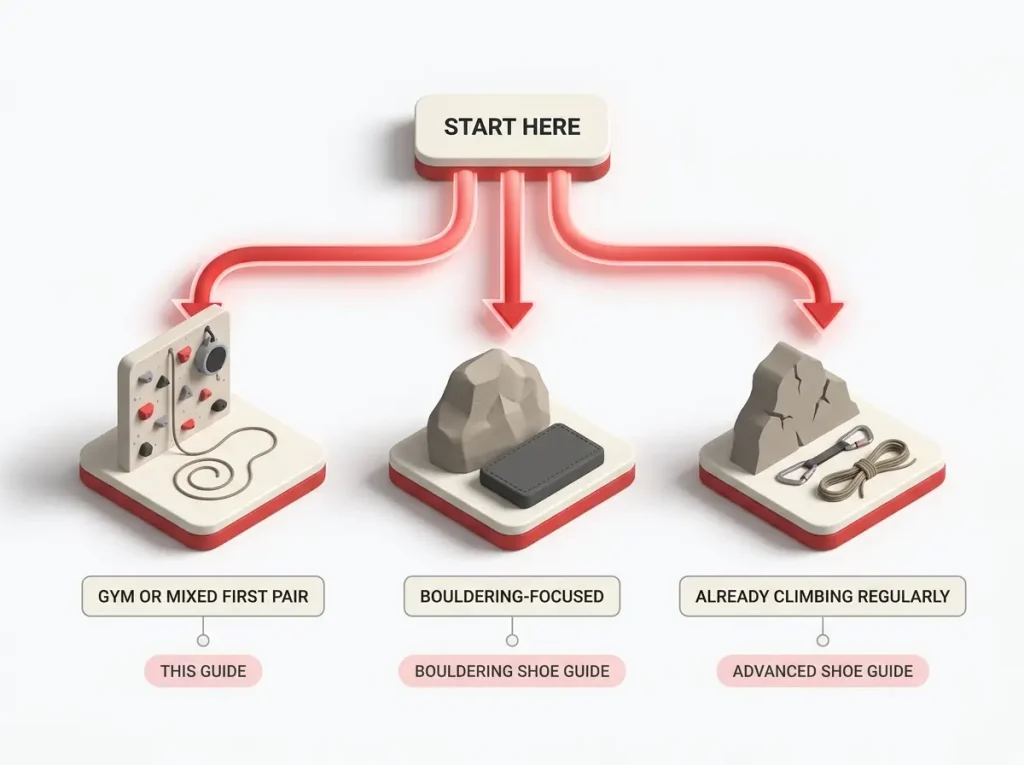
Before you spend a dime, one honest question: is this even the right list for you? A good climbing partner doesn’t hand everyone the same shoe. They ask what you actually climb first, because “beginner” isn’t one bucket, and the wrong starting point sends you to the wrong shoe.
This guide is for the person buying their first climbing shoes for general gym climbing, top-roping, the auto-belay, and the occasional outdoor day once you get curious. Comfort first, performance later. If that’s you, keep reading, because everything below is built around your feet and your first year, not somebody else’s grade.
If you’re specifically here for bouldering, that’s a slightly different conversation. Bouldering shoes tend to run softer and more sensitive for powerful, feet-cutting movement, and we cover that separately in our rundown of the best beginner bouldering shoes and the mistakes to skip. Go there instead if the boulder cave is where you live.
And if you already climb regularly and you’re hunting for your next, more technical shoe, maybe a dedicated sport climbing shoe for the local crag, you’ve outgrown this page. You want our full climbing-shoe buying guide for climbers past the first-pair stage, which sorts shoes by discipline and foot type rather than by “what’s forgiving on day one.” No sense re-reading beginner advice you already lived through.
One more bit of routing while we’re here. If you found this while trying to figure out whether you need a climbing shoe at all versus the grippy approach shoes you saw at the trailhead, those are different tools, and the distinction trips up a lot of first-timers. Climbing shoes are for vertical rock. Approach shoes get you to the base.
Here’s the one rule the rest of this article runs on: your first shoe’s job is to let you climb for two hours and still want to come back next week. Not to send you a grade harder on day one. Not to look hardcore on the shoe wall. Comfortable, supportive, forgiving. That’s the whole brief. The most common mistake new climbers make is buying the shoe a stronger gym friend wears, a shoe matched to someone else’s feet and someone else’s grade. Yours is a different job.
What Actually Makes a Climbing Shoe Beginner-Friendly
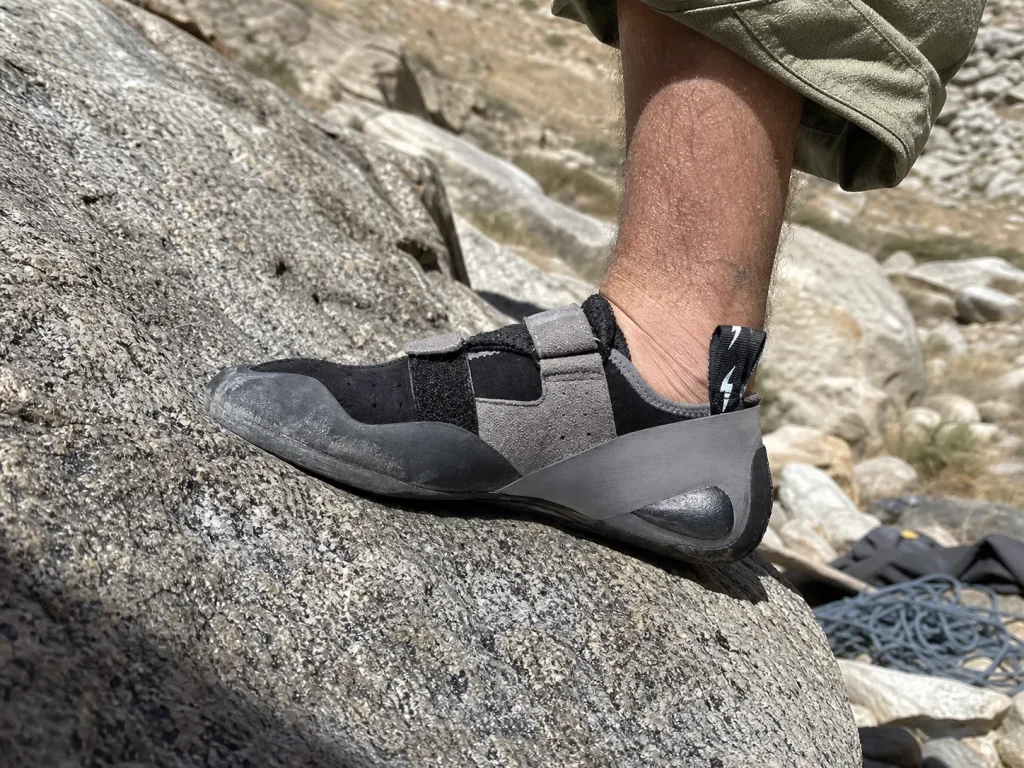
Walk up to the shoe wall and it’s a row of aggressive, banana-shaped shoes that look fast and technical. Ignore most of them for now. The flat, almost boring-looking ones are the right call while you’re learning, and it’s mechanics, not gatekeeping.
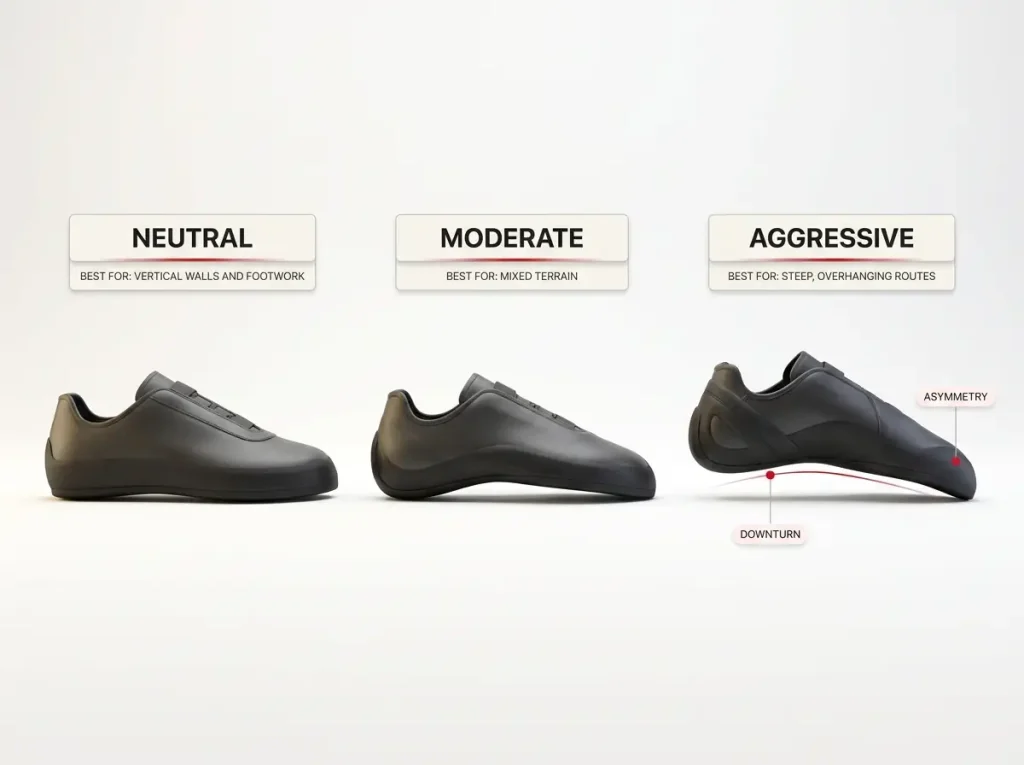
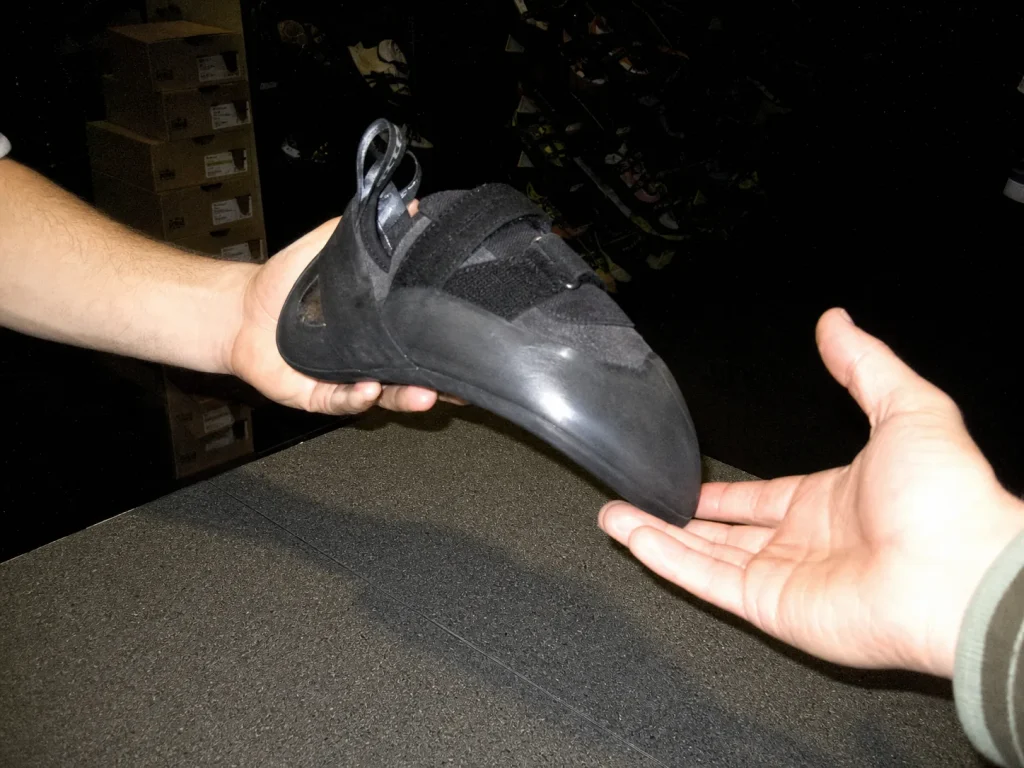
Climbing shoes come in three rough shapes. A neutral shoe sits flat, like a normal shoe, with a thicker midsole and a stiffer sole. A moderate shoe has a slight curve. An aggressive shoe has a pronounced downturn, that banana camber built to hook and pull on steep, overhanging terrain. The downturn is a real tool, but it’s a tool for a climber pulling on a roof, not for a beginner learning footwork on vertical walls and slabs. You won’t use it, and you’ll pay for having it in every minute of discomfort.
The flat shape isn’t a compromise you settle for. It’s physically built to be stood in all day. That stiffer sole spreads the load across your whole foot instead of concentrating it on your toes, which is exactly what keeps your feet from screaming after two hours of standing on tiny gym holds. The La Sportiva Finale gets cited constantly as a top beginner pick for precisely this reason: its 5mm sole is stiff enough to ease the foot fatigue that makes new climbers quit early.
Two words you’ll hear from day one. Smearing is pressing the flat rubber of your sole against the wall and trusting friction alone, no edge involved. Edging is standing on a small hold with the edge of the shoe. A stiff, flat beginner shoe smears and edges forgivingly, which matters when your footwork is still a work in progress. An aggressive shoe rewards precise feet you don’t have yet and punishes the imprecise feet you do.
So the filter is easy. For your first pair, buy neutral. When you eventually start projecting steep, overhanging routes and your feet get precise, you’ll know it, and there are clear signs you’re actually ready to graduate to an aggressive shoe. That day is further off than the shoe wall wants you to believe.
The Six First Pairs Worth Your Money
These are the shoes people actually start in, the names every honest list circles back to. No exotic performance shoes, no upsell. Everything here is neutral to moderate, forgiving, and priced so you’re not crushed when you wear through your first pair, and you will wear through it faster than you expect.
One thing before you scroll: you do not need all six. You need the one that fits your foot. Any single pair here will carry a beginner well past their first year of climbing. Pick by foot shape and closure preference, buy that one, go climb.
Best Overall — La Sportiva Finale
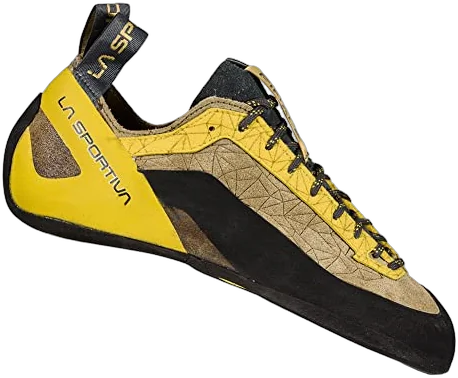
If you want one shoe that does everything a beginner needs and asks nothing complicated in return, this is it. The Finale is a flat, supportive, honest shoe that handles gym sessions and easy outdoor routes without drama. The leather upper will relax a bit as you break it in, so buy it snug. It comes in men’s and women’s lasts, and the difference between them matters more than the label, which we get into in the sizing section below.
Best Affordable — La Sportiva Tarantulace

The Tarantulace is the answer when the budget is tight and you still want a shoe that won’t hold you back. It’s the lace-up sibling to the velcro-heavy field, and the laces are the point: you can dial the fit finger by finger, snug over the toes and easier over a wide midfoot, then back it all off when your feet puff up two hours in. Durable rubber means it survives the toe-dragging habit every beginner has. This is the pair I’d point a cash-strapped new climber toward without a second thought.
Most Forgiving — Black Diamond Momentum

If your feet run wide, or you just want the least-fussy shoe on the list, the Momentum is the pick. The soft, slipper-like last conforms to the foot instead of forcing your foot to conform to it, so it forgives the odd bony spot that makes stiffer shoes miserable. That softness is why it works for so long: climbers report it staying comfortable and capable from their first easy routes well into the 5.11 range. The velcro straps make it painless to yank off between climbs, which you’ll want to do more than you think.
Best for Narrow Feet — Butora Endeavor
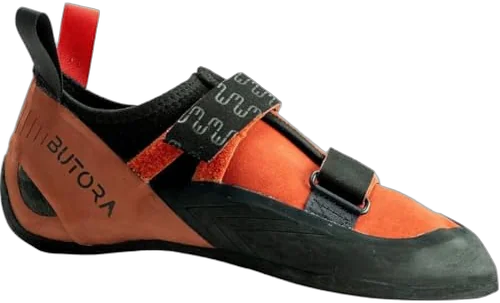
Narrow feet are the quiet problem nobody warns you about. Slip into a wide shoe and your heel lifts, your foot slides, and every foothold feels vague no matter how hard you try. The Endeavor is built on a low-volume last that actually cradles a slim foot, and Butora sells it in a Narrow fit for men and a Tight fit for women so you can match your foot instead of forcing it. The microsuede upper is comfortable straight out of the box, and the mild downturn gives you a bit of shape to grow into without the punishment of a full aggressive shoe.
Best Budget — Evolv Defy and Elektra
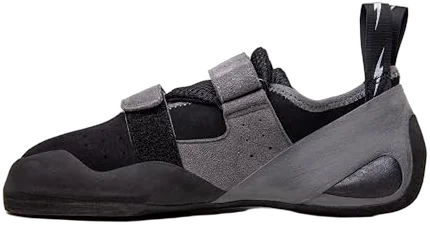
The Defy for men and the Elektra for women are the shoes to grab when you want to spend the least and still get something worth climbing in. They sit on a flat, low-asymmetry profile that’s easy on new feet, and because the upper is synthetic, it barely stretches, so the fit you feel in the box is close to the fit you’ll live with. That’s a real advantage for a first-timer buying online. It’s also the pick if you keep a vegan gear closet, since the synthetic build skips leather entirely.
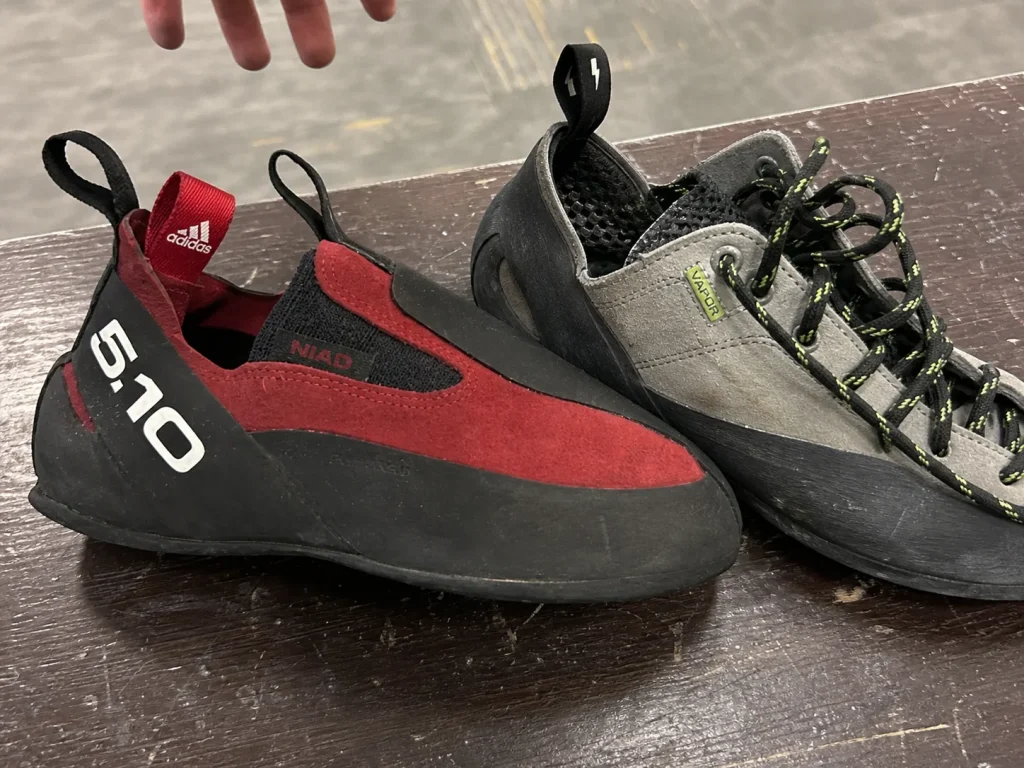
Best Slip-On — Five Ten Niad Moccasym
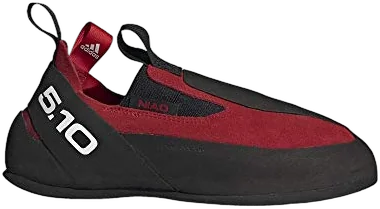
If closures annoy you, the Moccasym is the antidote. No laces, no straps, just an elastic slip-on you step into and forget. That simplicity hides a real trade-off worth knowing: a slip-on gives you the most sensitive feel of any shoe here, which some beginners love and some find like too much information too soon. The full-leather upper conforms to your foot as you climb, so it can start snug and settle into something molded to you. Buy it tight, because that leather will give.
Getting the Size Right Without Wrecking Your Feet
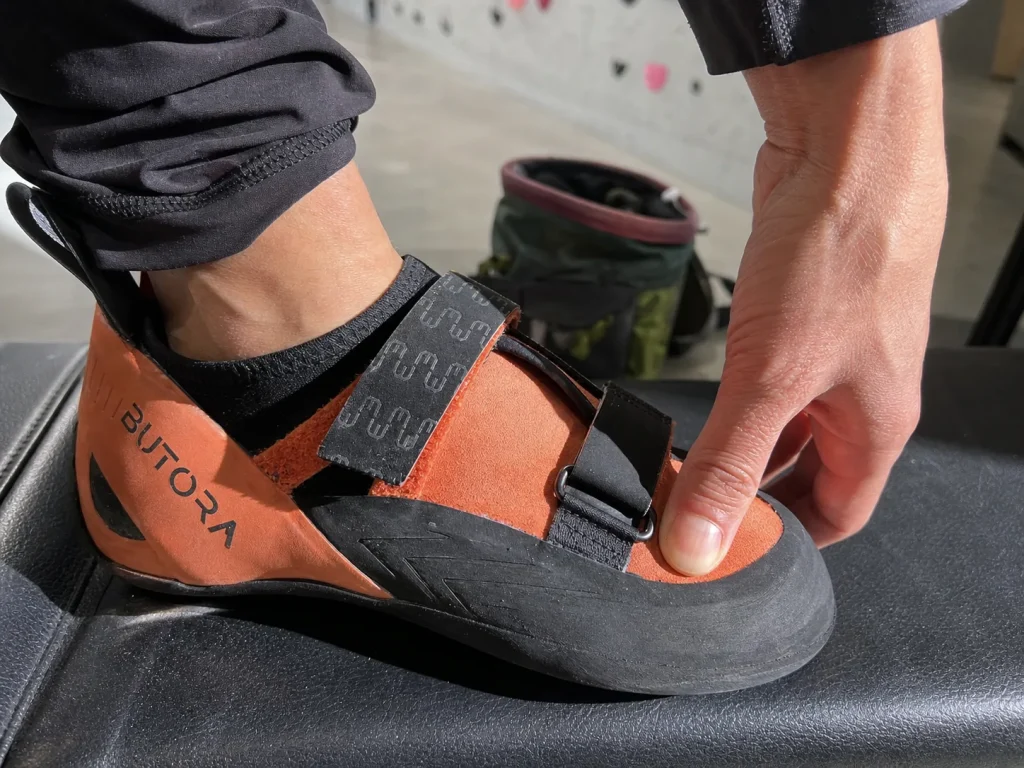
Here’s where most first pairs go wrong. Everyone repeats “size down” like gospel, a beginner takes it as far as it’ll go, and they walk out with a shoe they can’t stand in for ten minutes. The real version has a hard ceiling on the pain.
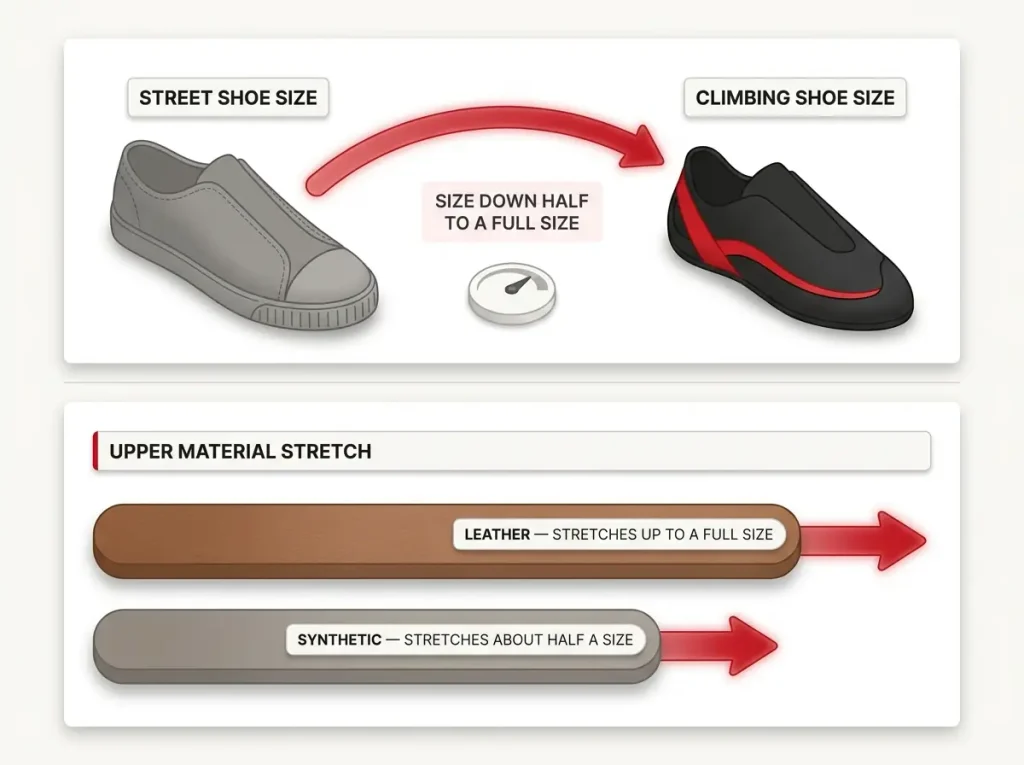
Start with a sane anchor: climbing shoes generally run a half to a full size down from your street shoe size, adjusted for the brand and the specific last. Your toes should reach the front of the toe box with a slight curl, snug all around with no dead space where your foot slides. That’s the target. Not agony, not a bag of air, just a shoe that moves when your foot moves.
Now the ceiling nobody prints, and it’s the important part. If you feel numbness, sharp pain, or you’re ripping the shoes off after one or two minutes, the shoe is wrong. Not “you’re not tough enough yet.” Wrong. The honest test is simple: if you can’t stand through one full route or boulder problem without needing them off your feet, size up. Tight has a real limit, and pushing past it doesn’t make you a better climber, it just makes you a climber who dreads putting the shoes on.
The single most useful sizing rule for a first-timer is about material, because leather and synthetic behave completely differently. An unlined leather upper can stretch up to a full size over its break-in period, so you buy it almost uncomfortably snug knowing it’ll relax into shape. A synthetic upper barely moves, maybe half a size at most, so what you feel in the store is close to what you’ll have in six months. Get this backward and you either end up with a leather shoe that’s now a boat, or a synthetic shoe that never stops hurting.
If you want the deeper version of all this, our full walk-through of how a climbing shoe should actually fit goes hold by hold through toe position, heel tension, and dead space. And once you own a leather pair that’s a touch too tight, you don’t have to suffer through it, because it will loosen as you break it in.
Try shoes on at the end of the day, not first thing in the morning. Your feet swell slightly as the day goes on, which puts them closer to how they’ll actually feel mid-climb once you’ve warmed up. A shoe that fits perfectly at 8 a.m. can turn brutal by your evening session.
Men’s vs Women’s Lasts, and Why the Difference Is Real
The men’s and women’s split isn’t marketing, and it isn’t about color. A women’s last generally runs a narrower heel and a lower instep volume, because that’s the more common foot shape difference, and every pick above comes as a gendered pair for exactly this reason. But the label is a starting point, not a rule. Match the last to your foot, not your ID. A narrow-footed man often fits a women’s last better, and a higher-volume woman may find the men’s version cradles her foot without pressure points.
This is also where the wrong hand at the counter does quiet damage. A guy with slim feet gets handed the men’s shoe by default, ends up with his heel swimming, and spends months blaming himself for footwork that’s really a fit problem. If your heel lifts or your foot slides no matter how tight you crank the closure, the volume is wrong, and switching lasts fixes what no amount of cinching will. Our deeper breakdown of women’s climbing-shoe fit digs into heel volume and foot shape if that’s the puzzle you’re solving.
Velcro, Laces, or Slip-On, and What the Upper Is Made Of
Two spec choices actually face you at the shelf, and both feel bigger than they are. Let’s cut them down to what matters for you day to day.
Closure first. Velcro straps are fast on and fast off, which is genuinely nice in the gym where you’re pulling your shoes off between every couple of climbs. Laces give you the finest fit tuning across the whole foot, which pays off if your feet are an odd shape or you want snug toes over a wider midfoot. A slip-on has zero hardware and the least adjustability, trading control for pure simplicity and sensitivity. None of these is better than the others. It’s about your feet and how often you take the shoes off, and the honest answer for most beginners is that velcro’s convenience wins in the gym while laces win for tricky-shaped feet. If you want to go deeper, the full laces-versus-velcro breakdown weighs both in detail.
The upper material is the choice that actually changes how you size, and it’s the same leather-versus-synthetic split from the sizing section. Leather stretches and molds to your foot over weeks. Synthetic and microfiber hold their shape and barely budge. Neither is superior, but you buy them at different tightness, so know which you’re holding before you commit to a size.
Then there’s rubber, and here’s the anti-hype truth: for a beginner, the rubber compound matters far less than the fit. Shops love to talk sticky rubber and name-drop Vibram, and yes, softer stickier rubber grips better and wears faster while firmer rubber lasts longer and edges better. But a well-fitting shoe with average rubber will always beat a poorly-fitting shoe with premium rubber, so don’t let a spec sheet drive your first purchase. If you’re curious how the compounds actually differ, our climbing-shoe rubber guide covers the why behind the sticky-rubber claims. Just don’t let it override fit.
One field detail worth knowing so you’re not surprised: the toe rubber and the rand wear fastest right where beginners drag their toes up the wall reaching for the next foothold. It’s a habit you’ll break as your footwork sharpens, but it’s the reason your first pair seems to wear out “too soon.” That’s not a defect. That’s the shoe recording your learning curve.
When to Stop Renting and Actually Buy
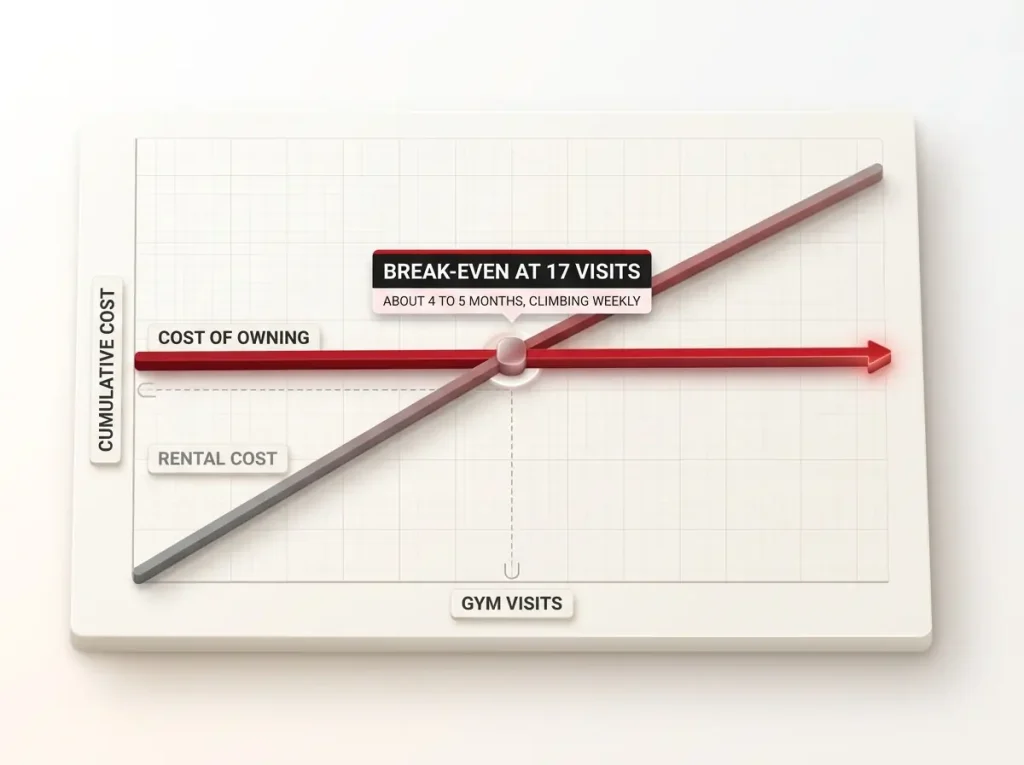
Everybody writes the list of best beginner shoes and nobody answers the question sitting underneath it: am I even ready to buy? Here’s the actual number.
Owning starts beating renting at roughly 17 gym visits. That’s the break-even point where the money you’d sink into rental fees would have bought your own pair, and you can see the full math in our gym membership and cost break-even guide. Climb about once a week and you cross that line in under four to five months. So if you’ve been at it steadily for a season and you’re still renting, you’re now paying extra for worse shoes.
Your own shoes are usually the first real gear a new climber buys, right alongside a chalk bag, and they pay you back every session. You don’t have to take our number on faith, either. Butora, a company that literally sells first-pair shoes, tells its own customers the same thing: once you’re climbing weekly and taking it seriously, it’s time to stop renting. The trigger is climbing regularly, not climbing well. Waiting until you’re “good enough” to deserve your own shoes gets it exactly backward.
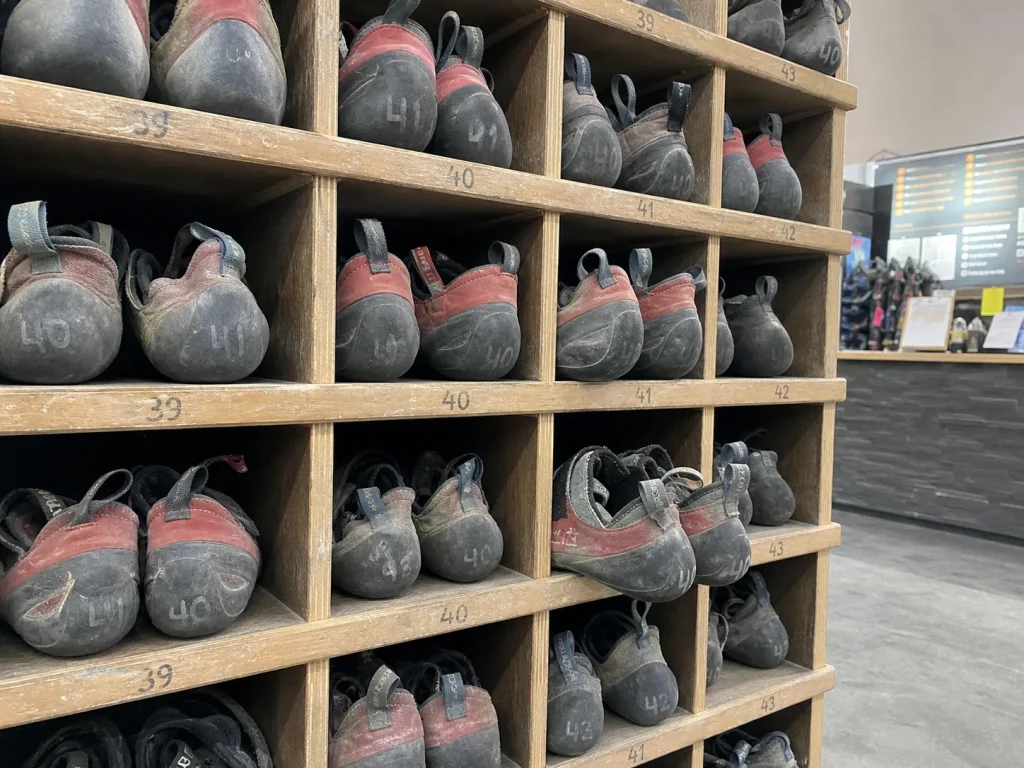
Because here’s the hidden cost of waiting that nobody mentions. Rental shoes are stretched out from a hundred other feet, worn smooth on the rubber, and shaped like nobody’s foot in particular. Every session in them is a session practicing imprecise footwork on equipment that can’t transmit what your feet are doing. Buying your own pair sooner isn’t only a comfort upgrade, it’s a technique decision. Precise shoes teach precise feet.
The moment your own shoes stop feeling like a luxury and start feeling like yours is usually the same moment your footwork clicks. It’s not a coincidence. When you can finally feel the hold through the rubber instead of guessing, your feet get honest fast.
There’s also a third option nobody frames for beginners: buying used. A gently-used first pair is real money saved, as long as you check the wear on the rubber, look for delamination where the sole meets the upper, and confirm they weren’t climbed into the ground. Our guide on how to buy used climbing gear without getting burned walks through what to inspect so a bargain doesn’t turn into a dud.
The Shop-Employee Trap
Now the part that costs more beginners than any spec ever will, and it happens at the counter with a smile.
Picture the friend who walks into the gym pro shop genuinely excited to buy their first pair. A staffer, someone who climbs hard and fits intermediate and advanced customers all day, sizes them up and hands over an aggressive, downturned shoe cranked painfully tight, because that’s a good shoe and that’s how a serious climber wears it. Our beginner nods, buys it, and can’t stand in it for ten minutes. Their feet hurt every session. And a month later they’ve quietly stopped coming to the gym, blaming climbing when the real culprit was a shoe built for someone they aren’t yet.
There’s no villain here, which is what makes it so common. Gym and shop staff usually climb well, and “as tight as you can stand it” is normal, correct advice for them. It’s just wrong for you. They’re fitting the climber they see in the mirror, not the one standing at the counter with six sessions of experience and feet that still need to be talked into liking this sport.
The counter-move is to walk in already knowing your one rule. Comfort first. Neutral profile. And the stand-in-it test: if you can’t wear the shoe through a full route without pain, it’s not the shoe for your first pair, no matter how good it is for the person selling it. Say that out loud and it’s easy to politely turn down the upsell. Any of the six shoes above passes the walk-in test. The high-performance shoe they’re reaching for does not, at least not for a while.
Name the mistake before you make it and it loses its power. You are not buying a shoe to prove you’re serious. You’re buying a shoe to keep climbing long enough to get good, and pain on day one is the fastest way to quit before that happens.
What Too-Tight Shoes Do to Your Feet Over the Years
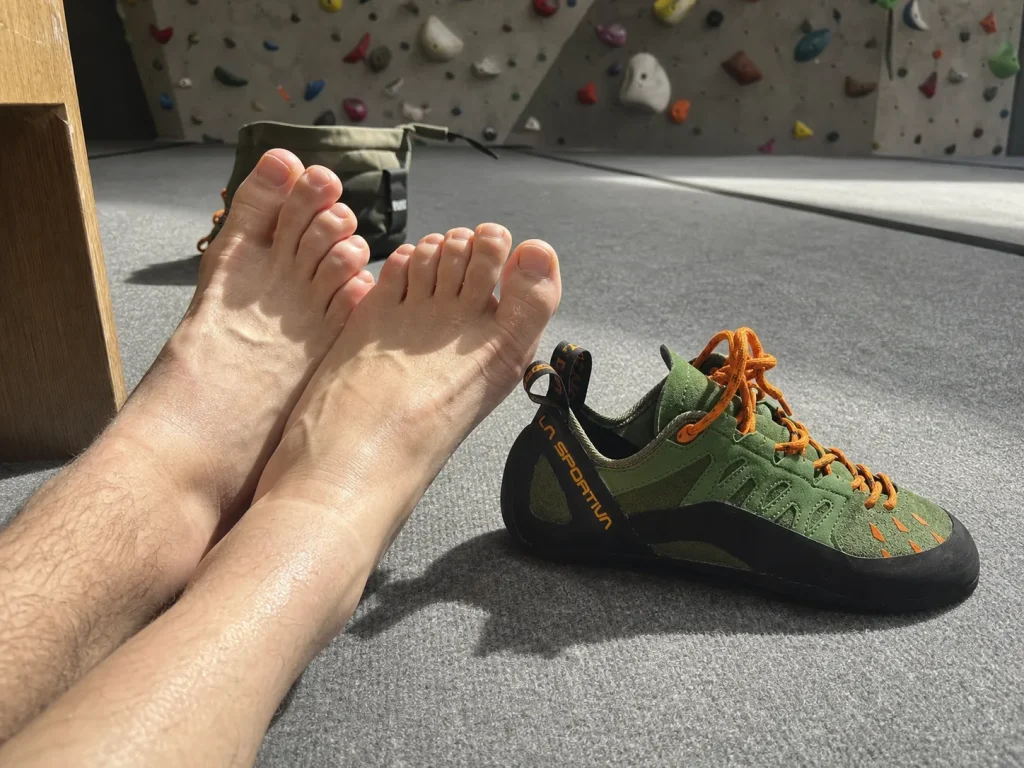
Nobody selling you shoes brings this up, so we will. It’s the unglamorous long game, and it belongs in an honest guide.
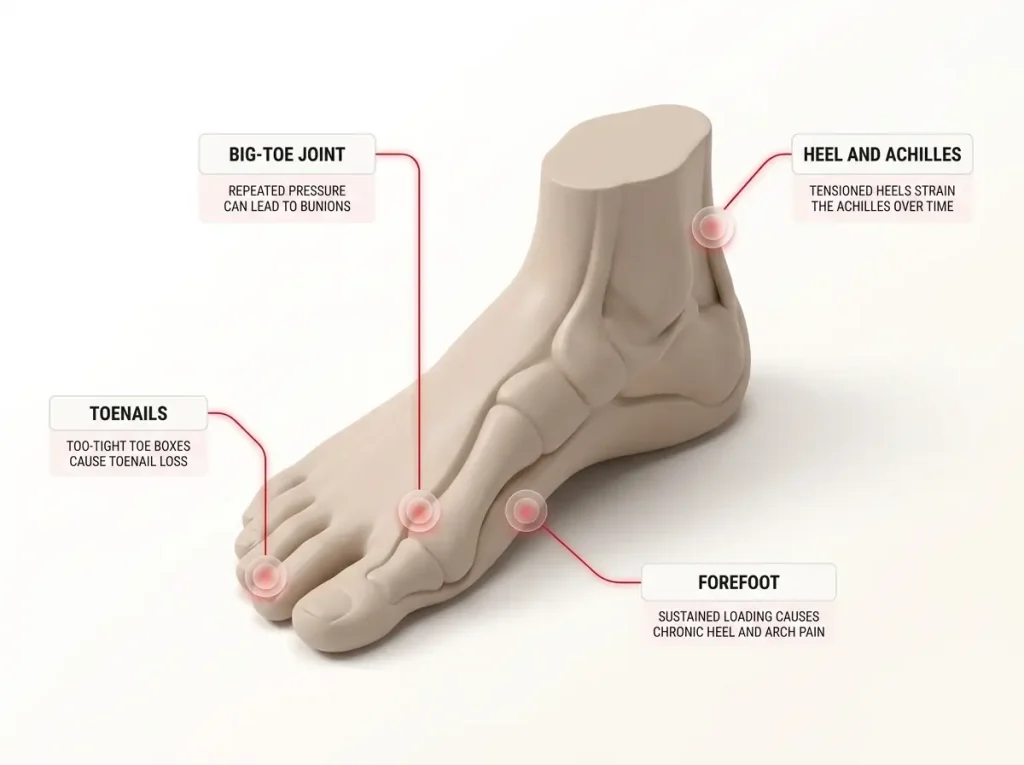
The research here isn’t a scare tactic, it’s data. A peer-reviewed epidemiological study of foot injuries in sport climbers found that climbers with five or more years of experience show markedly elevated rates of hallux valgus, the bunion where the big-toe joint pushes outward, compared to the general population. The same research also documents Achilles tendinopathy, Haglund’s deformity, plantar heel pain, and chronic ankle instability, much of it tied to years in climbing footwear. And the habit driving it is measurable: a peer-reviewed review of footwear practice in rock climbing found climbers on average accept shoes nearly four UK sizes down from their street shoes. Sizing way down isn’t internet lore. It’s a documented practice with a documented bill.
The mechanism is exactly what it sounds like. Cram your feet into shoes a size or more too small, wear them too long per session, do it for years, and the damage stacks up past the everyday blisters every beginner expects: toenail loss, hammertoes, and bunions become the quiet regulars at every climbing gym. Aggressive downturned shoes worn too early make it worse, because they force the toes into a curled, loaded position that a flat shoe doesn’t.
Here’s the honest takeaway, and it’s the anti-sell heart of this whole guide: you do not need pain to climb well as a beginner. Snug and comfortable beats brutal and tight every single time at this stage. Save the aggressive, toes-curled fit for the specific day a specific hard route actually demands it, and that day is a long way off. Your feet have to last as long as your stoke does.
Take your shoes off between climbs and don’t walk around the gym in them. It sounds obvious, but the climbers with the worst foot problems are usually the ones who lace up once and leave them on for two hours. Size for a full session, not a two-minute try-on, and give your toes air between burns.
The 15-year climber who finally connects chronic bunion pain to a decade of too-small shoes almost always says the same thing: they never questioned it, because “that’s just what climbing shoes feel like.” It doesn’t have to be. Start with a shoe that fits like a shoe, and your feet will thank you longer than any grade will.
Conclusion
Your first pair of climbing shoes has one job, and it isn’t to impress anyone. Buy neutral, buy comfortable, and buy one of the six shoes above, because the right first shoe keeps you coming back, not sends you a grade harder on day one. Size snug with a hard ceiling on pain, and remember that leather stretches while synthetic holds its shape. And ignore the day-one upsell, the aggressive shoe, the tight-as-you-can-stand advice, and the whole idea that pain equals progress.
Next gym session, run the two-hour test on whatever you’re leaning toward. Lace up, climb a full session, and notice whether you spend it thinking about your feet or about the next hold. The right first pair is the one you forget you’re wearing. Find that, and you’ve got everything a beginner shoe needs to do.
Frequently Asked Questions
01Should beginner climbing shoes be tight or loose?
Snug, not painful. Your toes should touch the front with a slight curl and there should be no dead space, but numbness or sharp pain means the shoe is wrong, not that you are being tough. If you cannot stand through one full route without ripping them off, size up.
02What is a good first climbing shoe to buy?
A neutral, flat-profile shoe like the La Sportiva Finale or Tarantulace, the Black Diamond Momentum, or the Evolv Defy and Elektra. All are forgiving, affordable, and built to be stood in for hours while you learn. Skip anything aggressive or downturned for now.
03How much should you spend on your first pair of climbing shoes?
Less than the shop wants you to. A good beginner pair sits at the budget-to-mid tier, and any of the six picks here will carry you well past your first year. You will wear through your first pair faster than expected, so a high-performance shoe on day one is wasted money.
04Are aggressive or downturned shoes bad for beginners?
For a first pair, yes. Downturned shoes are built for steep, overhanging terrain a beginner is not climbing yet, they are less comfortable to stand in while learning footwork, and worn too early or too tight they contribute to long-term foot problems. Start neutral and graduate later.
05When should I stop renting and buy my own climbing shoes?
Roughly at 17 gym visits, which is under four to five months if you climb weekly, because that is where owning gets cheaper than renting. Climbing regularly is the trigger, not being good yet. Worn rental shoes also hold back your footwork, so your own pair helps sooner.
Safety Notice: Rock climbing and mountaineering are inherently high-risk
activities that can involve physical trauma or fatal incidents. The information on Rock Climbing Realms is for
educational and informational purposes only. Techniques and advice presented here are not a substitute
for professional, hands-on instruction. Conditions and risks vary by location. Always seek guidance
from a qualified instructor before attempting new techniques. By using this website, you agree that you
are solely responsible for your own safety. Any reliance you place on this information is strictly
at your own risk, and you assume all liability for your actions. Rock Climbing Realms and its authors
will not be held liable for any harm, damage, or loss sustained in connection with the use of this information.
Affiliate Disclosure: We are a participant in the Amazon Services LLC Associates Program, an
affiliate advertising program designed to provide a means for us to earn advertising fees by advertising and linking
to Amazon.com. As an Amazon Associate, we earn from qualifying purchases. We are also an official affiliate partner
of Black Diamond Equipment via the AvantLink network. If you click on a Black Diamond affiliate link and make a
purchase, we may earn a commission at no additional cost to you. We also participate in other affiliate programs.
Additional terms are found in the terms of service.