
In this article
You are ten feet above your last piece of protection. Your forearms are pumping. Suddenly, your foot slips. Gravity takes over instantly.
In that split second, you aren’t thinking about safety standards or laboratory testing. You are relying entirely on a silent promise woven into your nylon rope and forged into your metal gear.
This safety assurance is visualized by the UIAA Safety Label. It is a strict benchmark for life safety equipment that separates survival from catastrophe.
As a climbing guide, I have seen gear pushed to its absolute limit. I have also seen the confusion in students’ eyes when they try to read the tiny, cryptic stamps on their carabiners. It looks like a secret code, but it is actually the data that keeps you alive.
We are going to strip away the confusion. We will move past the confusing acronyms and look at how to read these labels. This is how you understand your safety margin in technical rock climbing and mountaineering.
The Rules: Who Defines “Safe”?

What is the real difference between mandatory CE and voluntary UIAA certifications?
The main difference is simple. The CE mark is a mandatory standard to sell gear in Europe. The UIAA label is a voluntary standard created by climbers that often demands much higher quality.
When you pick up a piece of gear, you will almost always see the CE Mark (Conformité Européenne). Think of this like a passport. It means the equipment meets the minimum European Norms (like EN 892 for ropes or EN 12277 for harnesses) set by the European Committee for Standardization (CEN). Without this mark, a manufacturer cannot legally put their gear in stores. It sets the baseline for quality control.
However, legal compliance isn’t always the same as maximum safety. This is where the UIAA Safety Label comes in.
This standard is managed by the International Climbing and Mountaineering Federation (UIAA). Specifically, the UIAA Safety Commission writes these rules. They are climbers, guides, and engineers. While they work with the legal laws, the UIAA often pushes for stricter safety specs based on real accidents.
For example, the global standards for climbing and mountaineering equipment set by the UIAA have very strict rules about rust and corrosion. These rules go far beyond what the government requires. When you see the UIAA logo, you are looking at gear that has passed a test designed to help you survive a worst-case scenario. Understanding this is the first step in reading climbing rope labels effectively.
Dynamic Ropes (UIAA 101): The Physics of Survival

How does the “Fall Factor 1.77” test guarantee safety in real-world falls?
The “Fall Factor 1.77” test guarantees safety by being brutal. Under UIAA 101 (and EN 892), the lab subjects the rope to a “guillotine” scenario that is far worse than a normal sport climbing fall. If the rope survives the lab, it will easily survive the crag.
The test is simple but harsh. They drop an 80kg (176 lbs) weight from about 16 feet high onto just 9 feet of rope.
Crucially, the rope runs over a sharp edge test apparatus. This simulates a carabiner digging into the rope. To earn the label, single ropes must hold 5 of these falls in a row without snapping.

In the wild, you will rarely experience a fall factor this high. A typical fall at the gym or crag generates much less energy.
The “fall rating” on the packaging might say “6 falls.” This is not a countdown. It doesn’t mean your rope will snap on the seventh fall. It is just a measure of durability and sheath slippage resistance. When you browse a comprehensive climbing rope guide, you can trust that a higher fall count means a longer life for your rope, whether you use single ropes, half ropes, or twin ropes.
Pro-Tip: Rotate which end of the rope you tie into every time you climb. This spreads out the wear and tear from falling and hanging, keeping your rope stretchy and safe for longer.
What does the 12kN Impact Force limit mean for your body and gear?
The 12kN limit acts as a “fuse.” It ensures the shock of a fall doesn’t hurt your body or break your protection points.
Impact Force is the shock you feel when the rope catches you. The UIAA says a single rope cannot create more than 12 kilonewtons (kN) of force. They chose this number because military studies showed that 12 kN is roughly the most force a human body can take before internal organs get hurt.
A rope with a lower rating (like 7.8 kN) has higher dynamic elongation. This gives you a “soft catch.” This is vital for your comfort, but also for your gear. If a rope stopped you too instantly (like static ropes used for rope access), it could rip gear out of the rock. By stretching, the rope protects the hardware.
But there is a trade-off. Ropes that are very soft stretch a lot. They can stretch up to 40% of their length in a fall. If you are climbing low to the ground, that stretch could make you hit the floor.
You have to balance comfort with safety. This is also why having belay devices decoded is important. A good device works with the rope to soften the fall.
American Alpine Club accident reports frequently show that “ground falls due to rope stretch” happen. Remember that a soft catch is great, but you need to watch your distance from the ground.
Is “Water Repellent” just marketing, or does the UIAA test actually prove it?
The UIAA Water Repellent standard is real science. It proves a rope absorbs less than 5% of its weight in water. This is very different from old marketing terms like “dry treated.”
Years ago, companies would just spray a coating on a rope and call it “Super Dry.” There was no test to prove it worked. The UIAA water repellent rope standard changed that.
In this standard test, they rub the rope against a rough surface and then soak it for 15 minutes. To pass, the rope must barely drink any water. Untreated ropes can soak up half their weight in water.
This matters because a wet rope is dangerous. Water acts like a lubricant inside the rope. It makes the fibers slip, which makes the rope weaker. Also, if it freezes, a wet rope turns into a stiff cable. You can’t tie knots or use your belay device.
If you climb ice or mountains, look for the UIAA standard logo. It is mandatory for climber safety. If you only climb in the summer sun, knowing the difference helps you decide between a dry vs non-dry climbing rope. You might save money by skipping the treatment if you don’t need it.
Hardware & Anchors (UIAA 121 & 123): The Silent Failures

Why is “Stress Corrosion Cracking” the new Silent Hazard for rock anchors?
Stress Corrosion Cracking (SCC) is an invisible rot. It attacks stainless steel near the ocean, causing bolts to snap suddenly.
For a long time, we thought if a bolt wasn’t rusty (general corrosion), it was safe. We were wrong. In seaside areas, salt and chemicals attack the inside of standard stainless steel. The bolt might look shiny and new on the outside, but inside, it is full of tiny cracks.

The UIAA updated UIAA 123 (Rock Anchors) to fix this. The comprehensive report on anchor corrosion failures shows that normal “marine grade” steel isn’t good enough anymore. They now define specific corrosion resistance classes.
For sea cliffs, Titanium is now the recommendation for high corrosion resistance. As a climber, be careful clipping protection in tropical beach areas unless you know they have been updated. This applies to your own gear too. Inspecting your anchor chain and personal anchor systems (PAS) for signs of environmental wear is just as important as checking the bolts.
The Retirement Matrix: When Is Safe Too Old?

How do you translate “shelf life” and “usage intensity” into a retirement date?
Retirement comes down to two things: time and use. Life safety equipment has a strict 10-year limit, even if you never use it. Active gear wears out much faster.
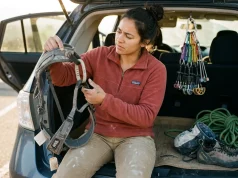
Every piece of soft gear (ropes, harnesses, slings) expires after 10 years. Even if a Type C harness (standard sit harness) has been sitting in a dark closet with the tags still on, throw it away after a decade. Materials like Nylon, Dyneema, and Dynex degrade over time. They get brittle and lose their strength.
You cannot see this damage with your eyes. It happens chemically. The structural degradation of climbing harnesses is a real danger. If the calendar says 10 years, retire it.
| Climbing Gear Lifespan Estimates | |||
|---|---|---|---|
| Frequency of Use | Intensity Description | Rope Lifespan Estimate | Harness Lifespan Estimate |
| Daily / Intensive | Guides, Instructors, Dirtbags. Frequent loading, abrasion, UV exposure. | 6 months – 1 year | 1 – 2 years |
| Weekly | Weekend Warriors. Consistent use, occasional falls. | 2 – 3 years | 3 – 5 years |
| Occasional | Once per month. Seasonal climbers. | 4 – 5 years | 5 – 7 years |
| Rare | 1-2 times per year. Mostly storage. | Up to 7 years | Up to 7 years |
| Storage Only | Never used. Stored in cool, dark, dry place. | 10 years (Max) | 10 years (Max) |
If you use your gear, it dies sooner based on real-world longevity. Here is a simple guide:
- Daily Use (Guides/Dirtbags): 6 months to 1 year.
- Weekend Warriors: 2 to 3 years.
- Occasional Use: 5 to 7 years.
Stop guessing by looking at it. Use these retirement schedules to make safe decisions. Many climbers use a climbing gear lifespan tracker to write down when they bought their gear.
Pro-Tip: Use a sharpie or colored tape to write the year of purchase on your slings or harness tags. Don’t rely on your memory to know if that gear is three years old or six.
Final Thoughts
The UIAA Safety Label is more than a logo. It represents decades of science and testing in facilities like the Black Diamond QC lab or UIAA accredited centers. It ensures your rope can handle forces you hope never to create. It makes sure the shock of a fall doesn’t hurt your insides. It identifies the only metals that can survive the sea.
But the final link in the safety chain is you. A certified rope cannot save you if it is 15 years old. A Titanium bolt cannot hold you if you don’t clip it.
Take ten minutes today. Open your gear closet. Check the dates on your harness and rope. Compare them to the retirement matrix above. If in doubt, retire it. The mountain will be there tomorrow, but only if your gear works.
FAQ – Frequently Asked Questions
What is the main difference between CE and UIAA standards?
CE is a legal rule required to sell gear in Europe. UIAA is a voluntary standard created by climbers that often requires better safety performance and tougher testing.
Will a rope rated for 5 falls break on the 6th fall?
No. The 5-fall rating is for massive, worst-case laboratory falls. In normal climbing, a rated rope can handle hundreds of small falls over its life.
Is marine grade stainless steel safe for sea cliffs?
Not always. New research shows standard stainless steel can crack internally due to stress corrosion near the ocean. For seaside climbing, Titanium anchors are the only truly safe option.
When should I strictly retire my climbing harness?
Retire it immediately if it looks worn out or has a red core showing. Otherwise, retire it after 10 years, even if it looks new. If you use it every week, replace it every 3 to 5 years.
Safety Notice: Rock climbing and mountaineering are inherently high-risk
activities that can involve physical trauma or fatal incidents. The information on Rock Climbing Realms is for
educational and informational purposes only. Techniques and advice presented here are not a substitute
for professional, hands-on instruction. Conditions and risks vary by location. Always seek guidance
from a qualified instructor before attempting new techniques. By using this website, you agree that you
are solely responsible for your own safety. Any reliance you place on this information is strictly
at your own risk, and you assume all liability for your actions. Rock Climbing Realms and its authors
will not be held liable for any harm, damage, or loss sustained in connection with the use of this information.
Affiliate Disclosure: We are a participant in the Amazon Services LLC Associates Program, an
affiliate advertising program designed to provide a means for us to earn advertising fees by advertising and linking
to Amazon.com. As an Amazon Associate, we earn from qualifying purchases. We are also an official affiliate partner
of Black Diamond Equipment via the AvantLink network. If you click on a Black Diamond affiliate link and make a
purchase, we may earn a commission at no additional cost to you. We also participate in other affiliate programs.
Additional terms are found in the terms of service.