In this article
You’re three moves from the top when you hear it—a sharp pop from your ring finger. The pain hits fast, but the panic hits harder. Do you finish the route? Test it with a crimp? Drive to the ER, or just tape it up and hope for the best?
I’ve been climbing for over fifteen years, and I’ve watched dozens of partners make this exact choice wrong. The climbers who panic, who try to “test” the finger, who convince themselves it’s just a tweak—they’re the ones sidelined for months. The ones who act decisively in the first 48 hours? They’re back on the wall in weeks.
Here’s exactly what you need to do—from the moment you feel that pop to the point where organized healing begins.
⚡ Quick Answer: Stop climbing immediately. Apply buddy tape or a rigid splint to protect the injured finger. Avoid ice and NSAIDs for the first 48-72 hours—they interfere with the natural inflammatory response your body needs for healing. Elevate your hand, avoid testing the finger, and see a specialist with ultrasound capability if you heard an audible pop or suspect a complete rupture.
The Anatomy of the Pop: Understanding What Just Broke

That sound you heard was elastic potential energy releasing as pulley fibers tore. The A2 pulley at the base of your finger and the A4 pulley at the middle phalanx are the most vulnerable structures when you crimp.
Here’s the thing most climbers don’t realize: when you crimp, the load on your A2 pulley can hit three to four times the force at your fingertip. A shock load from a slipping foot can exceed the pulley’s breaking point in an instant.
The crimp grip—PIP joint flexed around 90 degrees, DIP joint hyperextended—creates massive bowstringing force directed away from the bone. That 50-pound hold you’re pulling on? Your pulley is absorbing 150 to 200 pounds of tension. Failure usually starts at the rim of the pulley and rips outward.
Grading the Damage
The Schöffl grading system tells you what you’re dealing with and how long you’ll be out:
Grade I strain means microscopic tearing. Your finger hurts when you crimp, but there’s no bowstringing and full range of motion. Conservative treatment with tape and active rest gets you back in two to four weeks.
Grade II partial rupture involves complete tearing of the A4 or partial A2/A3. You might’ve heard a pop. Localized swelling is common. This needs ten days of strict immobilization and four to six weeks off climbing.
Grade III complete A2 rupture is the one that scares people. Audible pop, loss of crimp strength, and you can feel or see the flexor tendon bowstringing away from the bone. You’re looking at three to four months before full loading.
Grade IV multiple pulley ruptures means surgery and a four-to-six-month timeline.
Pro tip: Swelling in the first 24 hours can physically mask bowstringing, making self-diagnosis unreliable. Assume the worst and protect accordingly.
Understanding proper hangboard training protocols can help prevent pulley injuries by building tendon resilience gradually.
The Golden Hour: Immediate Response
The single most damaging mistake you can make right now is the “test.” That urge to try one more crimp, just to see how bad it is—it’s how Grade I sprains become surgical Grade III ruptures.
A pulley injury that involves microscopic tearing can propagate into a complete rupture within seconds under load. I’ve watched it happen. A climber feels a pop, swears it’s minor, and attempts one more move. Then comes the second pop. The session goes from a minor setback to a four-month nightmare.
The moment you feel pain in the volar aspect of your finger—the palm side—the session is over. No exceptions. No “let me just finish this problem.” Pack up.
Field Triage
You don’t need an MRI to get a rough sense of what’s wrong. Start with these questions:
Did you hear an audible pop? If yes, assume Grade III or IV until imaging says otherwise.
Can you see visible bowstringing? Gently flex your fingers and look at the base—if the tendon visually protrudes away from the bone, you have a complete rupture.
Is there a mechanical block when you try to make a fist? Don’t force it. If motion feels jammed or produces sharp localized pain, something structural is damaged.
The psychological piece here matters more than most climbers admit. Denial runs deep in our community. “It’s just a tweak” is the most dangerous phrase in climbing. Telling your partner or belayer immediately helps break out of the performance mindset. This kind of psychological first aid shifts your brain from “how do I finish this route” to “how do I protect this finger.”
For strategies on managing the mental challenges of injury, see our guide on mental training for climbing and this external resource on managing mindset and mental health when injured.
Protection and Immobilization: The First 24 Hours
Protection is the most important thing you can do right now. The “P” in PEACE stands for exactly that. Your job for the next 24 to 48 hours is complete unloading.
Athletic tape alone won’t cut it for anything beyond a mild Grade I. Research shows the H-taping technique reduces tendon-bone distance by around 16 percent, but tape stretches within minutes and loses compressive pressure. It’s a proprioceptive reminder—a signal to your brain that says “don’t use this finger”—not a structural support.
For Grade II and above, you need a pulley protection splint. A rigid thermoplastic ring or commercially available PPS presses the tendon against the phalanx, maintaining the anatomical relationship essential for the pulley to heal at the correct length.
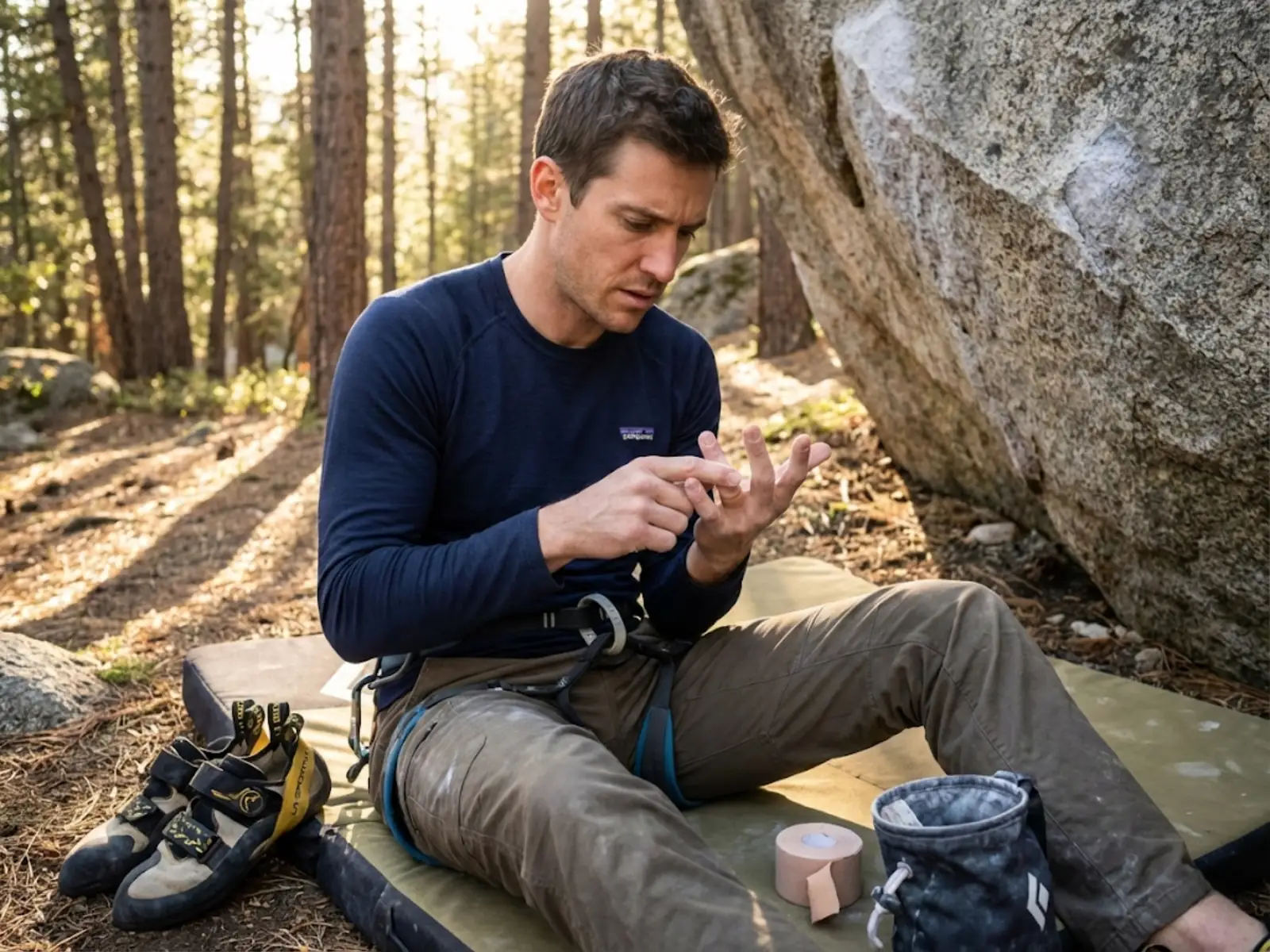
If you don’t have access to a splint immediately, buddy tape the injured finger to an adjacent digit. Ring to middle works well. This prevents lateral stress and restricts independent movement until you can get proper protection.
Pro tip: Wear the splint or buddy tape 24/7, including during sleep. Unconscious movements—rolling over, curling your hand under a pillow—can apply significant torque to the healing structure.
For broader context on managing climbing injuries in remote settings, our wilderness first aid for climbers guide covers field triage protocols.
Managing Inflammation: The PEACE & LOVE Protocol
Forget the old RICE protocol. The current evidence points to PEACE & LOVE, which respects the biology of tissue recovery.
Here’s what most climbers get wrong: the inflammatory response isn’t an error. It’s the first stage of healing. Your body is releasing growth factors like TGF-beta and IGF-1 that signal collagen remodeling. Shutting that down with aggressive cryotherapy or NSAIDs can actually slow your recovery.
Ice and Anti-Inflammatories: Handle With Care
Ice causes vasoconstriction. That limits blood flow and reduces delivery of the macrophages and growth factors you need for soft tissue injury repair. If you’re going to ice, use it only for pain management—ten minutes maximum—and only if the pain is preventing sleep.
NSAIDs like ibuprofen inhibit COX enzymes, which sounds technical, but here’s the practical takeaway: those enzymes produce prostaglandins, and prostaglandins are essential for tendon remodeling. Studies show that NSAID use in the acute phase leads to weaker long-term tissue strength.
If you need pain relief, reach for acetaminophen. It acts centrally on pain perception without disrupting local healing.
What Actually Helps
Elevation above heart level facilitates venous return and reduces throbbing. Prop your hand on a pillow while sitting or sleeping.
Gentle compression can help manage swelling, but don’t wrap it tight enough to cut off circulation. And if you want more details on the science behind this approach, the PEACE and LOVE protocol for acute soft tissue injuries breaks it all down.
Nutritional Support: The Collagen Synthesis Window
Connective tissue healing depends on collagen type I synthesis. The rate-limiting factors are glycine, proline, and vitamin C. You probably have enough of these in a normal diet, but during the acute phase, targeted supplementation can make a measurable difference.
Research by Dr. Keith Baar shows that 15 grams of hydrolyzed collagen peptides combined with 50 milligrams of vitamin C can double collagen synthesis markers when timed correctly. The protocol is simple: take it 30 to 60 minutes before your peak metabolic activity window.
In the acute phase, that means before passive range of motion work (if tolerated) or simply before bed when cellular repair activity peaks.
Hydration matters too. Dehydrated connective tissues exhibit poor viscoelastic properties and reduced nutrient transport. Aim for 3+ liters per day.
And alcohol? Hard pass. It’s a potent vasodilator that exacerbates swelling, impairs muscle protein synthesis, and disrupts sleep architecture. Strict abstinence for at least the first 48 hours.
For more on the science, see this study on Vitamin C-enriched gelatin supplementation and collagen synthesis.
Pro tip: Mix collagen powder into orange juice for a simple, bioavailable protocol. The vitamin C from the juice handles the cofactor requirement.
Diagnostic Triage: When to See a Doctor
Self-diagnosis in the first 48 hours is unreliable. Edema can physically fill the space between tendon and bone, masking the sensation of bowstringing. Pain localization is difficult due to referred pain and diffuse swelling.
If you want an accurate picture, you need diagnostic ultrasound. It’s the gold standard for assessing pulley integrity, allowing dynamic observation of the tendon during flexion. A bone-tendon distance greater than 2mm at the A2 pulley or greater than 1mm at the A4 pulley generally indicates rupture.
MRI is useful for assessing concomitant injuries—collateral ligament strain, volar plate damage—but for isolated pulley injuries, skilled ultrasonography is often more practical and just as informative.
Red Flags That Mean ER or Urgent Care
Visible bowstringing during gentle flexion. Inability to flex the finger at all. Numbness or tingling that could indicate nerve involvement. Severe pain that doesn’t respond to elevation and rest.
When seeking care, specifically look for an orthopedist or certified hand therapist who uses ultrasound and has experience with climbing injuries. The questions to ask: “Do you treat rock climbers? Do you have experience with pulley injuries? Do you use diagnostic ultrasound in the office?”
General practitioners typically lack the specialized knowledge to accurately grade pulley damage. Use climbing-specific directories like Dr. Jason Hooper or The Climbing Doctor to find vetted providers.
Daily Life Modifications: Protecting the Finger Beyond the Gym
Your finger doesn’t know the difference between a crimp and a door handle. Simple daily tasks can become sources of micro-trauma if you’re not careful.
Typing applies percussive force that can irritate an acute pulley injury, particularly in the A3 and A4 regions. Buddy taping keeps the injured finger out of the way during keystrokes. Voice-to-text dictation software can significantly reduce cumulative stress on the injured hand.
Strict “no lifting” with the injured hand. Even a coffee mug applies shear forces to the healing tissue. Use your non-dominant hand for everything, even if it feels awkward.
Keeping Things Dry
Wet tape is useless tape. It macerates the skin and loses rigidity. For showering, cover the hand with a bread bag or umbrella bag, sealed at the wrist with a rubber band. Cling film works too for a tighter seal.
If you’re using a removable thermoplastic splint, you can take it off for washing—but only if the finger stays strictly straight and unloaded. Dry the skin completely before reapplying.
And during taping for sleep: wear the protection 24/7. Elevate on a pillow. Unconscious movements during the night are more dangerous than most people realize.
Transitioning to Recovery: What Happens After Hour 48
As you approach the 48-hour mark, the physiological landscape shifts. You’re moving from acute containment to early organization—from pure Protection to preparing for therapeutic load.
Here’s the first checkpoint: has resting pain subsided? If yes, you can begin gentle tendon gliding exercises within a strictly pain-free range. If resting familiar pain persists, strict protection continues. Don’t force it.
Contrast baths become an option after 48 to 72 hours. Alternating between warm and cold water creates a vascular pumping effect that helps flush edema and bring in fresh, nutrient-rich blood. Three minutes warm, one minute cold, repeat three to five cycles.
Recovery Timeline by Grade
Grade I strains typically return to easy climbing in two to four weeks with proper protection and progressive loading.
Grade II partial ruptures often take four to six weeks to return to easy climbing, with full loading at eight to ten weeks.
Grade III complete A2 pulley ruptures usually begin easy climbing at six to eight weeks, with full loading at three to four months.
Grade IV multiple pulley ruptures require surgical intervention and a four-to-six-month rehab timeline.
These recovery timelines assume strict adherence to the acute phase protocol. Cheating in the first 48 hours resets the biological clock. Complete pulley ruptures don’t forgive early loading.
Once you’re cleared for rehab, our 4-week intro strength plan for climbers provides a foundation for rebuilding strength while preventing re-injury.
Conclusion
The actions you take in the first 48 hours after a pulley injury aren’t just about managing pain. They’re the foundation of tissue reconstruction. Stop immediately. Immobilize with a rigid splint. Let the inflammatory response do its job. Fuel the healing process with collagen and vitamin C.
Most of all, accept that the session is over. The climbers I’ve seen make the best recoveries are the ones who shift into protection mode immediately—no bargaining, no denial, no “just one more test.”
The next time you hear that pop, you’ll know exactly what to do.
FAQ
How long does a pulley injury take to heal?
Recovery time depends on the grade. Grade I strains heal in two to four weeks. Grade II partial ruptures take four to six weeks. Grade III complete ruptures require three to four months. Grade IV multiple pulley ruptures need surgery and four to six months. These timelines assume strict adherence to protective protocols in the acute phase.
Can you climb with a pulley injury?
No. Continuing to climb, even on easy routes, can convert a manageable strain into a complete rupture. The moment you feel volar pain in your finger, the session is over. Climbing through a pulley injury is how four-week recoveries become four-month ordeals.
Should you tape a pulley injury?
Athletic tape alone is insufficient for anything above a mild Grade I. H-taping reduces tendon-bone distance by around 16 percent, but tape stretches fast and loses structural support. For Grade II and above, you need a rigid pulley protection splint. Tape serves as a proprioceptive reminder until you can access proper protection.
How do I know if I tore my pulley?
Key signs include an audible pop during crimping, immediate sharp localized pain at the base or middle of the finger, visible bowstringing during gentle flexion, and loss of grip strength. Self-diagnosis is unreliable in the first 48 hours due to swelling. Diagnostic ultrasound is the gold standard.
What is the difference between a pulley injury and tenosynovitis?
Pulley injuries are focal, presenting with localized pain at the base or middle of the finger, often with an audible pop and triggered by crimp grip. Flexor tenosynovitis is diffuse inflammation of the tendon sheath, presenting with pain along the entire finger, a sausage-like appearance, and gradual onset from overuse.
Risk Disclaimer: Rock climbing, mountaineering, and all related activities are inherently dangerous sports that can result in serious injury or death. The information provided on Rock Climbing Realms is for educational and informational purposes only. While we strive for accuracy, the information, techniques, and advice presented on this website are not a substitute for professional, hands-on instruction or your own best judgment. Conditions and risks can vary. Never attempt a new technique based solely on information read here. Always seek guidance from a qualified instructor. By using this website, you agree that you are solely responsible for your own safety. Any reliance you place on this information is therefore strictly at your own risk, and you assume all liability for your actions. Rock Climbing Realms and its authors will not be held liable for any injury, damage, or loss sustained in connection with the use of the information contained herein.
Affiliate Disclosure: We are a participant in the Amazon Services LLC Associates Program, an affiliate advertising program designed to provide a means for us to earn advertising fees by advertising and linking to Amazon.com. As an Amazon Associate, we earn from qualifying purchases. We also participate in other affiliate programs. Additional terms are found in the terms of service.