In this article
Lynn Hill—arguably the greatest rock climber of her generation—was 72 feet up a cliff in Buoux, France when the ground rushed toward her. No broken hold. No frayed rope. She simply hadn’t finished tying her figure-eight knot. A climbing partner had distracted her mid-tie-in, and she trusted her hands over her eyes. The 1989 fall nearly killed her.
If a world-class climber with decades of muscle memory can skip a safety check, so can you.
After years of guiding and teaching sport climbing and trad climbing, I’ve watched the same pattern repeat: the more experienced the climbers, the sloppier the checks. The statistics back this up—51 fatalities in 2023, the highest since the 1950s, and a 15% spike in injuries in 2024. The culprit isn’t gear failure. It’s human error. Complacency.
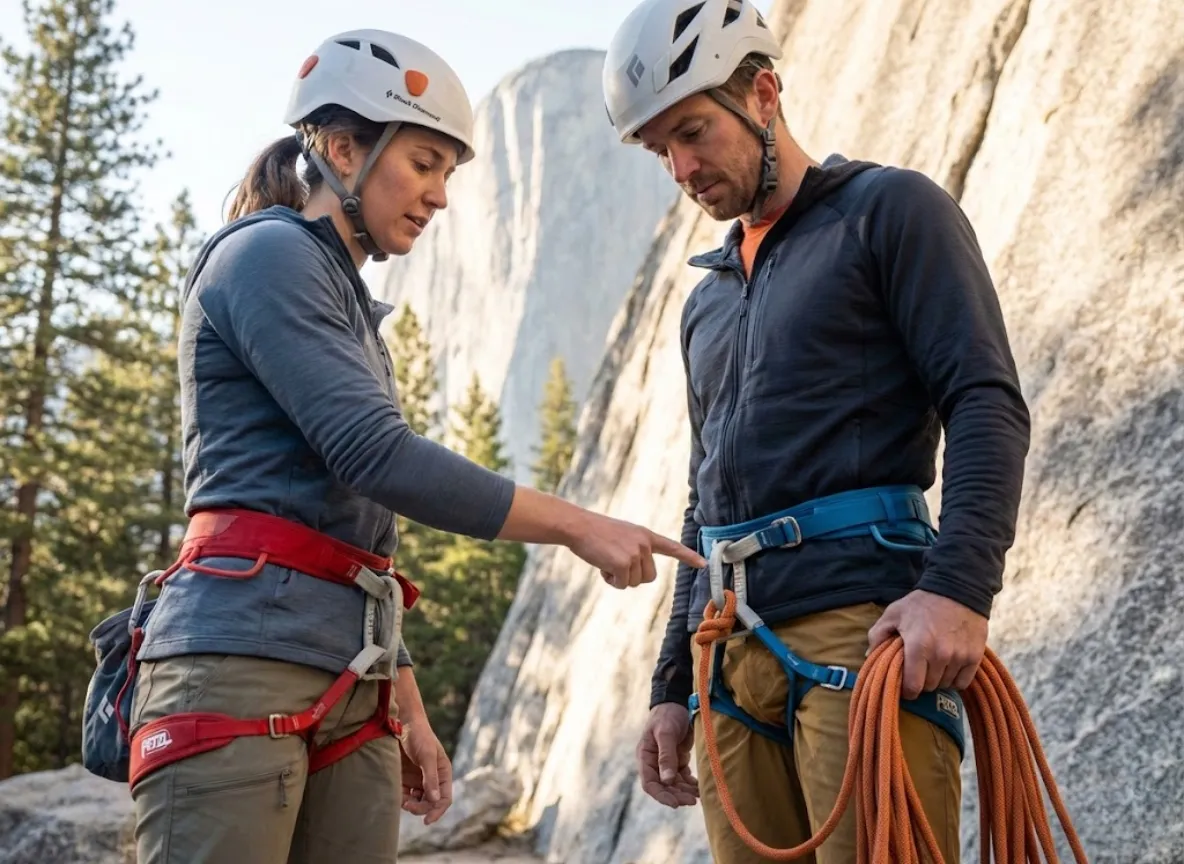
This guide breaks down the six steps that experienced climbers routinely skip—not because they’re lazy, but because repetition breeds invisible danger. By the end, you’ll have a pre-climb checklist system that catches the mistakes that send people to the ground.
⚡ Quick Answer: The 6 pre-climb safety checks most climbers skip are: psychological readiness assessment (the “Lynn Hill Effect” warning), complete harness audit including leg loops and age verification, kinesthetic knot verification using finger tracing, squeeze-testing carabiner gates, environmental hazard scanning for rockfall and weather, and the friction hitch “interview” for rappels. Each step takes seconds but addresses blind spots that cause fatal accidents.
The Science of Complacency: Why Experience Breeds Error

Here’s the paradox nobody talks about: experienced climbers are more dangerous to themselves than beginners. Not because they lack skill—but because they’ve done the same motions ten thousand times until their hands move on autopilot while their brains check out.
The “Lynn Hill Effect”: When Muscle Memory Fails
Lynn Hill’s fall wasn’t a fluke. It was a textbook case of complacency prevention failure. Mid-tie-in, a friend called her name. She looked up, hands still on the rope, brain already elsewhere. When she grabbed the rock to start climbing, her knot was only half-finished.
Dr. Valerie Karr’s longitudinal study of American Alpine Club accident reports (2005-2024) identified “distraction” and “complacency” as the primary drivers of climbing accidents among seasoned climbers. The 2024 data is striking: 100 accidents occurred during ascent versus only 46 during descent. That “I’m just starting” mindset creates vulnerability.
Pro tip: Point to your knot every single time and say the words out loud: “Eight dressed, tail checked.” It sounds ridiculous. It works.
The fix isn’t more skill—it’s deliberate interruption of autopilot. When you catch yourself going through the motions, that’s exactly when you’re most at risk. The partner check isn’t ceremony. It’s survival.
The Fatality Surge: Understanding the Numbers
The post-pandemic climbing boom flooded outdoor crags with gym-trained climbers who have strength but lack outdoor judgment. The American Alpine Club reported 51 deaths in 2023 and 49 in 2024—the highest consecutive death toll in 70 years. That’s not coincidence; it’s correlation.
The American Alpine Club’s safety education initiative has documented this surge, working since 2013 toward standardized climbing instruction across the U.S. These aren’t beginner mistakes. The victims are often intermediate climbers with 2-5 years of experience—competent enough to feel confident, not seasoned enough to respect the margin of error.
Understanding mastering belay techniques and pre-climb communication is the foundation everything else builds on.
Root Check 1: The Harness Audit (Beyond “Doubled-Back”)
Every gym teaches you to check your buckle. But the gym harness check is a fraction of what outdoor climbing demands.
The “O” Buckle Danger: Visual Mnemonics That Save Lives
Here’s a phrase that could save your life: “If you see an ‘O’, say ‘Oh St.'”
When a harness buckle isn’t doubled-back, the visible metal forms an “O” shape—an open circle. When it’s correctly threaded, you see a closed “C” shape. This terminology sounds simple, but it’s rarely taught, and old-style buckles without auto-locking features still circulate in rental fleets and borrowers’ gear closets.
The waistbelt must sit above your hip bones—not on them. If you take an inverted fall with a low-sitting harness, it can slide right over your pelvis. And check the leg loops: a twisted loop can flip you upside down on impact, leading to head trauma.
Harness Degradation: The 10-Year Retirement Rule
Your harness has a death date. According to Black Diamond’s QC Lab, nylon harnesses have a maximum 10-year shelf life even if unused. With regular use, that drops to 1-3 years depending on sun exposure and abrasion.
The belay loop is the most stressed component. Testing shows a loop cut 90% through can still hold around 13kN—but that’s zero margin for error. If you’ve stored your harness in a hot car trunk (the off-gassing from car batteries creates acid contamination), retire it immediately.
The UIAA harness safety standards (EN 12277) provide international guidelines for inspection and retirement. For more details, check our guide on understanding your harness’s true lifespan.
Root Check 2: The Knot Verification (The Finger Trace Protocol)
Looking at your knot isn’t checking it. Your brain pattern-matches what it expects to see—which is exactly what happened to Lynn Hill.
“Interview the Knot”: Touch Over Sight
The fix is kinesthetic verification. Run your fingers along each strand of the figure-eight knot. The strands must be parallel, not twisted, with a 6-inch safety knot tail. Your fingertips catch what your eyes miss.
Pro tip: Trace the eight every time. Use your index finger to follow the rope’s path through the knot like you’re tracing a maze. If a strand crosses over itself or the tail is too short, you’ll feel it before you see it.
This takes three seconds. It’s the difference between a finished knot and one that’s 90% dressed—invisible to the eye, lethal on a fall.
The Closed System: Rope-End Knots
Between 2010 and 2024, 11 fatalities in Yosemite alone occurred because climbers rappelled off the ends of their ropes. No stopper knot. No closed system. Just gravity.
A triple barrel or figure-eight in the rope end closes the system—if you lower or rappel past the end, you stop instead of fall. Some guides argue that rope-end knots create snag hazards. The American Alpine Club’s rebuttal: a snag is manageable; a ground fall is not. For foundational essential climbing rope protocols, our gear guide covers the basics.
Root Check 3: The Belay System Interrogation
Your life depends on your partner’s setup. Trusting without verifying is gambling.
The Squeeze Check: Why Looking Isn’t Locking
“Usually a visual check is not good enough to prove that a locker is locked,” notes the American Alpine Institute. “It’s always good to give it a quick squeeze test.”
Screw-gate carabiners can appear closed but not be fully threaded. Triple-locks have multiple failure modes. The solution is tactile: physically squeeze the gate inward. If it moves, it’s not locked. Auto-locking carabiners like the Petzl Attache reduce this failure mode, but dirt can jam mechanisms. Never assume.
Belay Device Threading: Brake Strand Position
The brake strand must be on the correct side of your belay device—typically down and toward the brake hand. With tube-style devices like the ATC-XP, orientation matters for ergonomics. With GriGri and other assisted-braking devices, the rope must wrap under the cam, not over it.
Petzl’s own documentation warns: “A moment of inattention, an instant of fatigue, excessive confidence: moments of absence in which one can quickly forget…” Review the Petzl’s official partner check protocol for the manufacturer’s complete guidelines.
Skipped Step 4: The Environmental Scan (What’s Above Your Head?)
Gym climbers don’t learn hazard assessment. The walls are inspected, the holds are bolted, and nothing falls from above. Outdoor rock is a different world.
Rock Fall Hazard: The “Sector Scan”
Before you touch the first hold, scan the route and the area above the anchor for loose blocks, “choss” (crumbling rock), and fresh rockfall scars. The belayer should position in the “fall shadow”—the zone not in the trajectory of falling debris.
“Loose rock almost killed my belayer” is one of the most common cautionary tales on Mountain Project forums. Yet rock fall hazard discussion is absent from most gym curricula. The National Park Service climbing safety guidelines emphasize that climbers are responsible for their own safety and must assess environmental hazards—including loose rock—before every ascent.
For approaches that combine terrain assessment with objective hazard assessment in alpine environments, our mountain gear guide expands on these skills.
Pro tip: Wear your helmet at the base of the climb, not just while climbing. Most rockfall injuries occur at belays, where partners stand directly beneath the action.
Environmental Hazards: Weather, Wildlife, and Heat
Check the horizon for storm clouds before you start. Lightning kills more mountaineers than equipment failure. Wildlife hazards include bee and wasp nests inside cracks—a common horror story—and snakes sunning on ledges.
UV exposure degrades nylon. If your rope has been baking in the sun at the base for hours, factor that into its condition. And if you hear thunder, begin descent immediately. Don’t wait for rain.
Skipped Step 5: The Medical Inquiry (The Epi-Check)
This one feels awkward. It’s also lifesaving.
Anaphylaxis Protocol: “Left Brain Pocket, Epinephrine”
Outdoor climbing exposes you to allergens far from EMS response. Before multi-pitch routes, explicitly ask your partner: “Do you carry an EpiPen or insulin? Which pocket is it in? How do I use it?”
According to research on epinephrine for carrying epinephrine in a climber’s medical kit, the medication remains stable in cold environments down to -25°C, making alpine kits viable. But it degrades in heat and light. Know where it is. Know how to use it.
“Left brain pocket, epinephrine” should be as automatic as “On belay?”
Mental Readiness: The Eye Contact Check
Before calling “On Belay?” make direct eye contact with your partner. Are they mentally present—or distracted by conversation, their phone, or fatigue?
Complacency often manifests as inattention. Your partner may be rigging correctly but be completely checked out mentally. Establish a verbal contract: “I’m ready to climb. You’re ready to belay. Let’s go.”
Skipped Step 6: The Friction Hitch “Interview” (Rappel-Specific)
Rappelling is where experienced climbers die. The friction hitch backup exists for a reason—but simply tying it isn’t enough.
The Interview: Test Before Trust
You must “interview” your auto-block before committing. Manually slide the hitch down and fully weight it while still tethered to the anchor. If it slips during the interview, add wraps or increase cord diameter before unclipping your Personal Anchor System.
The physics are unforgiving. According to HowNOT2 testing, a 3-wrap auto-block on 4mm cord can slip at forces as low as 1.34kN. A 4-wrap on 5mm cord slips at 3.62kN. Those numbers mean the difference between a controlled stop and an uncontrolled descent.
Cord Selection: Diameter Matters
Thinner cords grip harder but can over-grip—locking so tight you can’t release them. Thicker cords release easier but may slip on modern thin ropes (8.9-9.2mm diameter).
The rule of thumb: use cord 60-70% of your rope diameter. For a 9.8mm rope, 5-6mm cord is ideal. Sterling Hollowblock is purpose-built for this application. For the carabiner that completes the system, consult our guide on selecting the right carabiner for rappel systems.
Conclusion
Three truths about pre-climb safety checks:
- Complacency is the enemy. If Lynn Hill can skip a check after decades of climbing, you can too. Replace assumption with deliberate verification.
- Touch, don’t just look. Squeeze the gate. Trace the knot. Weight the hitch. Kinesthetic checks catch what eyes miss.
- Expand your aperture. Safety isn’t just harness-and-knot. It’s weather scanning, rock quality assessment, medical preparation, and reading your partner’s mental state.
On your next climb, run through these six skipped steps out loud with your partner. It’ll feel awkward for exactly one session—then it’ll become as automatic as tying in. That discomfort is the sound of complacency dying.
FAQ
What is the ABC climbing safety check?
ABC is a mnemonic for basic checks: Anchor, Buckles, Carabiner or Connector. Some expand it to the ABCDE mnemonic, adding Device and End of rope (stopper knot). This systematic approach ensures no critical component is overlooked before leaving the ground.
How often should I do a partner check?
Before every pitch, not just the first one. Complacency increases as the day progresses, and the American Alpine Club notes that afternoon accidents spike—likely due to accumulated fatigue and the false comfort of routine.
Should you tie a knot in the end of a climbing rope?
Absolutely. Between 2010 and 2024, 11 rappelling deaths in Yosemite occurred from climbers going off rope ends without a stopper knot. A closed system with a rope-end knot prevents this entirely.
What is the squeeze check for a carabiner?
A tactile verification where you physically squeeze the carabiner gate inward. If it moves, it’s not locked—even if it looks locked. Visual inspection alone misses half-engaged screwgates and dirty auto-lockers.
How do I check for harness wear?
Inspect the belay loop, tie-in points, and buckle stitching for fraying, abrasion, or discoloration. Any visible core material (white inner fibers) means immediate retirement. Check the manufacture date—10 years is the maximum lifespan regardless of use frequency.
Risk Disclaimer: Rock climbing, mountaineering, and all related activities are inherently dangerous sports that can result in serious injury or death. The information provided on Rock Climbing Realms is for educational and informational purposes only. While we strive for accuracy, the information, techniques, and advice presented on this website are not a substitute for professional, hands-on instruction or your own best judgment. Conditions and risks can vary. Never attempt a new technique based solely on information read here. Always seek guidance from a qualified instructor. By using this website, you agree that you are solely responsible for your own safety. Any reliance you place on this information is therefore strictly at your own risk, and you assume all liability for your actions. Rock Climbing Realms and its authors will not be held liable for any injury, damage, or loss sustained in connection with the use of the information contained herein.
Affiliate Disclosure: We are a participant in the Amazon Services LLC Associates Program, an affiliate advertising program designed to provide a means for us to earn advertising fees by advertising and linking to Amazon.com. As an Amazon Associate, we earn from qualifying purchases. We also participate in other affiliate programs. Additional terms are found in the terms of service.