In this article
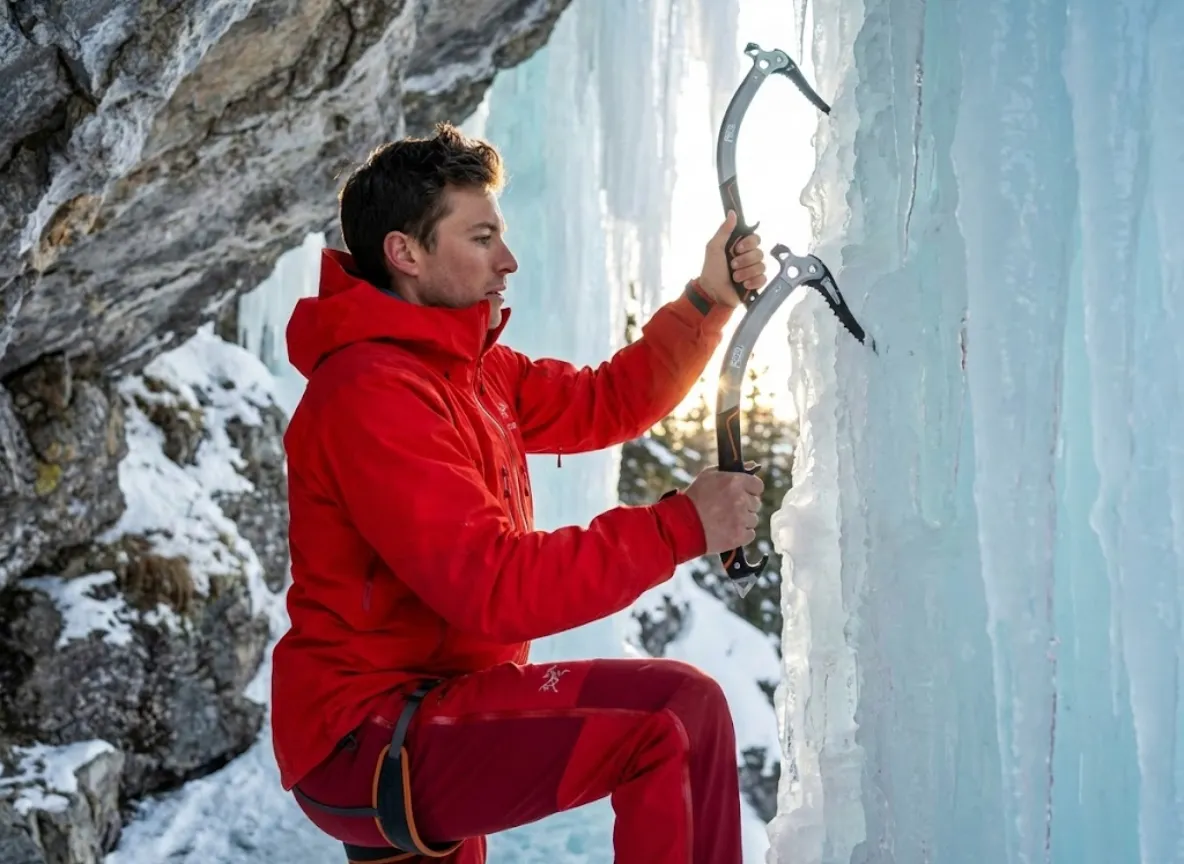
The pump starts as a whisper in your forearms. Then, it screams. You are fifty feet up a pillar in Cody or Ouray. The temperature is dropping. Your grip is failing, but not because you are weak. It is failing because you are fighting ice climbing biomechanics.
Every swing that bounces, shatters the water ice, or needs a second hit drains your energy bank. You cannot refill that bank while you are on the wall. Getting pumped is often a choice, not a necessity.
As a climbing guide trained to American Mountain Guides Association (AMGA) standards, I see strong gym climbers struggle on vertical water ice constantly. They try to muscle their way up. But movement efficiency isn’t about swinging harder. It is about force calibration: lining up your body with the shape of modern leashless ergonomic shafts and letting gravity do the work.
You want to move from a frantic battle to a rhythmic process of high-level skill acquisition. Your ice tools should feel like extensions of your arms, not heavy weights. This how-to technical guide breaks down the “flick,” the four steps of a good 3-step swing, and how to stop the “screaming barfies” so you can climb long ice bits without failing.
Why Do Modern Leashless Tools Swing Differently?

Modern leashless tools need a rotational “cast” rather than a linear drive. This is because their center of gravity is offset from the handle. You have to rely on whip-like momentum, not muscle, to get them into the ice.
How the “Balance Axis” Changes Your Swing
Old-school straight piolets were basically hammers. You drove them in a straight line from your shoulder to the ice. Leashless tools, like the Petzl Nomic, C.A.M.P. X-Dream, or the Black Diamond Cobra, are different. They have a complex weight distribution. The pivot point—where the tool wants to spin—sits closer to your pinky or even below your hand.
To master swing physics, you must find the tool’s “Balance Axis.” This is the invisible line the tool naturally rotates around.
Your technique needs to change. Stop hammering a nail. Start casting a fishing rod. You are “whipping” the head of the ice tool. This whip-motion relies on the tool’s resistance to spinning. A heavier head takes a bit more energy to start moving, but it hits with much more power.
Research on moment of inertia confirms that heavier implements stabilize swing trajectory. This means that once you overcome that initial resistance with a loose flick, the tool naturally wants to stay on a straight swing arc.
If you start with this loose flick, the moving energy drives the pick into the ice. If you fight this by gripping too tight or swinging in a straight line, the pick will wobble. It might even dive down too early. This is a huge factor when choosing the right ice axe. You need a tool, whether it’s a Black Diamond Viper or a C.A.M.P. USA model, that matches your natural swing speed.
Why the “15-Degree Rotation” Matters
Your wrist does not naturally swing in a perfect vertical line when your fingers are wrapped around a thick handle. If you use a standard leashless grip and swing without thinking, your arm will likely cause the pick to hit the ice at an angle.
This leads to glancing blows. It wastes energy and ruins the ice.
To fix this, expert climbers apply a “karate chop grip” mental cue, twisting their hand slightly outward on the handle. It is a subtle 15-degree rotation (internal rotation of the forearm relative to the tool). This ensures perfect shoulder-wrist-pick alignment with the gravity vector. Shoulder muscle activity studies indicate that corrected arm positions reduce joint stress and help transfer force better.
When the tool hits the ice, your hand naturally rotates back to a neutral position to pull. It creates a fluid cycle: twist to swing, relax to pull. Mastering this invisible adjustment is often the difference between a solid thunk and dangerous ice shattering prevention. Understanding why cold ice shatters helps you see why this precise, 90-degree impact angle is so important.
The Four Steps of an Efficient Swing
A good swing is a repeatable sequence—often taught as Reach, Flick, Set—that maximizes swing speed while saving your energy.
Step 1: Scan for “Natural Hooks”
The “Scan” phase starts before your arm even moves. Look for natural features in the ice. You want to find concavities—small dips, pockets, or old pick holes. This is called reading ice geometry.
Aim for these depressions. Some pros visualize aiming 2cm behind the surface. The surrounding ice will support the pick so you don’t have to swing as hard. If you swing at bulges, the ice will likely shatter and “dinner plate,” sending big chunks falling.
Research on affordance perception confirms experts utilize natural hooks to conserve energy. The data shows that beginners take an average of 3.6 swings to set a tool. Experts take only 0.6. That means experts often hook a hole without swinging at all.
Reducing your swing count is the best way to save energy. It requires the mental discipline to pause. You must focus on reading the ice rather than panic-swinging at the first piece of near-vertical ice you see.
Step 2: Load from the Shoulder
The “Load” phase starts close to your body. Pull your shoulder blade back and engage your lat muscles, arching the back slightly for core generation. Your elbow should rise after your shoulder moves.
Your forearm and wrist should stay relaxed right now. They are just the ropes connecting the engine (your back) to the tool.
Beginners often start the swing with their elbow. This leads to the Chicken Wing, where the elbow flares out to the side. This separates your arm from your core strength. It forces the small muscles in your shoulder to do all the work.
Start the move from your back and focus on swinging within the frame of your shoulders. Biomechanical analysis of elite performance demonstrates the importance of proximal movement initiation. This saves your delicate forearm muscles for the final snap. This pattern is a key part of training for ice climbing, because standard gym pull-ups rarely copy this specific motion.
Step 3: The Wrist Flick (The Snap)
The “Snap” happens at the very end of the swing phase. You use a rapid wrist flick to speed up the tool head. Think of it like a golf swing or cracking a whip.
Your arm stops moving, and that momentum transfers entirely to the tip of the tool. This relies on a wrist vs. elbow hinge mechanic.
Step 4: The Release
Immediately upon the impact phase, you must “Release.” Relax your grip instantly. This absorbs the vibration and lets blood flow back into your hand.
Pro-Tip: If you hear a high-pitched “ping” instead of a dull “thud,” you are likely gripping too hard at the moment of impact. Relax your hand the millisecond the pick touches the ice.
Tools with a heavy swing weight, like the Petzl Nomic, move slower but hit harder. The wrist flick is how you overcome that slow start. Studies on ice tool swinging movement confirm the wrist snap generates peak velocity right when you hit the ice.
If you don’t relax your hand—practicing good grip efficiency—shock waves travel straight into your tendons. This makes you tired faster. This cycle is why specific grip strength exercises focus on holding power (contact strength) rather than just crushing power.
How to Diagnose and Fix Efficiency Leaks
Even with good form, your body can fail you. Identifying these problems early is part of sustainable practice.
Stopping the “Screaming Barfies”
The Screaming Barfies are caused by blood rushing back into your hands. When you are cold and gripping tight, your blood vessels shrink. This restricts blood flow.
When you relax or warm up, the blood rushes back in. The vessels expand rapidly, causing intense pain and nausea. The Wilderness Medical Society explains reperfusion injury as the primary cause of this reaction.
To prevent this, use a straight-arm hang often. Shake out your hands before they go numb. Keep your core warm with good layers; think of your body like an ice box that needs insulation. If your body gets cold, it pulls blood away from your hands to protect your organs.
A solid ice climbing glove system helps, but technique matters more. Don’t squeeze the tool too hard. If you feel the pain coming, raise your arms. This uses gravity to slow the blood flow, rather than letting it rush in all at once.
The “Towel Hang” Drill
The Towel Drill mimics the open-hand grip you use on modern leashless ergonomic shafts. It is a staple in any dry-tooling drill checklist.
Drape two thick beach towels over a pull-up bar. Grip them vertically. Hang passively for time, aiming for 30 to 60 seconds. Once you can do that, add “Scapular Shrugs.” Engage your back muscles to lift your body slightly without bending your elbows.
This targets your finger muscles exactly how climbing does. Electromyographic studies of arm muscles confirm the high demand on forearm flexors during climbing. Standard pull-up bars let you close your hand into a fist or crimp, which doesn’t translate well to ice tools.
You need a setup that forces an open hand. A dedicated pull-up bar for climbers helps you drape the towels securely for this muscle-memory training.
Pro-Tip: Use thick beach towels rather than thin hand towels. The thicker fabric forces your hand open wider, which feels more like the handle of a Nomic or X-Dream tool.
Final Thoughts
Sustainable practice in ice climbing comes from physics, not just gym fitness. Rotate the tool around its balance axis. Use a slight 15-degree rotation. Look for natural holes in the ice.
Whether you use German technique (front-pointing) or French technique (pied à plat) for your feet, your upper body mechanics remain the same. Keep your center of mass over front-points to enable good hips-to-ice positioning, relieving your arms.
Refine your movement before your next trip to Ouray Ice Park or the backcountry. As Will Gadd or an instructor from Skyward Mountaineering might say: precision beats power every time.
FAQ – Frequently Asked Questions
Why do my ice tools bounce off the ice instead of sticking?
Bouncing often happens because you started the swing with your elbow instead of your shoulder. It can also happen if you forget to snap your wrist right when you hit the ice. Also, check your target. If you swing at a flat spot or a bulge, the tool is more likely to bounce. Aim for dips in the ice.
How do I stop getting the Screaming Barfies?
Keep your core warm by wearing a vest. Relax your grip immediately after every swing to let blood flow. Squeezing too hard, known as the death grip, cuts off circulation. When that blood rushes back, it hurts.
What is the correct way to hold a leashless ice tool?
Hold the grip near the bottom with a relaxed hand. Twist your hand slightly outward (about 15 degrees) to make the pick stand up straight. Don’t choke up on the handle. Holding it higher reduces the leverage and swing arc of your swing.
Why is the ice shattering when I swing?
Shattering, or dinner plating, happens when you swing too hard at brittle ice. This is common when it is very cold (below 14°F or -10°C). It also happens if you hit a bulge. In cold weather, tap the ice gently a few times to make a small hole before you take a full swing.
Risk Disclaimer: Rock climbing, mountaineering, and all related activities are inherently dangerous sports that can result in serious injury or death. The information provided on Rock Climbing Realms is for educational and informational purposes only. While we strive for accuracy, the information, techniques, and advice presented on this website are not a substitute for professional, hands-on instruction or your own best judgment. Conditions and risks can vary. Never attempt a new technique based solely on information read here. Always seek guidance from a qualified instructor. By using this website, you agree that you are solely responsible for your own safety. Any reliance you place on this information is therefore strictly at your own risk, and you assume all liability for your actions. Rock Climbing Realms and its authors will not be held liable for any injury, damage, or loss sustained in connection with the use of the information contained herein.
Affiliate Disclosure: We are a participant in the Amazon Services LLC Associates Program, an affiliate advertising program designed to provide a means for us to earn advertising fees by advertising and linking to Amazon.com. As an Amazon Associate, we earn from qualifying purchases. We also participate in other affiliate programs. Additional terms are found in the terms of service.