In this article
You are mid-sequence, your weight committed, when the foot placement vanishes. There is no warning—just the sudden, sickening acceleration of gravity as rubber skids across polished fiberglass macros. This isn’t bad luck; it is a failure of physics.
The “glassy” dual-texture hold (or dual-tex) is designed to punish rock climbers who rely on friction generated by gravity alone. As a climbing guide, I see strong athletes crumble on these geometric features because they treat them like outdoor granite crimps. To stay on the wall, you must stop pulling down and start pushing in. This simple change alters the force vector that keeps you vertical.
Here is how to master the physics of friction, body movement, and shoe selection matrix required to stay on the wall in a modern indoor climbing gym.
What Physics Governs the Interaction Between Rubber and Polished Resin?

This section breaks down the hostile environment of the hold. We need to move beyond “it’s slippery” to explain exactly why your shoes won’t stick to no-tex surfaces.
Why does static friction fail so abruptly on dual-texture surfaces?
Static friction fails instantly on these surfaces because the mirror finish removes the texture your rubber usually grabs, leaving you dependent on weak “stickiness” alone.
On standard climbing holds, your rubber works by physically digging into microscopic valleys and peaks. We call this a mechanical lock. Dual-tex surfaces—often made of glass reinforced plastic (GRP) or polyurethane (PU)—are polished to a high gloss level, effectively sanding away all those little gripping points. Consequently, you are forced to rely entirely on adhesion—molecular bonding—and the rubber’s ability to absorb energy. A recent tribological study of climbing shoe rubber highlights how this lack of defined texture creates a “pass or fail” situation.
When gravity pulls you down harder than your rubber can stick, you don’t just slide a little bit. You slip instantly. There is no kinetic friction to catch you once you start moving. This explains why the slip feels so sudden; there is no “recovery” once the slide begins. This is why analyzing dual-tex hold identification is critical before you even leave the mats—you cannot adjust once you are on the climbing wall.
Pro-Tip: Treat dual-tex as a binary switch. You are either 100% secure or 100% falling. Unlike rough rock, where a foot might slip an inch and catch, polished plastic offers zero second chances.
How does “Normal Force” dictate my body position?
“Normal Force” is just a physics term for perpendicular pressure. To increase grip on a slippery side, you must push directly into the hold, not just stand on it.
Friction follows a simple rule: the harder you push two surfaces together, the better they stick. Since the polished plastic is a frictionless material, the only thing you can control is how hard you push into it. Gravity pulls you straight down. But to stick to a vertical shiny appearance, you need to apply direct pressure at a 90-degree angle to the wall. If you just hang there, your feet aren’t pushing in at all, so you slip.
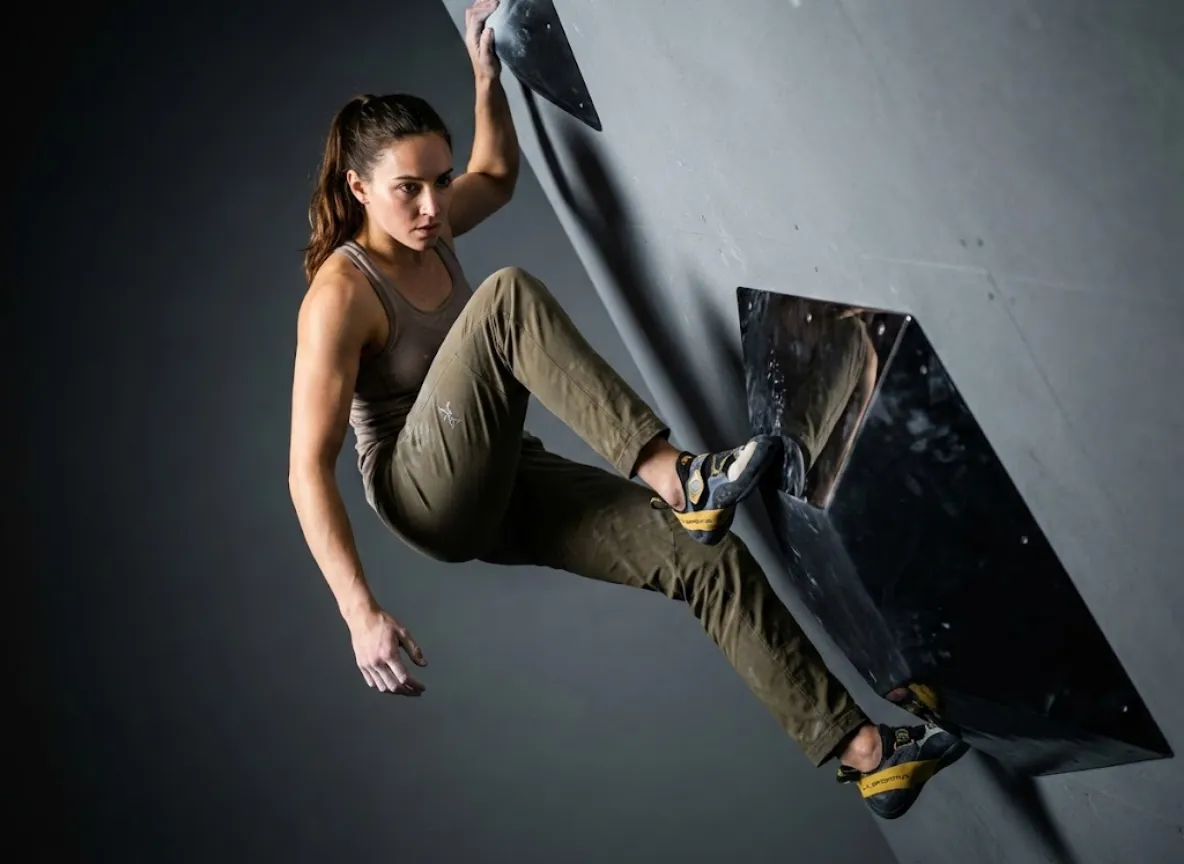
To create this inward pressure, you must lean your body away from the wall. This creates a diagonal force arrow that drives the foot into the hold. Extensive research into the biomechanics of rock climbing technique shows that successful movement requires visualizing a “cone” of friction. Your push must stay within this narrow angle of incidence to prevent slipping. This concept is fundamental when countering the barn door effect, as using your other leg to flag often provides the leverage needed to push in.
Which Biomechanical Adjustments Stop the Slide?
Understanding the math is useless if your body cannot do the moves. This section translates abstract ideas into concrete climbing positions.
Why is “hips close to the wall” often fatal on dual-tex?
Keeping hips close to the wall directs your weight straight down, which causes slips. Increasing your hips-to-wall distance allows your legs to drive force directly into the hold.
Standard instruction tells a new climber to keep their hips close to the wall to save arm strength. On dual-texture holds, this advice causes falls. If your body is vertical, your feet slide down. You must utilize the “Ass Out” technique. Deliberately move your center of gravity away from the wall to create a rigid triangle shape with your body. This outward position changes the angle of your leg, allowing your thigh muscles to drive the rubber directly into the face of the hold.
This requires a strong back and braced core. You must keep your spine straight while leaning, preventing your middle section from collapsing. Educational resources on vector forces in climbing emphasize that leaning back is often the only way to balance on a slab. To support this, maintaining body tension through specific core work is necessary for keeping that rigid shape under load.
How does dropping the heel maximize friction?
Dropping the heel puts more rubber on the wall. This engages more “sticky” surface area contact and prevents the wobbling that happens when you stand on your tiptoes.
Standing on your toes concentrates all your weight on a tiny point. This works on outdoor small edges but fails on smooth surfaces where you need surface area to stick. When you drop your heels downwards, you force the shoe into a “smear” position. This drastically increases the size of your contact patch. A larger patch allows the rubber to find tiny imperfections in the paint or mold and spread out the pressure.
The lowered heel also acts as a shock absorber. If your foot shifts slightly, the large surface area keeps you connected. On large no-tex volumes, this technique evolves into “smedging” (smearing + edging). Climbers must master the science of edging and smearing to understand when to switch between these two modes.
What is the “Border” technique used by elite climbers?
The “Border” technique involves targeting the manufacturing line where the rough texture meets the polish to gain a tiny physical edge.
Dual-tex holds are made by masking a portion of the mold or applying texture spray paint selectively. This process creates a distinct texture transition or “lip.” There is often a microscopic ridge at this spot that acts as a positive edge if you aim with toe precision. The strategy involves looking closely at this line and placing your toe rubber exactly on the textured face, using the transition line as a mechanical stop.
Elite climbers visualize this line during beta-reading before leaving the ground. They know they can’t feel around for it once they are on the slippery side. By targeting the border, you get a real physical edge to stand on. This nuance is a critical part of a broader analysis of climbing hold shapes, turning a friction problem back into a normal static movement.
Does My Gear Matter for Frictionless Surfaces?
Technique is the most important factor, but the material on your feet dictates the limit of what is possible.
How does rubber “Shore A Hardness” affect grip on plastic volumes?
Softer rubber molds to the surface better. This creates a superior bond on smooth plastic compared to stiff, hard rubber.
Shore A Hardness is just a number that tells you how hard the rubber is. For dual-tex, soft rubber (Shore A lower than 75) is better. It squishes easily to maximize contact area. We call this “wetting out.” Harder rubber (Shore A higher than 80)—like Vibram XS Edge—is great for standing on tiny rock edges, but it’s too rigid to bond with polished plastic. You can check these numbers on the standard shore hardness scale.
The softer compounds, such as Vibram XS Grip 2 or Unparallel’s softest mixes, are also better at absorbing energy. They dampen the micro-vibrations that often cause slips. However, this comes at a cost: soft rubber wears out faster on the gritty wall texture. Serious indoor climbers should consult a definitive climbing shoe rubber guide to build a collection that includes a dedicated soft shoe for these specific boulders.
Climbing Shoe Performance Matrix
Rubber Compound vs. Structural Stiffness Analysis
Performance
Maximum contact patch and deformation. High Hysteresis & Adhesion.
Models
Scarpa Veloce (S-72), Scarpa Drago / LV, La Sportiva Theory, Unparallel RS.
Performance
Balances smearing with edging power using tensioned systems.
Models
LS Skwama (XS Grip 2), Scarpa Instinct VSR, Unparallel UpMocc.
Performance
Forces toes into crimps; reduced smear area. Optimized for vertical edging.
Models
Evolv Shaman (Trax SAS), Unparallel RH Models.
Risk Factor
Bridges over volumes; fails to “wet out” on glass-like surfaces. Pure micro-edging.
Models
LS TC Pro, Scarpa Boostic, LS Katana Lace (XS Edge).
Should I use stiff or soft shoes for dual-texture climbing?
Soft shoes are generally better for dual-texture climbing. They allow your foot to bend and match the shape of the hold, giving you more feel and grip.
Stiff shoes act like a rigid lever. This supports your foot on small edges, but on a rounded volume, a stiff sole bridges over the curve. This reduces your contact patch to a thin line. Soft shoes allow the foot to flex and “grab” the hold like a hand. Sensitivity is your “sixth sense” on dual-tex; soft shoes let you feel the hold, alerting you to slips before they happen.
If you only have stiff shoes, you must compensate by dropping your heel even more aggressively. However, understanding the stiffness trade-offs in shoe construction will help you pick the right tool. Modern shoes seen in the IFSC World Cup are engineered specifically for this style, featuring rubber wraps that extend over the toe for grip in every direction.
Pro-Tip: If you must use stiff shoes on dual-tex, unstrap the bottom velcro or loosen the lower laces slightly. This allows the front of your foot to spread out and the shoe to flex slightly more than usual.
Putting It All Together
Surviving dual-textured hold demands requires you to ignore standard climbing wisdom. You cannot pull your way through; you must push.
- Push, Don’t Pull: Friction comes from pressure. Drive force into the wall ($90^{\circ}$ angle), often by increasing the hips-to-wall distance.
- Use More Rubber: Drop your heel to maximize surface area.
- Choose Soft Rubber: Use shoe rubber types with low stiffness to “mold” onto glassy surfaces.
- Aim for the Line: Use visual precision to stand on the manufacturing line for physical support.
Next time you are at the gym, find a slab with slippery volumes and practice the “No-Hands Smear.” It will teach you more about balance in ten minutes than a month of pull-ups.
FAQ – Frequently Asked Questions about Dual-Texture Climbing
Why do route setters use dual-texture holds if they are so slippery?
Route setters use them to force you to move a specific way. By making parts of the hold slippery, they force you to use precise body positioning and push in the right direction, rather than just powering through.
Can I use climbing chalk on the slippery part of a dual-tex hold?
No. Chalk creates a layer of dust that acts like a lubricant on polished surfaces. It makes the grip worse. Make sure your shoes are clean and wipe the hold with a towel if possible.
Do I need different shoes for dual-texture climbing holds?
It helps. Softer shoes work much better than stiff edging shoes. They bend to fit the shape of the hold, giving you more surface area to stick with.
Why do I keep slipping when I try to stand up on a dual-tex volume?
You are likely slipping because you aren’t pushing in enough. Move your hips away from the wall. This directs your push into the volume, rather than just standing vertically on top of it.
Risk Disclaimer: Rock climbing, mountaineering, and all related activities are inherently dangerous sports that can result in serious injury or death. The information provided on Rock Climbing Realms is for educational and informational purposes only. While we strive for accuracy, the information, techniques, and advice presented on this website are not a substitute for professional, hands-on instruction or your own best judgment. Conditions and risks can vary. Never attempt a new technique based solely on information read here. Always seek guidance from a qualified instructor. By using this website, you agree that you are solely responsible for your own safety. Any reliance you place on this information is therefore strictly at your own risk, and you assume all liability for your actions. Rock Climbing Realms and its authors will not be held liable for any injury, damage, or loss sustained in connection with the use of the information contained herein.
Affiliate Disclosure: We are a participant in the Amazon Services LLC Associates Program, an affiliate advertising program designed to provide a means for us to earn advertising fees by advertising and linking to Amazon.com. As an Amazon Associate, we earn from qualifying purchases. We also participate in other affiliate programs. Additional terms are found in the terms of service.