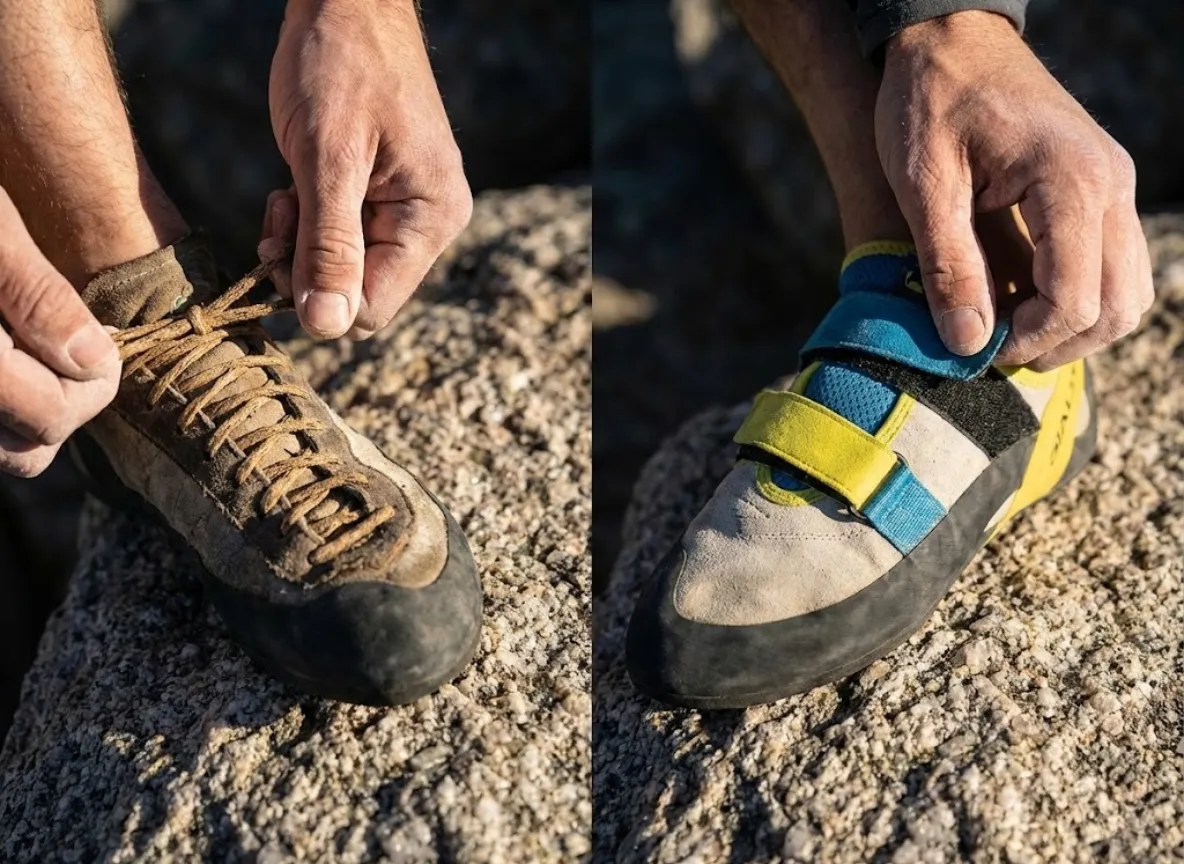
You are halfway up a 100-foot granite crack, feet swollen from heat and exertion. A velcro strap, blocked by a jammed foot, bites into your metatarsal, or worse—pops open entirely. The choice between climbing shoe laces vs velcro is not about how fast you can leave the gym; it is a critical technical variable that dictates structural integrity, volume management, and precision.
I have spent years guiding clients from the abrasive cracks of Indian Creek to the limestone pockets of Lander, and I have seen “convenient” closures fail at the crux too many times. Lace-up climbing shoes offer variable tension for irregular biomechanics, while velcro climbing shoes provide the structural cantilever stiffness required for aggressive bouldering. This closure decision matrix dismantles the marketing to align physics with your climbing style.
Key Takeaways
The Tension Model: Laces act as pulleys for zonal custom fit; Velcro acts as a fixed anchor for heel tension integration.
The Material Factor:Leather shoes require laces to manage stretch; synthetic climbing shoes allow velcro’s speed without sloppiness.
Discipline Specifics: Boulderers need the “toe hook patch” (Velcro); trad climbing demands the “corset effect” (Laces).
How to Choose the Right Closure System: An Expert’s Framework
This isn’t about preference. It is about matching the tool to the physiology of your foot shape and the geology of the rock.
The Physics of Lacing: The Variable Tension Model
Laces function as a mechanical pulley system. This allows you to isolate zones of pressure, creating a visual lacing map unique to your anatomy. You can lock the toe box tight for edging stability while leaving the midfoot loose to accommodate high arches, bunions, or nerve sensitivity. This zonal isolation is impossible with fixed points like straps.
Laces also effectively “laminate” the upper material to your skin. This eliminates dead space—those tiny air pockets that cause a shoe to roll unpredictably on micro-crystals. We call this the “Corset Effect.” It provides active support to the plantar fascia, which is critical for long-duration multi-pitch climbs where foot fatigue leads to sloppy footwork.
You need to understand these mechanical principles to leverage climbing shoe fit secrets effectively, connecting the tension of laces to the broader context of achieving a fit precision without injury.
The Physics of Velcro: The Cantilever Tension Model
Modern velcro straps, like La Sportiva’s Lock Harness, are not just closures. They are active tensioners. They work on a cantilever model, driving the heel forward into the toes to maintain an aggressive fit. Unlike older slippers or simple velcros fastenings found on rental gear, these systems provide genuine heel power.
Velcro also offers a massive surface area advantage. It clears the way for large rubber toe patches, which are essential for the toe hooking and scumming required in modern bouldering. A lace-up shoe creates friction interference in these scenarios.
Crucially, velcro allows for rapid decompression. You can instantly release pressure between attempts to manage blood flow and swelling. This on/off speed is vital for the gym cycle of climbing and belaying. It is why you see this system on the top bouldering shoes for beginners and pros alike.
Material Science: Why Upper Material Dictates Closure
The shoe construction must match the chassis. Leather vs synthetic is the defining variable here. Leather uppers can stretch up to a full size over their lifespan. Laces are required here to take up this slack and maintain performance as the material relaxes.
Synthetic uppers, like Lorica, do not stretch. Velcro closure shoes work perfectly here because the internal volume remains constant, requiring only lockdown rather than adjustment.
Consider care and maintenance and failure points as well. Lace fraying in cracks is a real risk when jamming repeatedly into granite. Conversely, plastic or metal buckles can snap under torque, and velcro gumming up with dirt can ruin the bond. This choice is often as critical as understanding the definitive climbing shoe rubber guide, because the best rubber in the world won’t help if your foot is sliding inside the shoe.
Our Selection Process: How We Built This Guide
We are committed to objectivity. We look beyond the marketing “fit” to the mechanical reality of the shoe’s construction.
Every shoe listed below is judged on four technical pillars:
Precision: The efficiency of force transfer and points of control.
Convenience:Belay transition ease and speed.
Crack Suitability:Crack durability and profile slimness.
Edging Stability: Lateral rigidity.
We synthesized data from technical specifications, biomechanical feedback, and community durability reports—specifically targeting known failure points like delamination—to filter out “hype” products. While we may earn a commission if you purchase through our links, our recommendations are driven by physics and performance data, not payouts.
The Best Climbing Shoes of 2026: Our Top Recommendations
Our Top Picks for The Kinetic Boulderer (Velcro Focus)
Scarpa Drago XT
$$$$
The Drago XT acts as a second skin for the dedicated boulderer, utilizing a minimalist single-strap closure to maximize rubber coverage for technical toe hooks. Unlike the original soft Drago, the XT adds structural reinforcement to the heel and tension system, offering a stiffer platform that resists ‘bagging out’ on small edges. The sensitivity is elite, allowing you to feel the texture of volumes through the sole. However, be warned: the soft Vibram XS Grip 2 rubber sacrifices durability for friction, meaning you will burn through the toe rubber quickly if your footwork is sloppy on abrasive walls.
Overall
Precision/Sensitivity
Convenience
Crack Suitability
Edging
Aggression
Closure
Single Strap Velcro (Floating Anchor)
Upper
Microsuede / Leather
Sole
Vibram XS Grip 2 (3.5mm)
Profile
High Asymmetry, Aggressive Downturn
You Should Buy This If…
You prioritize sensitivity and need to feel texture through the sole.
You require a massive rubber toe patch for technical toe hooks.
You climb primarily on steep, overhanging gym or outdoor terrain.
You Should Reconsider If…
You need a shoe for sustained edging on vertical granite.
You are looking for durability in crack climbing scenarios (exposed buckle).
The Solution Comp bridges the gap between lace precision and velcro speed with its ‘Fast Lacing System’—an internal harness connected to a single strap that vacuum-seals the heel and midfoot simultaneously. This version features a softer heel cup than the original Solution, significantly improving sensitivity on modern gym volumes. The aggressive P3 platform drives immense power through the toes on overhangs. The drawback? The fit is notoriously narrow in the forefoot, and the strap system creates a known wear point at the eyelet that can fail after heavy, long-term abuse.
Overall
Precision
Convenience
Crack Suitability
Edging
Heel Lock
Closure
Fast Lacing System (Hybrid Velcro/Harness)
Upper
Leather / Lorica Mix
Sole
Vibram XS Grip 2
Profile
Aggressive, P3 Platform
You Should Buy This If…
You need the most secure heel-lock on the market for aggressive hooking.
You want a hybrid system that offers near-lace precision with velcro speed.
You climb on varied steep terrain requiring both edging and smearing.
You Should Reconsider If…
You have a very wide forefoot (fit can be narrow).
You are concerned about strap durability (wear point at the eyelet).
New for 2025, the Voltage X addresses the ‘narrow fit’ constraint of Italian competitors by offering a broader toe box secured by a single VCR strap. It combines a sensitive midsole with a split sole design, allowing the shoe to flex and conform to large volumes without losing power. The broad toe patch is excellent for scumming. It is a high-volume alternative for indoor competition climbers who need comfort without sacrificing dynamic performance. However, the rubber is softer and less supportive for micro-edging outdoors compared to stiffer alternatives, making it less versatile for vertical face climbing.
Overall
Precision
Convenience
Crack Suitability
Edging
Volume Accomodation
Closure
Single VCR Strap (Velcro)
Upper
Microfiber
Sole
Vibram XS Grip Split Sole
Profile
Aggressive Downturn
You Should Buy This If…
You have a wider foot profile and find Dragos or Solutions too constrictive.
You prioritize rapid on/off for high-volume gym sessions.
You want a modern competition shoe at a slightly lower price point.
You Should Reconsider If…
You need a rigid platform for micro-edging outdoors.
You prefer a leather upper that molds to your foot over time.
Our Top Picks for The Granite Technician (Trad & Crack Focus)
La Sportiva TC Pro
$$$$
The TC Pro remains the gold standard for big wall and trad climbing, featuring a mid-height cuff that protects your ankles in painful off-widths. Its patented internal lacing system is shielded by leather gaiters, preventing the laces from fraying during repeated jamming. The stiff P3 platform ensures the shoe retains flat edging power over years of abuse. While unparalleled on vertical granite, the shoe is notoriously stiff and insensitive, making it feel clumsy in the gym or on steep sport routes where you need to grab holds with your toes.
Overall
Precision/Edging
Convenience
Crack Suitability
Durability
Support
Closure
Laces (Protected by leather gaiters)
Upper
ECO Leather (Unlined underfoot)
Sole
Vibram XS Edge (4mm)
Profile
Flat, Mid-Top Ankle
You Should Buy This If…
You are climbing multi-pitch trad routes or cracks.
You need ankle protection for off-widths.
You require a stiff platform to stand on small edges all day without calf fatigue.
You Should Reconsider If…
You are looking for a sensitive gym shoe (it is too stiff).
You have low-volume heels (the heel cup can be baggy).
Scarpa’s direct challenger to the TC Pro, the Generator Mid offers a significantly wider fit and extreme torsional stiffness via its Tri-Tension system. It uniquely incorporates a neoprene sock liner to cushion the malleolus (ankle bone) during painful jamming, addressing a major comfort complaint of trad climbers. The eco-suede upper is robust and protective. However, the toe box is quite bulky and tall, which makes it difficult to insert into thin finger cracks where a lower-profile shoe like the Katana would excel.
Overall
Precision
Convenience
Crack Suitability
Edging
Comfort (Wide Feet)
Closure
Laces (Standard)
Upper
Eco Suede / Neoprene Sock
Sole
Vibram XS Edge (4mm)
Profile
Flat, Mid-Top Ankle
You Should Buy This If…
You find the TC Pro too narrow or uncomfortable.
You want extra padding for the malleolus (ankle bone) during crack climbing.
You need maximum torsional rigidity for standing on edges.
You Should Reconsider If…
You need sensitivity for feeling placements.
You are climbing thin finger cracks (the toe profile is tall/boxy).
The Jett Crack brings dedicated crack climbing features—specifically covered laces and ankle protection—to a much more accessible price point. The rubber rand covers the laces effectively to prevent abrasion in jams, and the high-top cut offers decent ankle coverage. It uses CAT 1.5 rubber, which provides sticky friction. However, it is noticeably softer and less durable than high-end competitors like the TC Pro, meaning it offers less support for standing on micro-edges all day and may wear out faster under heavy abuse.
Overall
Precision
Convenience
Crack Suitability
Edging
Value
Closure
Laces (Covered)
Upper
Microfiber
Sole
CAT Rubber 1.5
Profile
Neutral
You Should Buy This If…
You want a dedicated crack shoe without spending over $200.
You need lace protection to prevent abrasion in jams.
You prefer a neutral profile for all-day comfort.
You Should Reconsider If…
You have an Egyptian foot shape (long big toe) as fit can be painful.
You need a shoe for sharp granite that requires extreme durability.
Our Top Picks for The Precision Sport Climber (Lace & Hybrid Focus)
La Sportiva Katana Lace
$$$$
The Katana Lace is the definitive edging shoe, utilizing a lacing system that extends far down the toe to compress the foot laterally. This creates a ‘corset’ fit for maximum power on micro-crystals. The P3 platform maintains a moderate downturn, making it versatile enough for vertical faces and slightly overhanging sport routes. It is a technical masterpiece. However, the 2022 update introduced a split-sole design that some purists find too soft compared to the original stiff board-lasted version, reducing its absolute rigidity on the smallest razor edges.
Overall
Precision
Convenience
Crack Suitability
Edging
Versatility
Closure
Laces (Full extension)
Upper
Leather / Microfiber Mix
Sole
Vibram XS Edge (Men’s) / XS Grip 2 (Women’s)
Profile
Moderate Downturn, P3 Platform
You Should Buy This If…
Your primary goal is standing on tiny edges on vertical rock.
You need a shoe that bridges the gap between technical trad and sport climbing.
You want the ability to micro-adjust volume at the toe box.
You Should Reconsider If…
You need a soft shoe for smearing on volumes.
You find the split-sole update (2022) too soft compared to the original.
Our Top Picks for The Developing Enthusiast (Beginner & Comfort)
La Sportiva Tarantulace
$$$$
Ideally suited for beginners, the Tarantulace uses an unlined leather upper that molds comfortably to the foot. The lacing system is critical here. It allows new climbers to keep the shoe loose during warm-ups and tighten it for performance, while also taking up the slack as the leather stretches significantly over time. It is durable and affordable. The trade-off is precision; the rounded toe box and thick rubber make it difficult to trust small feet, and the leather will eventually stretch so much that the shoe becomes sloppy for technical moves.
Overall
Comfort
Durability
Value
Precision
Convenience
Closure
Laces
Upper
Leather (Unlined)
Sole
FriXion RS (5mm)
Profile
Flat, Neutral
You Should Buy This If…
You are buying your first pair of shoes and prioritize comfort.
You have ‘difficult’ feet to fit (irregular shape) and need adjustable tension.
You want a durable shoe that can be resoled (though often cheaper to replace).
The Kubo is the perfect ‘second shoe’ for the dedicated gym climber. It features opposing velcro straps for a secure, rapid fit and utilizes the P3 platform with a 3/4 sole construction. This makes it easier to resole than entry-level models, a crucial feature for gym rats who wear through rubber quickly. It is softer and more sensitive than the Tarantulace. However, the opposing strap system can cause pressure points on climbers with very high arches, and the unlined upper is prone to stretching, requiring careful downsizing.
Overall
Comfort
Durability
Convenience
Resole Potential
Indoor Performance
Closure
Velcro (Opposing straps)
Upper
Unlined Microfiber
Sole
Vibram XS Edge
Profile
Moderate Asymmetry
You Should Buy This If…
You climb primarily indoors and want to take your shoes off between burns.
You want a shoe designed specifically to be resoled multiple times.
You want softer, more sensitive performance than the Tarantula/ce.
You Should Reconsider If…
You have very high arches (straps can cause pressure points).
The shoe debate is settled by your objectives, not by marketing.
Choose Laces (The Architect) if you have irregular feet (Morton’s toe, wide metatarsals) or need sustained edging pressure for Trad and Sport climbing. Laces offer the biomechanical customizability required for long durations on vertical terrain.
Choose Velcro (The Sprinter) if your climbing is episodic and high-intensity, like Bouldering or Gym sessions. The speed of removal is a performance factor for recovery, and modern straps offer sufficient structural tension for steep terrain.
The future is hybrid. Systems like Tenaya’s Draxtor and La Sportiva’s Fast Lacing System prove that 2025 is the era of “Best of Both Worlds,” minimizing the need for compromise.
Pro-Tip: If you choose laces for crack climbing, apply a thin layer of Seam Grip over the bottom eyelets. This creates a flexible shield that prevents the laces from being shredded by sharp crystals in foot jams.
Don’t just buy a shoe; invest in a technical partner. Review our top picks, check the fit guides, and select the system that aligns with your specific climbing goals, whether that’s projecting V-grades or multi-pitching in Eldorado Canyon.
FAQ – Frequently Asked Questions
Are lace-up climbing shoes better for wide feet?
Yes. Laces are generally superior for wide feet as they allow you to loosen the toe box specifically while keeping the ankle tight. This independent zonal control prevents the crushing pain typical of fixed points on straps. Models like the Butora Altura are often cited as a benchmark for this customizable wide fit.
Can you heel hook effectively in lace-up shoes?
Yes, heel hooking depends on the heel cup shape, not the closure. However, toe hooking is often compromised in lace-ups due to the lack of rubber on top of the foot and the interference of the knot.
Do velcro straps break easily?
The straps themselves are durable, but the buckles (plastic or metal buckles) are common failure points in crack climbing. When the foot is jammed and twisted, the buckle can snap or press painfully into the foot.
Should beginners buy velcro or laces?
It depends on pain tolerance. Laces allow beginners to keep shoes loose for all-day comfort during long sessions. However, velcro offers convenience for frequent breaks, which makes them a popular rental shoe upgrade for your first climbing shoes.
Risk Disclaimer: Rock climbing, mountaineering, and all related activities are inherently dangerous sports that can result in serious injury or death. The information provided on Rock Climbing Realms is for educational and informational purposes only. While we strive for accuracy, the information, techniques, and advice presented on this website are not a substitute for professional, hands-on instruction or your own best judgment. Conditions and risks can vary. Never attempt a new technique based solely on information read here. Always seek guidance from a qualified instructor. By using this website, you agree that you are solely responsible for your own safety. Any reliance you place on this information is therefore strictly at your own risk, and you assume all liability for your actions. Rock Climbing Realms and its authors will not be held liable for any injury, damage, or loss sustained in connection with the use of the information contained herein.
Affiliate Disclosure: We are a participant in the Amazon Services LLC Associates Program, an affiliate advertising program designed to provide a means for us to earn advertising fees by advertising and linking to Amazon.com. As an Amazon Associate, we earn from qualifying purchases. We also participate in other affiliate programs. Additional terms are found in the terms of service.