
In this article
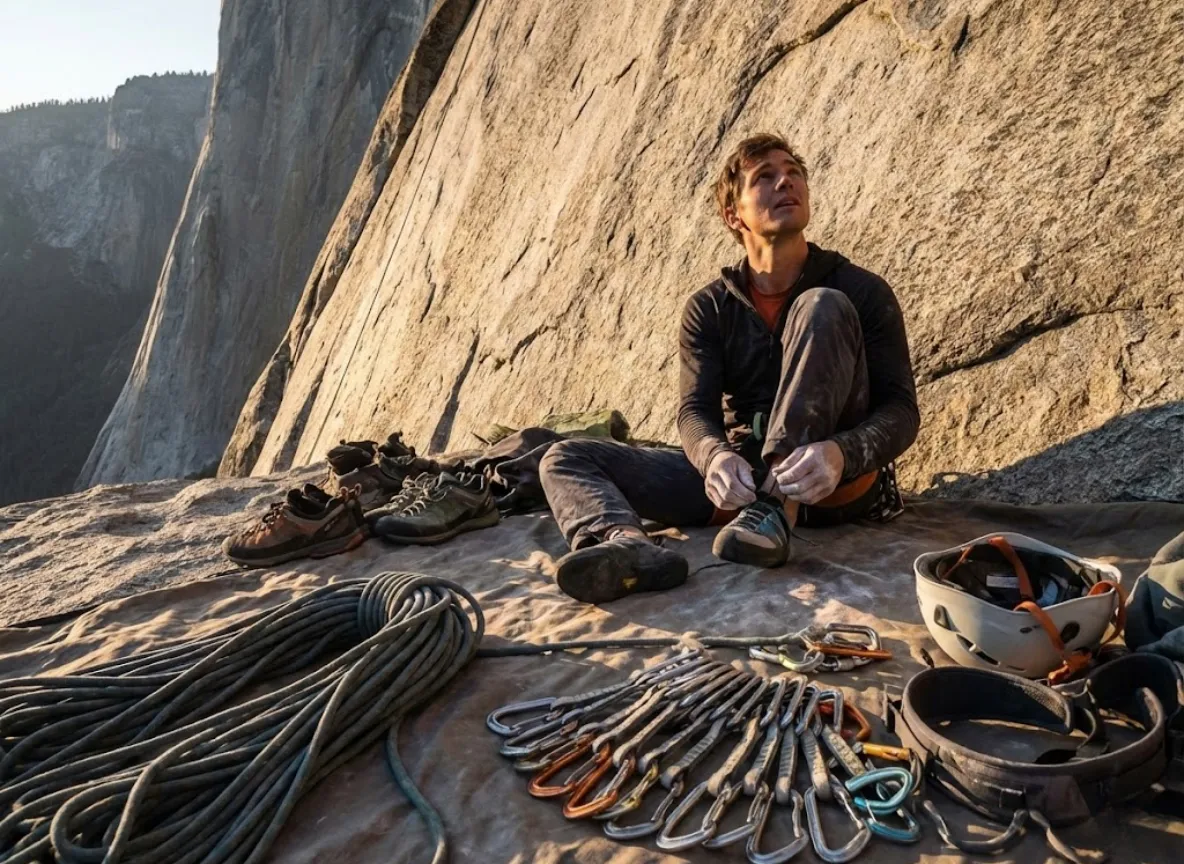
The padded floor is gone. Above you, there are no color-coded tape marks, only geological weakness and the humming silence of the vertical world. Stepping out of the gym transfers 100% of the safety burden from the facility manager to your own harness. This isn’t just a change of venue; it is a fundamental shift in safety preparedness where your gear stops being an accessory and starts being your lifeline.
As a guide, I’ve watched countless strong gym climbers freeze 40 feet up a real cliff because they didn’t trust their rock climbing equipment. The transition requires a new dossier of tools designed to manage gravity, abrasion, and rockfall in an uncontrolled environment. This guide maps that transition, functioning as a climber’s progression roadmap from the controlled plastics of indoor climbing to the complex reality of outdoor rock, equipping you with not just essential gear, but the life-support systems required for vertical independence.
How to Choose the Right Gear: An Expert’s Framework

Before you open your wallet for a commercial investigation of the market, you need to understand the objective mechanics of safety. Marketing copy focuses on colors and “send-ability,” but out here, we focus on failure points, breaking strength (kN), and metallurgy.
Why Does Certification and Metallurgy Matter?
If it doesn’t have a stamp, it doesn’t go on your rack. The foundation of outdoor safety is the regulatory framework established by the CE (Conformité Européenne) and the stricter, voluntary UIAA Safety Label from the International Mountaineering and Climbing Federation. These aren’t just logos; they are proof that the alloy in your hand has survived rigorous stress testing and that the manufacturer adheres to certification standards (ISO 9001) to prevent lethal defects.
Buying unverified PPE from random online marketplaces poses a genuine counterfeit risk. You must become obsessive about verifying the stamped ratings on your carabiners before trusting them with your life. Once you understand the safety stamps, you must understand the materials they certify, starting with the nylon that catches your fall.
Pro-Tip: Inspect your gear in good lighting. A micro-fracture in a carabiner or a soft spot in a rope core is invisible in a dim garage but obvious under a headlamp or bright sun.
How Does Shoe Rubber Affect Outdoor Performance?
Plastic holds are textured for friction; real rock is often polished glass or razor-sharp crystal. Your choice of rubber comes down to viscoelasticity: the trade-off between soft compounds for friction on smears versus stiff compounds for edging support. Soft rubber sticks to everything but wears out fast and offers zero support for your calves on long multi-pitch routes.

Fit mechanics also change outside. You might tolerate a crushing vacuum fit for a 3-minute bouldering problem, but learning more about climbing shoes fit secrets is crucial for routes where you can’t take your shoes off for hours. Be wary of the “stretch tax” on leather uppers, which can expand a full size, turning a precision tool into a sloppy slipper. Conversely, synthetic knit will hold its shape but might reek after a week in the desert.
What Distinguishes Sport from Trad Gear?
Your climbing harness determines your logistical ceiling. A gym harness is a sleek seat belt; an outdoor harness is a tool belt. The primary difference is racking capacity. Sport climbing requires a sleek 4-loop system for sport draws, while trad climbing demands a robust 5-loop setup to manage heavy racks of cams, nuts, and bolt hangers without sagging.

Hardware nuances matter too. You’ll want keylock noses on carabiners for snag-free sport clipping, versus extendable alpine draws for wandering trad routes that create rope drag. Even your belay device choice shifts; while Assisted Braking Devices (ABDs) like the Petzl GriGri are king for projecting, you must understand tube mechanics for rigging rappels. With the technical criteria established, we can apply this framework to mastering the gym to crag transition by selecting the specific tools that define your climbing future.
Our Selection Process: How We Built This Guide

We do not accept sponsored placements for safety-critical equipment. Our recommendations are based purely on technical specs, material science, and field durability. Every product was judged against the “Gym-to-Crag” criteria: durability against rock abrasion, UIAA/CE safety compliance, and functional ergonomics for outdoor mechanics—not just indoor ease-of-use. We analyzed metallurgical reports and over 60 data points from flagship products to isolate the “best-in-class.”
A Note on Affiliate Links: If you purchase through our links, we may earn a commission. This supports our research but never influences our safety verdicts.
The Best Climbing Gear of 2026: Our Top Recommendations for Every Need

Our Top Picks for The Sport Climbing Initiate
Petzl Spirit Express

The Petzl Spirit Express is the undisputed archetype of the modern sport quickdraw, and for good reason. The keylock nose interlocks like a puzzle piece, eliminating the infuriating snagging on bolt hangers that plagues cheaper wiregates. The ergonomic, variably wide dogbone is thick enough to grab comfortably when you’re desperately working a project (‘french freeing’). The bent gate on the rope end is tuned perfectly for rapid clipping. However, this performance comes at a premium price, and the bulky dogbones make them ill-suited for carrying on a lightweight alpine harness.
You Should Buy This If…
- You primarily climb sport routes and hate snagging on bolts.
- You want the easiest clipping action on the market.
- You project routes and often grab the dogbone.
You Should Reconsider If…
- You are building a lightweight alpine rack.
- You are on a strict budget (wiregates are cheaper).
Petzl Neox

The Petzl Neox represents a significant 2025 evolution in assisted braking, specifically tackling the ‘short-roping’ frustration common with the standard GriGri. By utilizing an internal wheel mechanism, it allows the rope to glide with almost zero friction when paying out slack, mimicking the fluid feel of a tube device while still engaging a cam during a fall. This eliminates the need for the specific ‘thumb press’ technique. The downside is that the wheel mechanism makes it less instant at locking for low-load situations, like hanging on a top-rope, and it is heavier and more expensive than its predecessors.
You Should Buy This If…
- You primarily lead belay and struggle with feeding slack quickly.
- You want the safety of assisted braking with the feel of a tube device.
- You are an early adopter of new belay technology.
You Should Reconsider If…
- You mostly top-rope (the GriGri locks faster for hanging).
- You are counting grams for a lightweight ascent.
Scarpa Instinct VS

The Scarpa Instinct VS is a precision instrument for the steep, technical demands of modern sport climbing. The moderately aggressive downturn combined with Vibram XS Edge rubber concentrates immense power onto the big toe, allowing you to stand on micro-edges that feel nonexistent in softer shoes. The Bi-Tension rand actively pulls power from the toes to the heel, keeping the shoe aggressive over time. However, the high-volume heel cup is a known fit issue for those with narrow heels, often leaving dead space that compromises secure hooking, and the break-in period is notoriously stiff.
You Should Buy This If…
- You need a precise shoe for small edges on vertical to overhanging rock.
- You want a shoe that maintains its shape over time (synthetic).
- You have a medium-to-wide forefoot.
You Should Reconsider If…
- You have a very narrow heel (high volume heel cup).
- You are looking for a flat, all-day multi-pitch shoe.
Mammut 9.8 Crag Classic

The Mammut 9.8 Crag Classic is the definitive ‘workhorse’ rope for the transition to outdoor climbing. Its 9.8mm diameter offers a reassuring balance: thick enough to withstand the abrasion of top-roping and repeated falls, yet thin enough to handle smoothly in a belay device. The high sheath proportion makes it incredibly durable against rough rock textures. While it is an excellent daily driver, it is not dry-treated, meaning it picks up dirt and aluminum oxide dust faster than treated ropes, eventually turning your hands black after a long season.
You Should Buy This If…
- You want a durable rope that can handle top-rope abrasion.
- You are buying your first outdoor rope and need reliability.
- You want a rope that feeds well in standard belay devices.
You Should Reconsider If…
- You are seeking an ultra-light rope for alpine pushes.
- You need a dry-treated rope for ice climbing.
Black Diamond Vision

The Black Diamond Vision solves the dilemma between heavy hardshells and fragile foam helmets. It uses a hybrid construction: a lightweight EPP foam core for shock absorption, capped with a polycarbonate crown patch to protect against rockfall. It is light enough (approx. 215g) to forget you’re wearing it on long approaches. However, because the hard shell only covers the top, the exposed foam on the sides is susceptible to cosmetic damage and gouges if you carelessly stuff it into your pack alongside sharp cams or nut tools.
You Should Buy This If…
- You want a helmet light enough to forget you’re wearing it.
- You climb in areas with loose rock (requires crown protection).
- You overheat easily and need maximum airflow.
You Should Reconsider If…
- You plan to sit on your helmet or shove it carelessly in a pack.
- You are on an extreme budget (hardshells are cheaper).
Our Top Picks for The Trad Apprentice
La Sportiva TC Pro

The La Sportiva TC Pro is the shoe that free-soloed El Capitan, and it remains the king of trad. Designed with a mid-height cuff, it protects your ankle bones from the brutality of wide crack jamming. The stiff flat last and Vibram XS Edge rubber provide a rigid platform for standing on tiny granite crystals all day without foot fatigue. The trade-off is a near-total lack of sensitivity; you often can’t ‘feel’ the rock under your toe, forcing you to trust the rubber blindly, and the stiff leather requires a painful break-in period.
You Should Buy This If…
- You are learning to jam cracks and want ankle protection.
- You climb long multi-pitch routes and need foot support.
- You primarily climb on granite or limestone edges.
You Should Reconsider If…
- You are bouldering steep overhangs (too stiff).
- You need high sensitivity for smearing on sandstone.
Petzl Adjama

The Petzl Adjama is tailored specifically for the logistical nightmare of trad climbing. Unlike sport harnesses, it features five gear loops, providing the critical real estate needed to rack a full set of cams, nuts, and alpine draws without overcrowding. The waist belt is designed to carry this heavier load without sagging, and the adjustable leg loops accommodate changing layers for alpine starts. However, the sizing can be tricky; the single waist buckle means if you are between sizes, the gear loops might not sit perfectly centered on your hips, and the padded waist belt can feel swampy in hot weather.
You Should Buy This If…
- You carry a double rack of cams and need the space.
- You climb in changing weather and need adjustable leg loops.
- You want a dedicated rear loop for tag lines or approach shoes.
You Should Reconsider If…
- You are a strict sport climber (it’s overkill).
- You want the lightest harness possible for redpointing.
Black Diamond Camalot C4

The Black Diamond Camalot C4 remains the industry benchmark for active protection. Its double-axle design allows for a massive expansion range, meaning a single cam can fit a wider variety of crack sizes compared to single-axle competitors. This range is incredibly forgiving for beginners learning to gauge crack width on the fly. While lighter than previous generations, the 4-lobe head width makes them difficult to fit into shallow pockets or pin scars compared to narrower specialty cams like Aliens or the BD Z4, and carrying a full rack adds significant weight on long approaches.
You Should Buy This If…
- You are building your first trad rack (start here).
- You want the most versatile placement range per unit.
- You need durable gear that withstands abuse.
You Should Reconsider If…
- You are climbing strictly in narrow pockets (single axle may be better).
- You are optimizing purely for ultra-light alpine speed records.
DMM Wallnuts

DMM Wallnuts are a masterclass in passive protection design. Unlike simple wedges, they feature a complex, scooped shape with a groove that allows them to bite into irregularities in the rock. This geometry enables them to sit securely in three different orientations, providing placement options in messy or irregular cracks where standard nuts might rattle out. The complexity of the shape does have a drawback: they can be significantly harder for the second climber to clean (remove) than simple flat-sided nuts, often requiring aggressive use of a nut tool and some cursing.
You Should Buy This If…
- You climb on limestone or irregular granite.
- You want the most secure passive placement possible.
- You need nuts that offer multiple placement orientations.
You Should Reconsider If…
- You only climb perfectly parallel splitter cracks.
- You prefer the classic straight taper of Wild Country Rocks.
Our Top Picks for The Comfort & Value Seeker
La Sportiva Tarantulace

The La Sportiva Tarantulace is the classic entry-level shoe for a reason. It uses an unlined leather upper that molds comfortably to the foot, providing a custom fit after the break-in period without the excruciating pain of performance shoes. The flat last and FriXion rubber offer a stable platform for learning footwork. However, that comfort comes with a ‘performance ceiling.’ The unlined leather stretches significantly—often a full size—making the fit sloppy over time, and the rounded toe shape lacks the precision needed for tiny edges on intermediate or advanced routes.
You Should Buy This If…
- You prioritize comfort above all else.
- You have ‘weird’ feet (leather molds to bunions/shape).
- You are on a budget but want reliable gear.
You Should Reconsider If…
- You need high performance for steep overhangs.
- You want a synthetic shoe that doesn’t stretch.
Petzl Corax
 ),
),
The Petzl Corax is the ‘everyman’ harness, renowned for its versatility. Its dual waist buckle design is a game-changer for fit; it allows for a massive range of adjustment, keeping the belay loop perfectly centered whether you’re wearing a t-shirt or a puffy jacket. It is robust, comfortable, and highly adjustable. The downside is bulk. The foam padding and extra buckles make it significantly heavier and less packable than sport-specific harnesses, taking up valuable space in your pack, and the gear loops are basic compared to higher-end models.
You Should Buy This If…
- You climb in varying temperatures/layers.
- You want one harness that does everything decently.
- You share a harness with someone of similar size.
You Should Reconsider If…
- You want a lightweight performance harness.
- You hate dealing with extra strap tail.
Black Diamond ATC-Guide

While assisted braking devices are popular, the Black Diamond ATC-Guide remains an essential tool for the outdoor climber. This tubular device allows for rappelling on two strands of rope—a mandatory skill for cleaning sport routes or retreating from multi-pitch climbs. Its ‘Guide Mode’ also allows for belaying two followers simultaneously directly from the anchor. However, it lacks any mechanical braking assistance, relying entirely on your hand strength to arrest a fall, and lowering a follower in guide mode is notoriously difficult and jerky without advanced rigging knowledge.
You Should Buy This If…
- You plan to do multi-pitch climbing.
- You need to rappel on two strands of rope.
- You want a lightweight backup device.
You Should Reconsider If…
- You only belay lead climbers in a gym setting.
- You require assisted braking for catching heavy falls.
Conclusion
The transition from gym to crag is not a shopping spree; it is an education in safety preparedness.
Standards Save Lives: Never compromise on UIAA/CE certifications. If the stamp isn’t there, the safety isn’t either. Fit Over Features: A $200 shoe that hurts too much to stand on is worthless compared to a $90 shoe that lets you focus on your footwork. Material Reality: Understand that soft rubber wears fast and leather stretches; buy your gear based on the rock you climb, not the marketing hype.
Before you head to the crag, inspect your gear, partner check every knot, and remember: safety is an active process, not a product you can buy.
FAQ – Frequently Asked Questions about Gym to Crag Gear
What is the most important piece of gear to buy first for outdoor climbing?
Climbing shoes and a harness. These are the two items that require a precise, personal fit for safety and comfort, unlike ropes or draws which can be shared. Consider the La Sportiva Tarantulace for a comfortable first outdoor shoe.
How long does climbing gear actually last?
Soft goods (nylon ropes or harnesses) have a maximum gear lifespan of 10 years even if unused, but regular use cuts this to 3-5 years. Hard goods (carabiners) can last indefinitely unless worn, cracked, or dropped from significant height. Check the Petzl Adjama details for more on gear maintenance.
Can I use my gym harness outdoors?
Yes, provided it is UIAA or CE certified and in good condition. However, gym harnesses often lack the gear loops necessary for carrying outdoor racks (quickdraws, cams, cleaning gear). Upgrading to something like the Petzl Corax offers better outdoor utility.
Do I really need a helmet for sport climbing?
Yes. Outdoors, the risk isn’t just hitting the wall; it is rockfall from above, dropped gear from other parties, and flipping upside down during a lead fall. The Black Diamond Vision offers protection without the bulk.
What other essentials should be in my kit?
Beyond the hardware, don’t forget the Ten Essentials. You should carry a chalk bag (with liquid chalk or a chalk ball), a stick clip to protect the first bolt, a rope bag to keep your line out of the dirt, a headlamp for late exits, and a knife for emergencies. If you are bouldering, a crash pad is mandatory.
Safety Notice: Rock climbing and mountaineering are inherently high-risk
activities that can involve physical trauma or fatal incidents. The information on Rock Climbing Realms is for
educational and informational purposes only. Techniques and advice presented here are not a substitute
for professional, hands-on instruction. Conditions and risks vary by location. Always seek guidance
from a qualified instructor before attempting new techniques. By using this website, you agree that you
are solely responsible for your own safety. Any reliance you place on this information is strictly
at your own risk, and you assume all liability for your actions. Rock Climbing Realms and its authors
will not be held liable for any harm, damage, or loss sustained in connection with the use of this information.
Affiliate Disclosure: We are a participant in the Amazon Services LLC Associates Program, an
affiliate advertising program designed to provide a means for us to earn advertising fees by advertising and linking
to Amazon.com. As an Amazon Associate, we earn from qualifying purchases. We are also an official affiliate partner
of Black Diamond Equipment via the AvantLink network. If you click on a Black Diamond affiliate link and make a
purchase, we may earn a commission at no additional cost to you. We also participate in other affiliate programs.
Additional terms are found in the terms of service.