
In this article
You’re three pitches up a granite wall when your partner goes limp on the rope. Maybe they took a rock to the helmet. Maybe it’s heat exhaustion. Either way, they’re hanging unconscious 40 feet below your anchor, and the nearest SAR team is hours away—if they can even reach you. After fifteen years of guiding in the high country, I’ve been in this situation twice. Both times, the skills I’m about to share got us down safely.
This guide walks you through the complete counterbalance rappel rescue protocol—from escaping your belay to lowering an incapacitated partner to safety. You’ll learn the mechanical principles, the step-by-step rigging, the gear requirements, and the critical failure points that can turn a rescue into a tragedy.
⚡ Quick Answer: A counterbalance rappel rescue lets you descend while simultaneously lowering an unconscious partner by using the anchor as a redirection point. First escape your belay using a Munter-Mule-Overhand knot and friction hitch to secure the victim. Then rig your rappel device on the opposite strand of rope so you and your partner act as counterweights. Control the descent with an autoblock backup and, if needed, pass knots when you run out of rope.
Understanding Counterbalance Mechanics
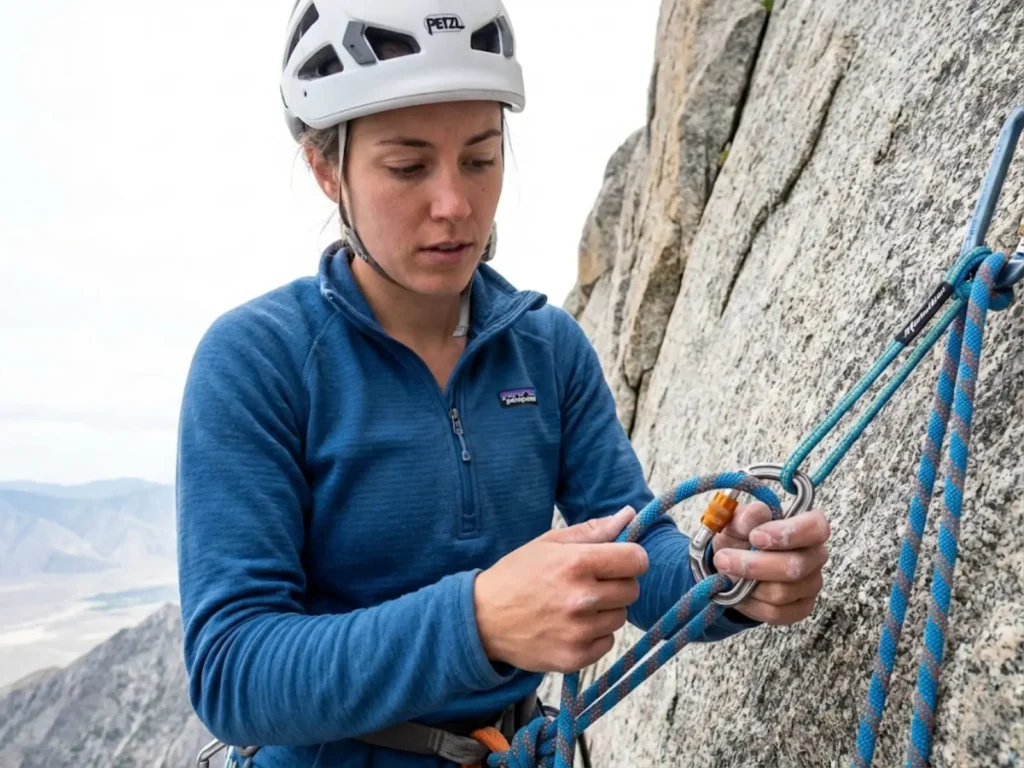
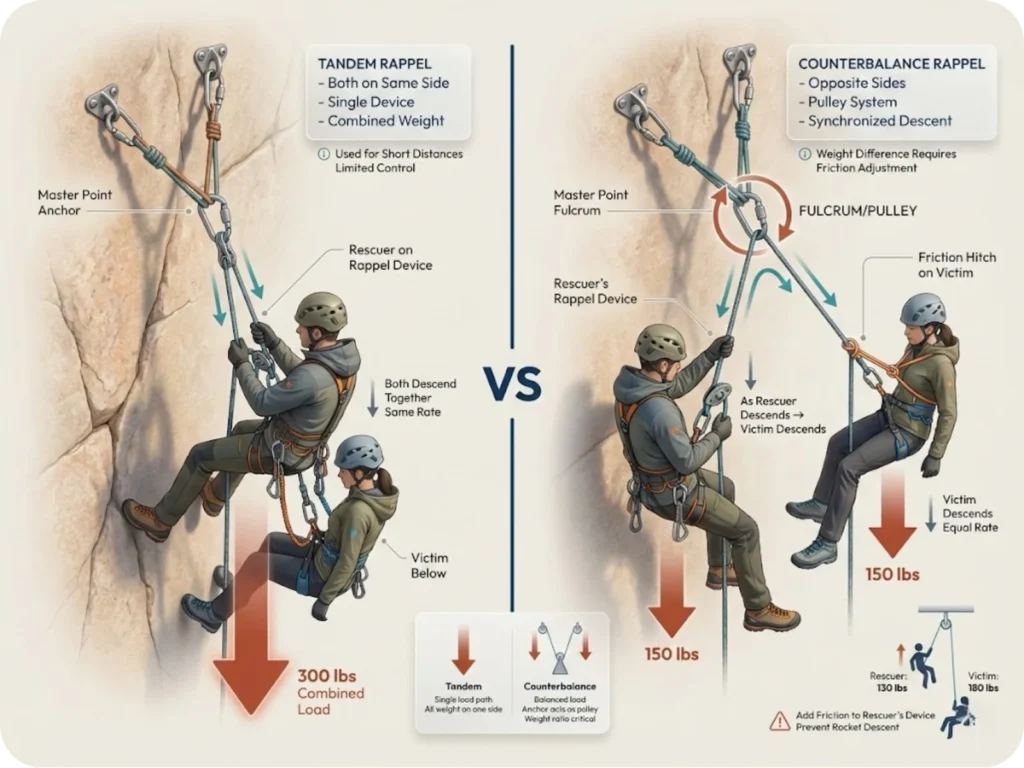
The counterbalance system works on a simple principle: you and your partner are on opposite sides of the anchor, acting like weights on a pulley. As you descend, the victim descends at the same rate. It’s fundamentally different from a tandem rappel, where both climbers hang from the same device and descend together.
The anchor’s master point becomes your fulcrum. A locking carabiner there redirects the rope, and whatever weight you put on one side pulls the other side down. If you weigh less than your partner, you’ll need extra friction on your device—otherwise, you’ll rocket down while they barely move.
Understanding your gear matters here. Dynamic ropes stretch 5-10% under static load, so when you transfer weight from one system to another, expect the rope to extend by a foot or two. That’s normal. Plan for it. A tight system suddenly gets looser when you add body weight, and that slack has to go somewhere.
Pro tip: Before committing to the descent, “weight and stress” the entire system while still clipped to your personal anchor tether. Load your rappel device, let your weight settle, and confirm the friction hitch holding the victim hasn’t slipped. If something’s wrong, you’ll find out while you can still fix it.
The anchor must pass the EARNEST criteria: Equalized, low Angles, Redundant, No Extension, Solid, and Timely. During a rescue, you’re loading that anchor with two people—often in dynamic, unbalanced configurations. A single-point failure here is catastrophic. If you’re unsure about multi-pitch anchor systems, this isn’t the time to learn. Practice those fundamentals before you need them.
The Physics of Weight Transfer
When you transfer the victim’s weight from your belay device to a friction hitch, the rope extends. A 200-pound climber on a 60-meter dynamic rope can stretch it 6-10 feet. This is why you need a catastrophe knot tied below your primary lock-off—if anything slips during the transfer, that backup catches the load.
Every redirect through a carabiner eats efficiency too. You lose about 10-15% of mechanical advantage per redirect, which matters less in a simple counterbalance but becomes significant if you’re building complicated systems. Keep it simple. Complicated systems fail in ways you can’t predict.
When Counterbalance Is the Right Choice
Not every rescue calls for counterbalance. On straight vertical walls with clean rappels below, a redirected lower or standard tandem is often faster. But when terrain gets steep—roofs, overhangs, traverses—counterbalance shines. You can maneuver around obstacles because you’re descending independently of the victim.
According to 2024 climbing accident statistics, 46 accidents occurred during descent compared to 100 during ascent. The data shows that experienced climbers aren’t immune: experts were involved in 33 accidents, while beginners accounted for just six. Technical terrain demands practiced self-rescue skills, regardless of how many years you’ve been climbing.
Phase 1: Escaping the Belay
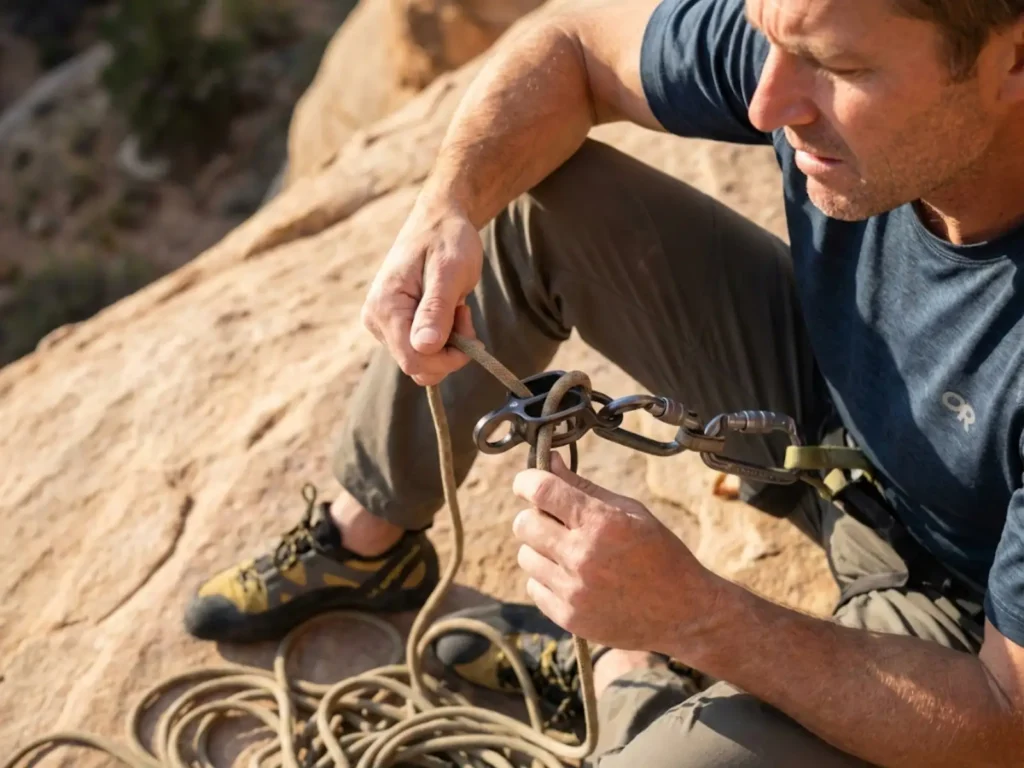
The belay escape is the foundation of all self-rescue. If you can’t escape, you can’t help your partner. Period.
Most multi-pitch leaders belay the follower in guide mode using a plaquette device like the Petzl Reverso or Black Diamond ATC Guide. When your partner weighs the rope, the device locks. That’s great for holding a fall—not so great when you need to move.
Here’s what research on climber fatigue tells us: after 24 hours of continuous climbing, grip strength drops by 9.2%, and static hang time—how long you can hold onto something—plummets by 71.2%. Those are sobering numbers. In a rescue, you use mechanical systems, not muscle. Every time you’re tempted to “just hold it” with your bare hands, remember that fatigue is already working against you.
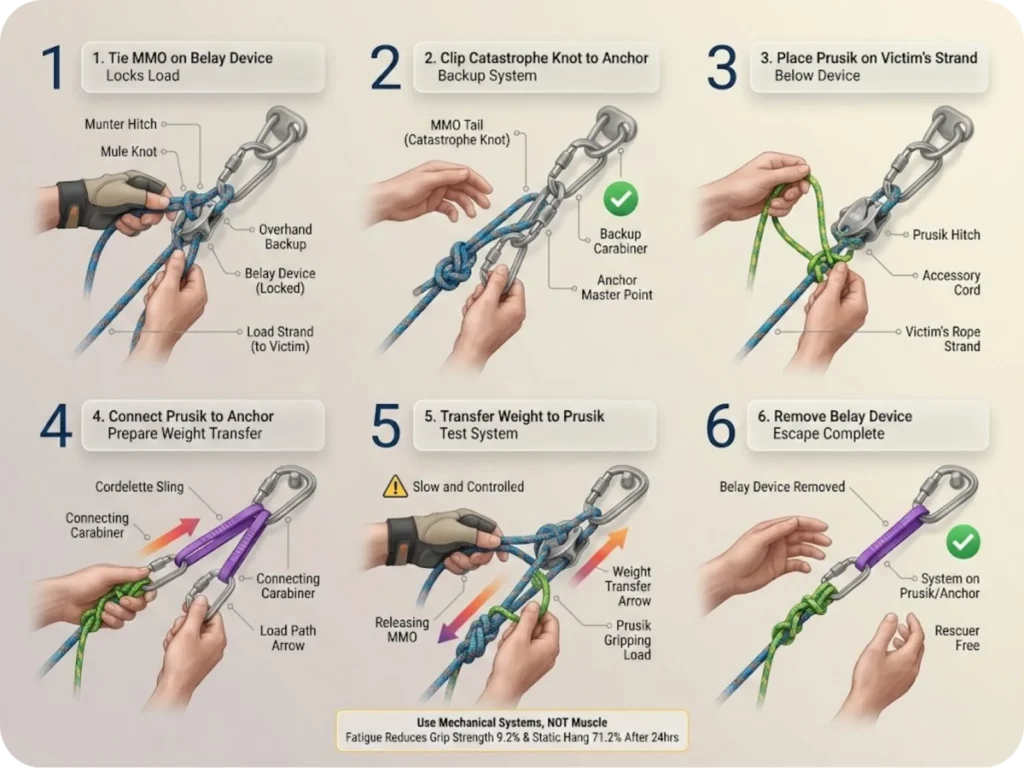
Step 1: Lock Off the Belay Device
The Munter-Mule-Overhand knot (MMO) is your primary lock-off. Tie it directly onto the brake carabiner of your belay device. The mule provides the lock; the overhand provides the backup.
Dress the knot tightly. A sloppy mule can slip under dynamic loading—and in a rescue, loads are rarely predictable. Leave a 12-18 inch tail so you can release it easily later when you need to transfer weight.
Step 2: Install the Catastrophe Knot
Tie a figure-eight on a bight in the brake strand, below the MMO. Clip this to a secure point on the anchor with a locking carabiner. This is your “oh shit” backup. If the MMO accidentally releases during weight transfer, the victim stays connected to the anchor instead of falling.
Don’t skip this step. I’ve watched experienced climbers omit it because “the MMO is solid.” It is—until it isn’t. Redundancy isn’t paranoia; it’s professionalism.
Step 3: Rig the Load Capture System
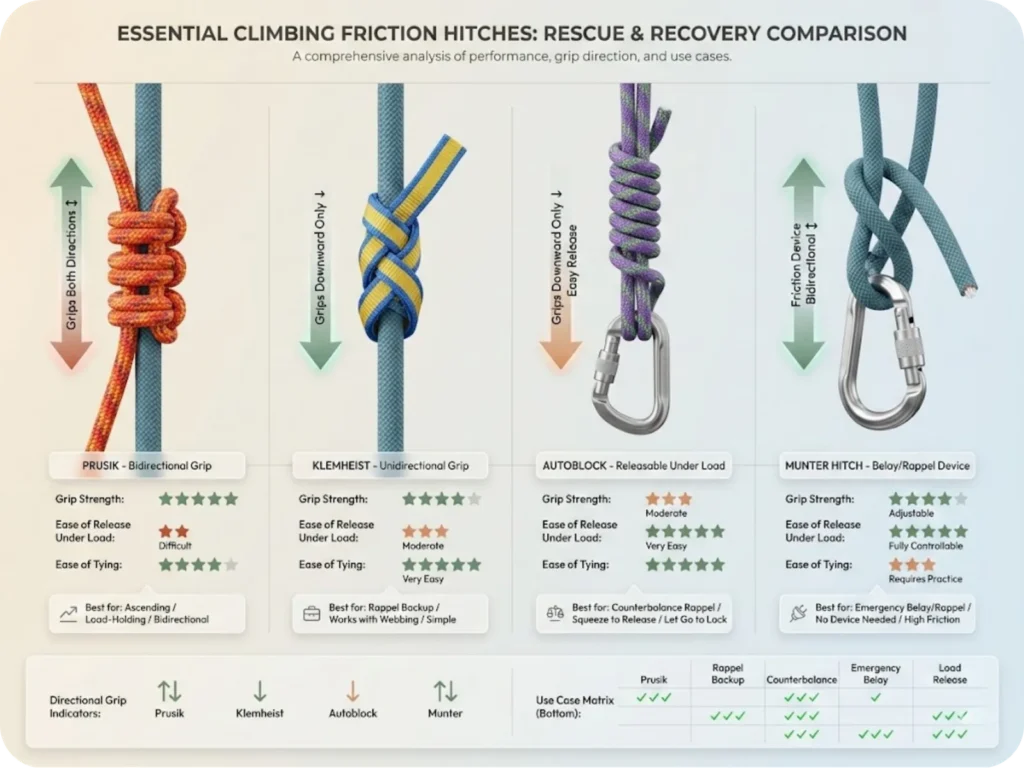
Now you need to capture the victim’s weight on a separate system so you can remove the belay device. Place a 3-wrap Prusik (or Klemheist) on the victim’s strand of rope, above the belay device. This friction hitch will hold them when you release the MMO.
Connect a 6-7mm cordelette from the Prusik back to the anchor using a load-releasable hitch—either a Mariner’s hitch or a Munter-Mule on a separate carabiner. This assembly is sometimes called a “rescue spider” or “Radium release.” It lets you lower or adjust the victim’s position later.
Pro tip: Pre-tie your Prusik loops at home using Sterling Hollow Block or similar cord. Fumbling with loose cord in a stressful situation wastes time you may not have.
Step 4: Transfer the Weight
Slowly untie the MMO on the belay device. As the rope slides, the victim’s weight transfers from the device to the Prusik and cordelette. Once the belay device is slack, remove it from the anchor. You’re now free to move—the victim is held entirely by the friction hitch system.
This transfer is the moment of highest risk. Move slowly. Watch the Prusik. If it starts to slip, stop immediately and troubleshoot before continuing. Only when everything is stable do you proceed to rigging the counterbalance descent.
Phase 2: Rigging the Counterbalance Descent
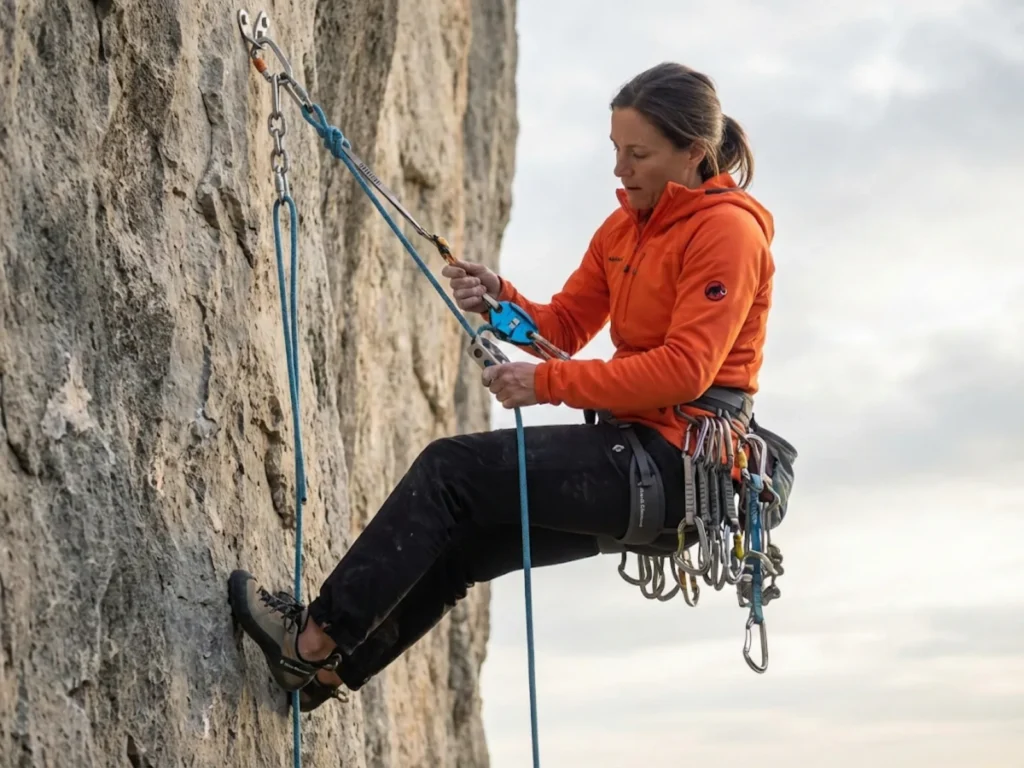
With the victim secured on the load capture system, you can now rig for the actual descent.
Clip a locking carabiner to the anchor’s master point. This is your redirection—the “rap ring” that creates the counterbalance. Pass the victim’s rope through this carabiner, so the strand runs from the Prusik, through the redirect, and then down the opposite side.
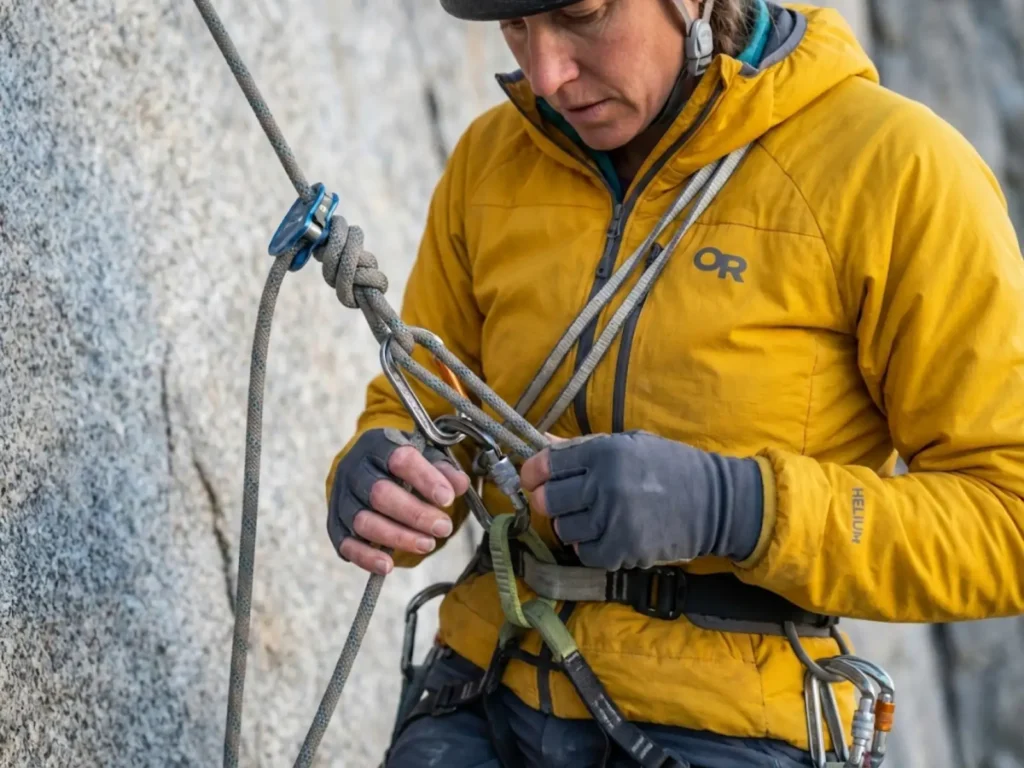
You’ll attach your own rappel device to that free strand. Use a rappel extension—the Petzl Connect Adjust or a double-length sling—to keep the device at eye level. This positioning lets you see what you’re doing, and more importantly, it gives you space to attach an autoblock backup to your belay loop without the device interfering.
The autoblock is your “third hand.” A 3-wrap Klemheist or Prusik below the device grabs the rope if you let go. In a normal rappel it’s optional; in a rescue it’s mandatory. You’ll have enough to manage without worrying about losing control of the descent.
Pro tip: Use a Klemheist instead of a Prusik for the autoblock—it’s easier to release if you need to adjust mid-rappel.
If you need a refresher on basic rappel safety fundamentals, review those skills before attempting a rescue. The counterbalance demands precise rope handling, and mistakes compound quickly.
Setting Up the Redirection
Thread the victim’s rope through the locking carabiner at the master point. Verify the gate is locked—say it out loud if you have to. Check for twists in the rope that could create friction or catch on the carabiner.
The rope now runs from the victim (held by the Prusik), up through the redirect, and down the opposite side where you’ll clip in. Both strands should run cleanly without crossing or tangling.
Attaching Your Rappel Device
Clip your device—ATC, Reverso, or Grigri—to the free strand. If using an assisted-braking device like the Grigri, understand that the ergonomics differ in a counterbalance setup. Test it before committing.
With the rappel extension in place, your device sits at chest or eye level. Below the device, tie your autoblock and clip it to your belay loop. The autoblock should have enough friction to lock the rope if you release your brake hand, but not so much that it jams when you want to descend.
Weight Testing the System
Before unclipping from the anchor, load everything. Weight your rappel device while keeping your PAS loosely connected. Feel the system settle. Confirm the Prusik holding the victim hasn’t slipped. Confirm your autoblock engages and releases properly.
If anything feels sketchy—odd sounds, unexpected movement, a Prusik that seems loose—stop. Fix it now. Once you unclip from the anchor, you’re committed. The time to troubleshoot is before you leave your last secure connection.
Phase 3: Executing the Descent
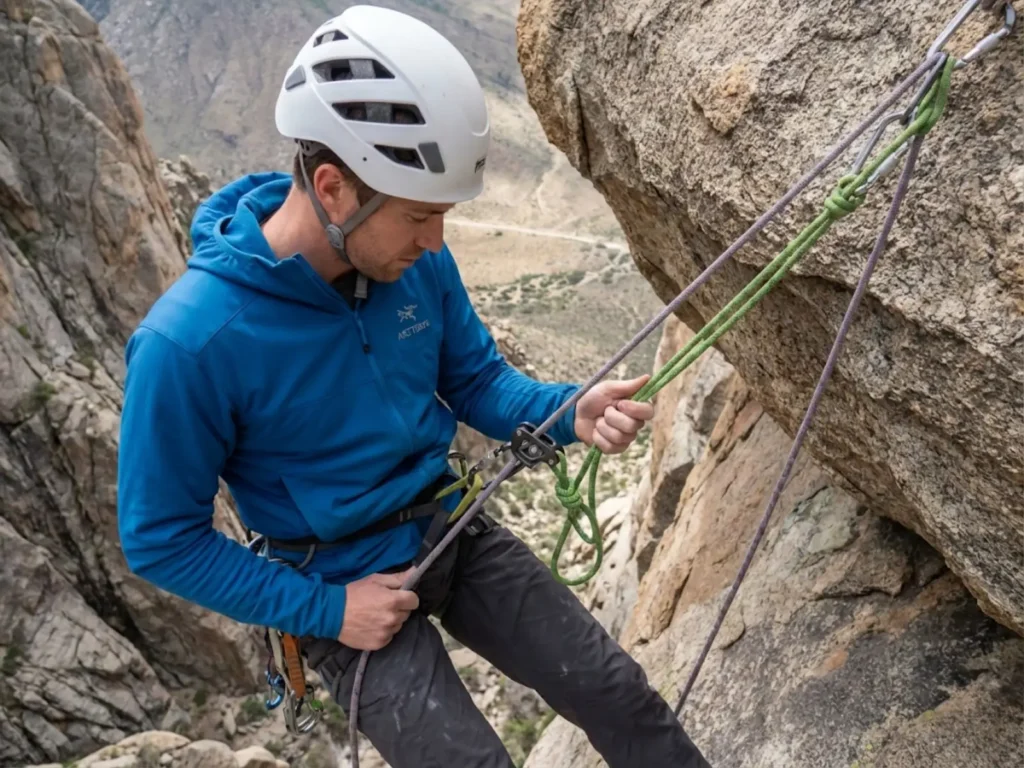
You’ve escaped the belay, rigged the counterbalance, and tested the system. Now you descend.
Release the load-releasable hitch at the anchor—the Mariner’s or Munter-Mule holding the victim’s Prusik. As that slack plays out, the victim begins to lower while you begin to descend. Control your speed with the autoblock. Squeeze it to release; let go to lock.
Move deliberately. The victim is unconscious and can’t protect their head. If you descend too fast, they’ll swing or spin, potentially striking the wall. Smooth, controlled movement keeps everyone safer.
If the victim outweighs you significantly, you’ll feel yourself being pulled down. Add friction to your device—extra wraps on an ATC, or use the essential climbing knots like the Munter hitch for more control. In extreme weight mismatches (more than 50 pounds difference), you may need a mechanical advantage system instead.
Reaching the Victim
Once you reach the victim, establish a hard connection. Clip a locking carabiner and sling from your belay loop to theirs. Now you’re physically attached. Even if something else fails, you won’t lose them.
If the victim is unconscious, check their airway and breathing immediately. Tilt their head to the side to prevent aspiration if they vomit. Suspension syndrome is a real danger—when someone hangs motionless in a harness, blood pools in their legs, potentially causing fainting or cardiac arrest. Speed matters. Get them horizontal or to the ground as quickly as safety allows.
Transitioning to Tandem Descent
With the victim secured to you, the final descent can be a tandem rappel—both of you hanging from your device, descending together. Transfer their weight from the original rope to your harness or a dedicated tandem setup. Keep your autoblock engaged. Move smoothly down the wall.
If terrain is complex—traverses, roofs, loose rock—take extra care. You’re maneuvering two bodies now. Use your feet against the wall to push off and steer around obstacles. The victim can’t help, so you provide all the control.
Advanced Techniques: Passing Knots and Rope Management
In multi-pitch self-rescue, a single rope length rarely reaches the ground. You’ll often join ropes with a flat overhand or Flemish bend, and that knot will eventually reach your device. When it does, you need to “hop” over it without losing control.
Stop 10-15 cm above the knot. Install a backup—a Prusik or mechanical rope grab like a Petzl Pro Traxion—above the knot and connect it to your harness. Unload your rappel device by sliding the Prusik up and sitting into it. Now your weight is on the Prusik, and the device is slack. Remove the device, re-rig it below the knot, and lock the carabiner.
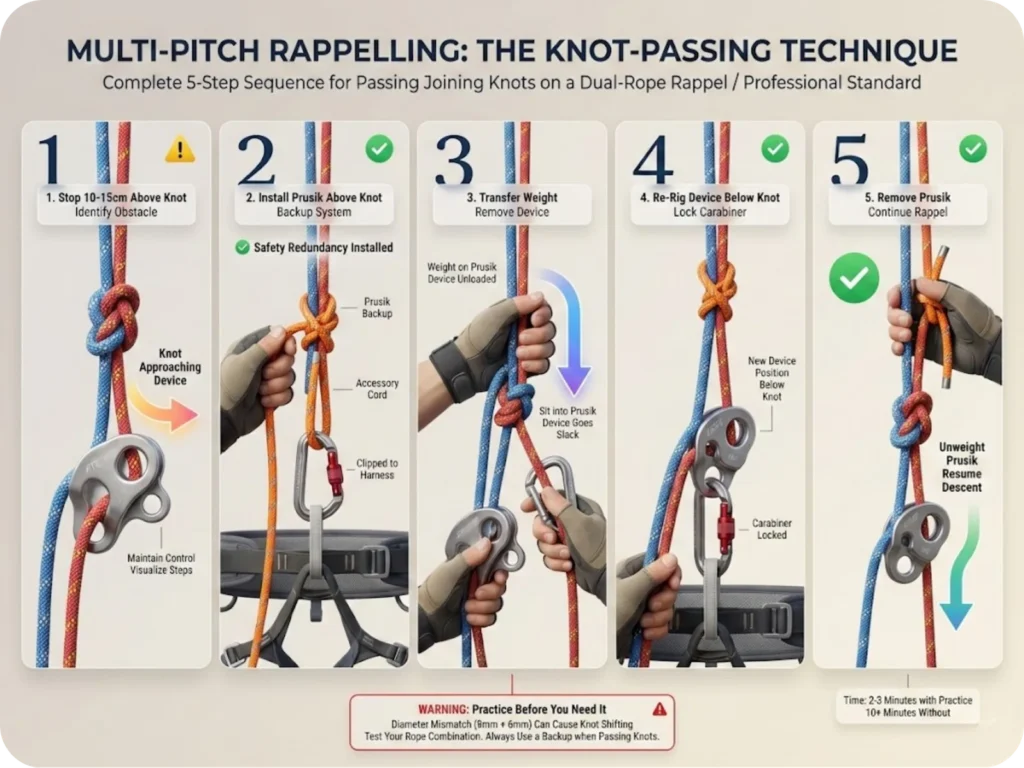
To resume, use a foot loop or muscle power to unweight the Prusik, then remove it and continue rappelling. The whole sequence takes 2-3 minutes once you’ve practiced it. Without practice, it can take ten—or worse, lead to mistakes that strand you mid-wall.
Modern climbers often pair a 9mm single rope with a 6mm cordelette as a tag line. The diameter mismatch creates problems: friction differences can cause the joining knot to shift at the rappel ring, leading to an unbalanced system or a jammed knot. Test your specific rope combination before you rely on it in a real rescue.
The Sling Method for Rope Deficits
Sometimes the knot reaches the anchor before you reach the next station—a “rope-length deficit.” One emergency technique uses a 60cm sling to pull the knot through the anchor while descending. You clip the sling to the knot and the anchor, allowing the knot to pass through the system as you lower.
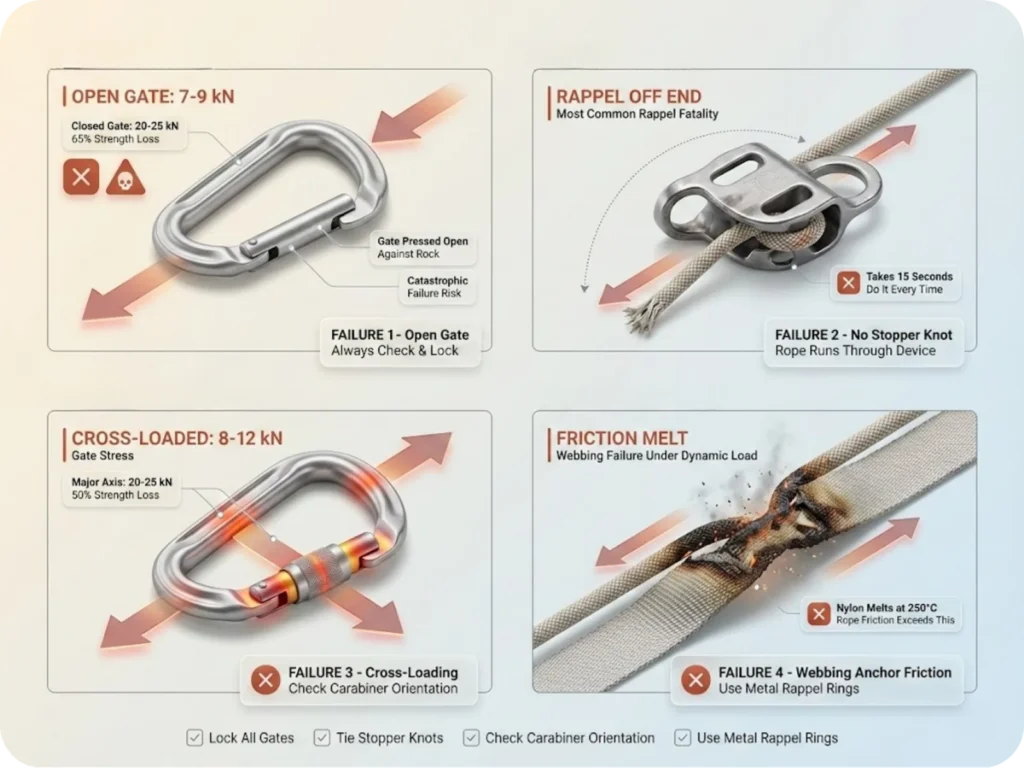
Critical warning: this only works on metal-to-metal anchors—rap rings or chains. Rope sliding under load generates enormous friction. On webbing anchors, that friction will melt the nylon in seconds. Use this technique only when you have no alternative and only on hardware anchors.
Critical Failure Points and How to Avoid Them
Rescues fail for predictable reasons. Know the failure points, and you can avoid them.
Failure to close the system. Tying stopper knots in the rope ends prevents rappelling off the end—the single most common cause of rappel fatalities. It takes 15 seconds. Do it every time. If you’re not in the habit, build the habit now, on easy terrain, before you’re stressed and distracted.
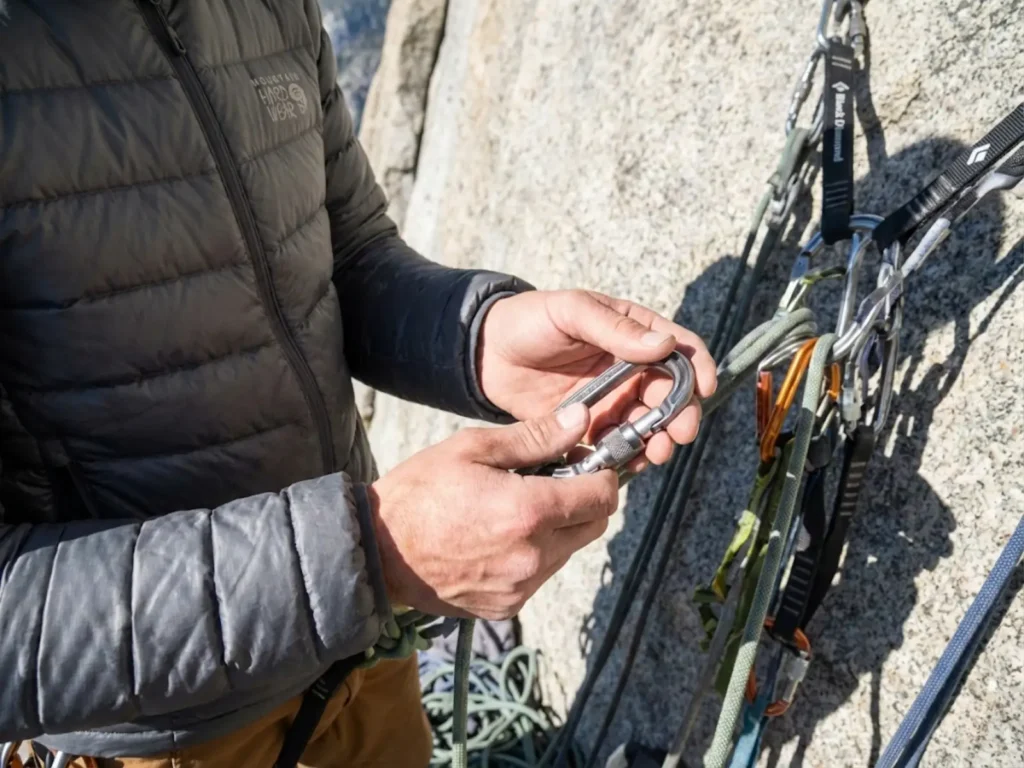
Open gate carabiners. During complex transitions, carabiners can become cross-loaded or have their gates pressed open against the rock. Open gate strength is only 7-9 kN—well below the 20-25 kN major-axis rating. That’s not enough for a rescue load. Check every carabiner. Check them twice. Verify gates are locked before you weight anything.
If you need a refresher on rappel safety techniques, review them. Most of those mistakes are amplified in a rescue scenario where stress and fatigue compromise your judgment.
The Perishable Skills Problem
Escaping the belay and passing knots are classified as perishable skills. Without regular practice, even professional guides can forget the sequence under stress. The AMGA recommends practicing self-rescue skills at least once per season.
I keep a spare rope at home and run through these sequences in my garage every few months. It sounds obsessive, but when I needed these skills for real—on a remote wall with an unconscious partner—I didn’t have to think. My hands knew what to do. That muscle memory doesn’t come from reading; it comes from repetition.
Gear Requirements and System Redundancy
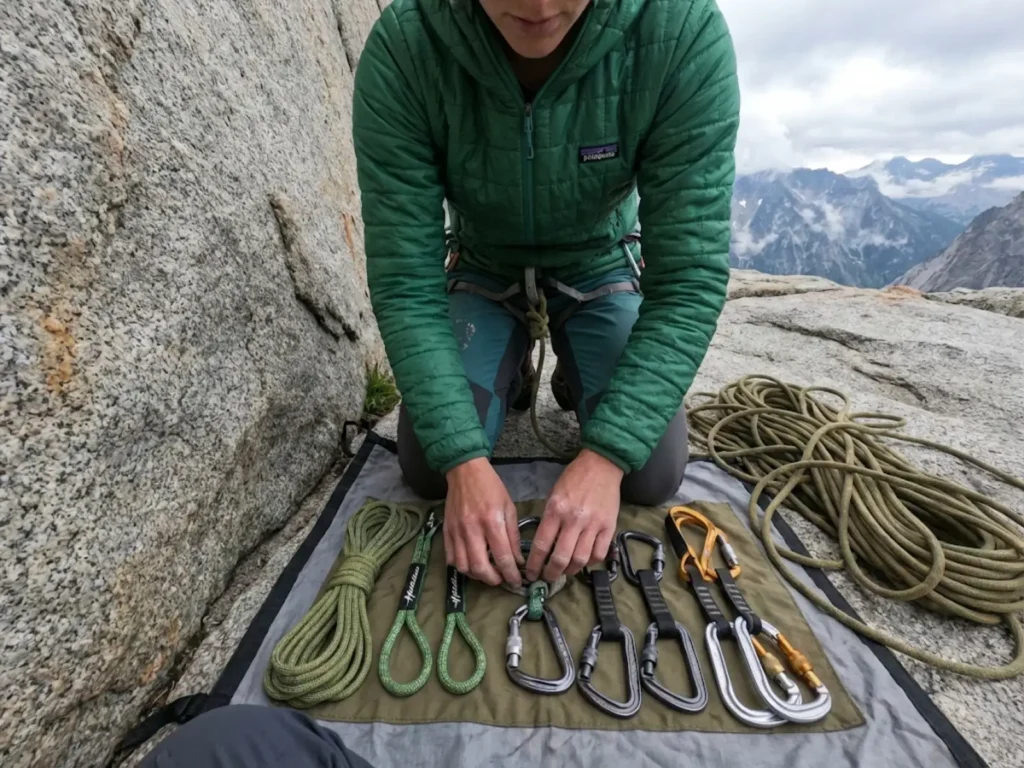
Every multi-pitch climber should carry a minimal rescue kit: a 6-7mm cordelette (20-25 feet), pre-tied Prusik loops, at least three extra locking carabiners, and a rappel extension. This gear adds about a pound to your rack. Compared to being stranded on a wall with no options, that weight is trivial.
Your plaquette device—Petzl Reverso, Black Diamond ATC Guide, or similar—is the foundational tool for rescue. Practice escaping the belay with your specific device. Each model handles slightly differently in guide mode, and you don’t want to discover quirks during an actual emergency.
Understand the difference between dynamic and static considerations. Dynamic ropes stretch 25-35% under impact loads—great for catching falls, tricky for precise weight transfers. Know your rope’s stretch characteristics. When rigging, account for the extension that occurs when you load the system.
Friction Hitch Selection
Different hitches for different jobs:
- Prusik (3-wrap): Multi-directional, grips in both directions, difficult to release under load. Best for primary load capture.
- Klemheist: Directional—only grips one way. Easier to release under load. Good for autoblocks and “bumping” down a rope.
- Autoblock: Directional, releases easily under load. Your go-to “third hand” backup during rappel.
- Munter hitch: Not a friction hitch but critical for rescue. Multi-directional, excellent for controlled lowering. Know this hitch cold.
Pro tip: Carry two pre-tied Prusik loops and one longer piece of cord for building a Klemheist on the fly. That combination covers nearly every rescue scenario.
Conclusion
The counterbalance rappel rescue is a high-stakes maneuver that demands technical precision, practiced muscle memory, and a conservative approach to risk. The accident statistics tell the story: experienced climbers aren’t immune to descent accidents, and the consequences of being unpracticed are severe.
Three things matter most. First, practice these skills in a controlled environment—your garage, a climbing gym, a low-stakes cragging day—before you need them on a big wall. Second, always close the system with stopper knots, redundant backups, and proper friction hitches. Third, respect the limits of fatigue. Use mechanical advantage, not brute strength. Your body will fail you when you need it most; your gear won’t.
Next time you rack up for a multi-pitch route, take an extra 30 seconds to check your rescue kit. That cordelette, those Prusik loops, that extra locker—they’re not dead weight. They’re your insurance policy when gravity turns against you.
FAQ
Can I perform a counterbalance rappel rescue if I weigh significantly less than my partner?
Yes, but you’ll need extra friction on your rappel device to prevent being pulled down too fast. Use extra wraps on your ATC or switch to a Munter hitch. For extreme weight differences (more than 50 pounds), consider building a mechanical advantage system with a 3:1 haul before attempting the descent.
What’s the difference between a counterbalance rappel and a tandem rappel?
In a tandem rappel, both climbers hang from the same device and descend together. In a counterbalance, you and the victim are on opposite sides of a redirection point at the anchor, acting as weights on a pulley system. Counterbalance works better for overhanging terrain or unconscious victims who can’t assist.
How do I know if my anchor is strong enough for a counterbalance rescue?
Your anchor must meet EARNEST criteria: Equalized, low Angles, Redundant, No Extension, Solid, and Timely. You’re loading it with two people in potentially dynamic configurations. Use at least two independent anchor points with a master point rated for 20+ kN. If you have any doubts, reinforce the anchor before starting the rescue.
What should I do if my partner is unconscious when I reach them?
Check their airway and breathing immediately. Tilt their head sideways to prevent aspiration if they vomit. Establish a hard connection by clipping a locking carabiner and sling from your belay loop to theirs. Be aware of suspension syndrome—blood pools in their legs while they hang motionless, which can cause cardiac arrest. Get them horizontal or to the ground as fast as safety allows.
Do I need to take a formal self-rescue course to learn this technique?
Studying the theory is valuable, but hands-on practice with a certified instructor is strongly recommended. Self-rescue skills are perishable—without regular practice, you’ll forget the sequence under stress. The AMGA recommends refreshing these skills at least once per season, and many climbers take a formal course every 2-3 years.
Safety Notice: Rock climbing and mountaineering are inherently high-risk
activities that can involve physical trauma or fatal incidents. The information on Rock Climbing Realms is for
educational and informational purposes only. Techniques and advice presented here are not a substitute
for professional, hands-on instruction. Conditions and risks vary by location. Always seek guidance
from a qualified instructor before attempting new techniques. By using this website, you agree that you
are solely responsible for your own safety. Any reliance you place on this information is strictly
at your own risk, and you assume all liability for your actions. Rock Climbing Realms and its authors
will not be held liable for any harm, damage, or loss sustained in connection with the use of this information.
Affiliate Disclosure: We are a participant in the Amazon Services LLC Associates Program, an
affiliate advertising program designed to provide a means for us to earn advertising fees by advertising and linking
to Amazon.com. As an Amazon Associate, we earn from qualifying purchases. We are also an official affiliate partner
of Black Diamond Equipment via the AvantLink network. If you click on a Black Diamond affiliate link and make a
purchase, we may earn a commission at no additional cost to you. We also participate in other affiliate programs.
Additional terms are found in the terms of service.