
In this article
The redpoint burned in your fingertips. You’d worked this V6 for three weeks, finally sticking the crux crimp—only to feel your skin slide off like you’d dipped your fingers in cooking oil. Looking down, you saw it: a chalky, greasy sheen coating the hold, the residue of a dozen climbers before you. That send slipped away not because you lacked the strength, but because nobody bothered to brush the damn holds.
After years of projecting in gyms and at outdoor crags from Fontainebleau to Red Rocks, I’ve learned that proper brushing technique separates climbers who send from climbers who slip. Here’s exactly how to maximize your friction, respect the rock, and become the kind of climber everyone wants at their crag session.
⚡ Quick Answer: Brushing holds removes the granular layer of excess chalk and skin oil that reduces friction. Use a boar’s hair brush for outdoor rock (especially sandstone and limestone), brush with “the flick” to eject dust rather than grinding it in, and always clean your tick marks before you leave. The rule is simple: first brush, first climb—and leave the rock cleaner than you found it.
Why Brushing Actually Matters (The Friction Science)
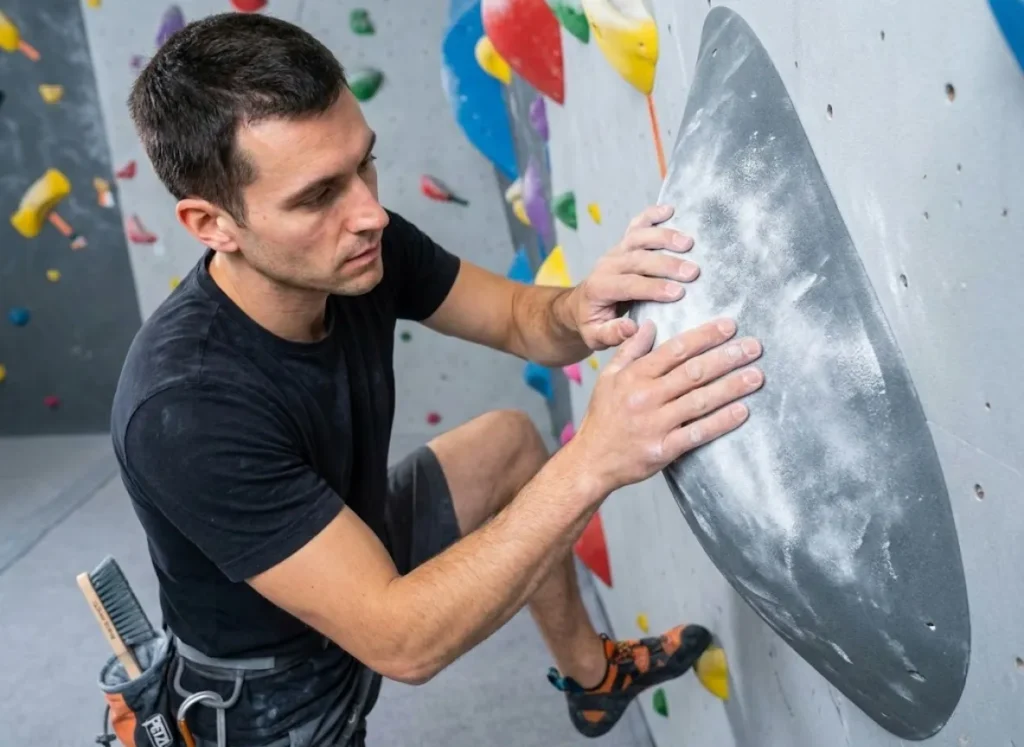
You’ve probably heard people say “brush the holds” like it’s gospel. But here’s the thing most climbers don’t understand: excessive chalk can actually work against you.
The Chalk Paradox: Help or Hindrance?
Chalk absorbs sweat and skin oils from your fingertips—that’s why it helps you improve friction and get better grip on holds. Research published by the National Institutes of Health has shown chalk can boost friction on limestone and sandstone by roughly 18-21%. That’s significant. The difference between sticking a crux and greasing off often comes down to that percentage.
But there’s a catch. When too much chalk accumulates on a hold, it creates what you might call a “granular layer”—loose particles rolling around like tiny ball bearings between your skin and the rock. Instead of your finger molding into the texture of the hold, you’re sliding on a bed of dust.
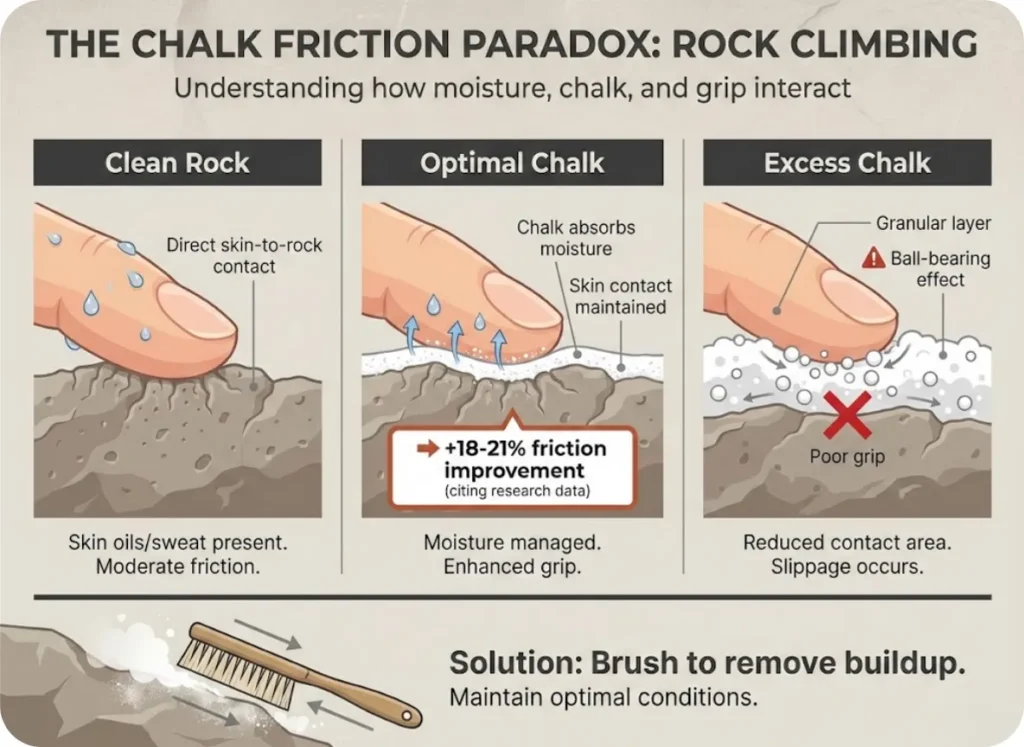
This is why regular brushing matters. You use chalk to manage moisture, then brush vigorously to remove chalk buildup and that sliding layer. A “caked” hold gives you the worst of both worlds—accumulated grime plus a rolling layer of particulate.
Pro tip: If the hold feels slick but looks chalked, that’s your cue. The granular layer is acting like lubricant. Time to brush.
How Friction Actually Works on Rock
Your fingertips grip rock through two mechanisms. First, there’s adhesion—bonding between your skin and the rock surface. Second, there’s interlocking—your skin physically deforming into the tiny textures and features of the hold.
Here’s the key insight: your skin is pliable. When it’s slightly hydrated (not sweaty, just supple), it can mold into rock texture like soft clay pressing into a mold. This maximizes contact area and therefore grip.
But if there’s loose chalk, rubber residue, or tick marks caked on that surface, your skin can’t do its job. It’s hitting a barrier instead of bonding with rock. Brushing clears that barrier. It’s not about rituals—it’s about getting your skin back in direct contact with stone.
The Moisture Curve: Too Dry vs Too Wet
Skin friction follows a bell curve. Too dry, and your skin becomes glassy—it loses the compliance needed to wrap around texture. Too wet (sweaty palms, humid conditions), and you get a slippery film that causes instant slip.
Chalk manages the “too wet” end of the problem. But the rock surface has to be clean enough to let adhesion happen. On muggy summer days at the crag, you’ll notice holds going from chalky-white to dark-streaked within hours. That’s the oil-chalk sludge building up. Frequent brushing becomes even more critical in those conditions.
Rock Types & How They React to Brushing
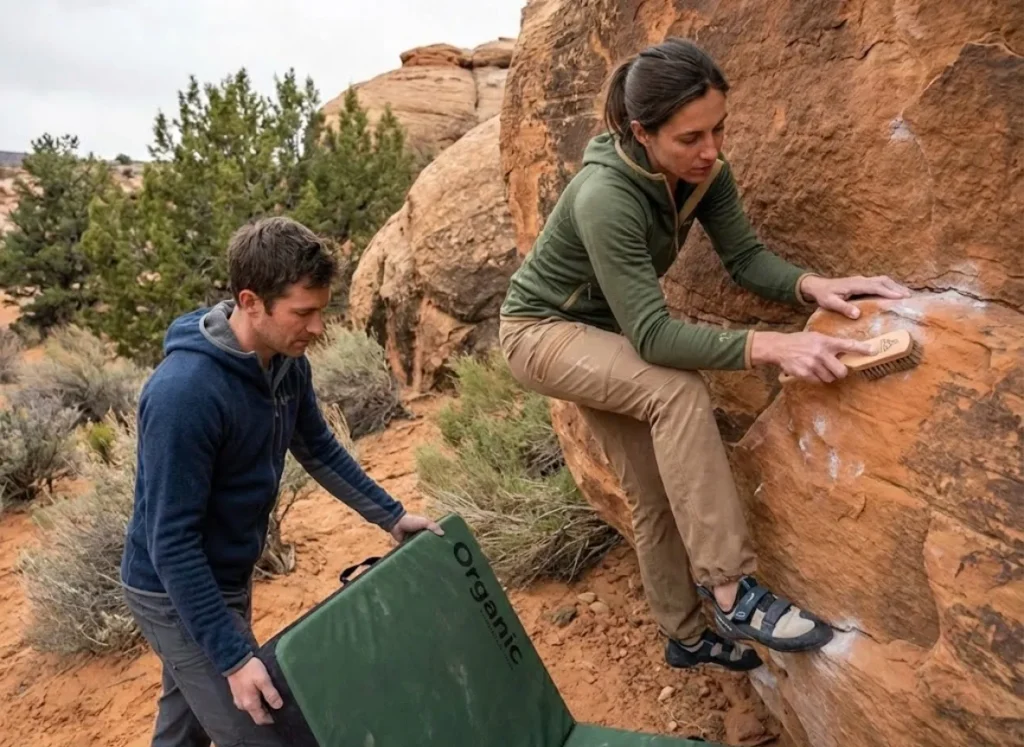
Not all rock is created equal. The brushing technique that works on gym plastic might destroy outdoor sandstone. Knowing your rock type keeps you from doing permanent damage.
Sandstone: Handle With Care
Sandstone is made of quartz grains held together by fragile cementing agents. That granular texture gives you excellent natural friction—some of the best in climbing. It’s why places like Fontainebleau, Red Rocks, and Joe’s Valley are legendary bouldering destinations.
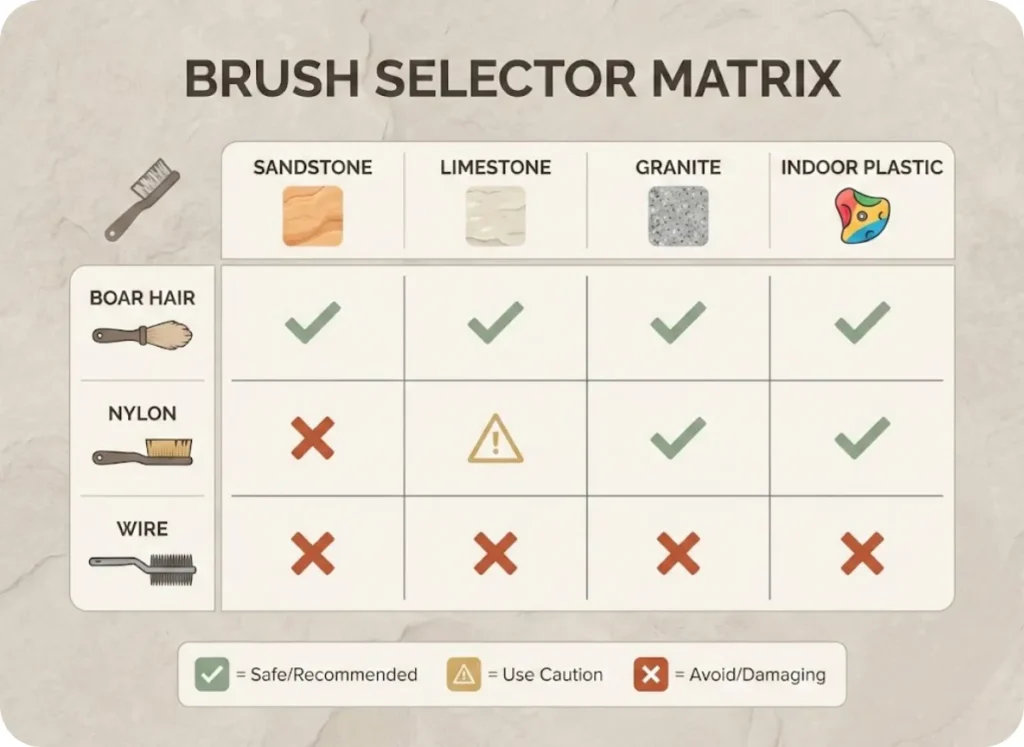
But here’s the trade-off: the cement holding those grains together is often softer than the grains themselves. Aggressive brushing with stiff nylon bristle brushes or wire brushes can scour away that cement, loosening grains and permanently changing the hold’s shape.
And here’s the critical rule: never climb or brush wet sandstone. When saturated, the cementing matrix weakens dramatically. Climbing on wet sandstone is like walking on wet beach sand—everything shifts and crumbles.
Wait 24-72 hours after rain before touching sandstone, depending on humidity and sun exposure. If any part of the rock looks darker or feels damp, walk away. The boulder will still be there tomorrow.
Pro tip: When in doubt at a sandstone area, stick to a boar’s hair brush only. It’s soft enough to protect soft rock while still clearing chalk effectively.
If you’re planning a trip to the world-renowned sandstone bouldering of Rocklands, pack the softest brush you’ve got.
Limestone: The Oil Trap
Limestone is smoother and less porous than sandstone. Grip depends more on skin adhesion than on mechanical interlocking. The problem? Because limestone isn’t porous, skin oils and rubber residue sit right on the surface instead of absorbing into the rock.
This creates a polished, glassy feel that builds up fast on popular routes. Of all rock types, limestone needs the most frequent brushing to cut through the oil-chalk sludge. Look for a visible sheen—that’s your signal.
A note on tool selection: limestone is softer than granite on the hardness scale. Metal brushes will scratch it. Stick with boar’s hair brush or nylon if you’re primarily gym climbing.
Granite: Durable but Not Invincible
Granite’s interlocking crystal structure—feldspar, quartz, mica—makes it highly wear-resistant. Those sharp crystal edges are what give you grip. Granite can handle stiffer brushing than sandstone or limestone without immediate damage.
But nothing is invincible. Over decades, popular holds become polished as the sharp edges of crystals are microscopically rounded by thousands of climbers’ shoes, fingers, and yes—brushes. Every stroke adds friction. Multiply that by years and you get polished classics that feel glassy compared to their original state.
For granite and gym holds (which are typically polyurethane), nylon bristle brushes work fine. But even here, brush with purpose—not obsession.
The Right Brush for the Job
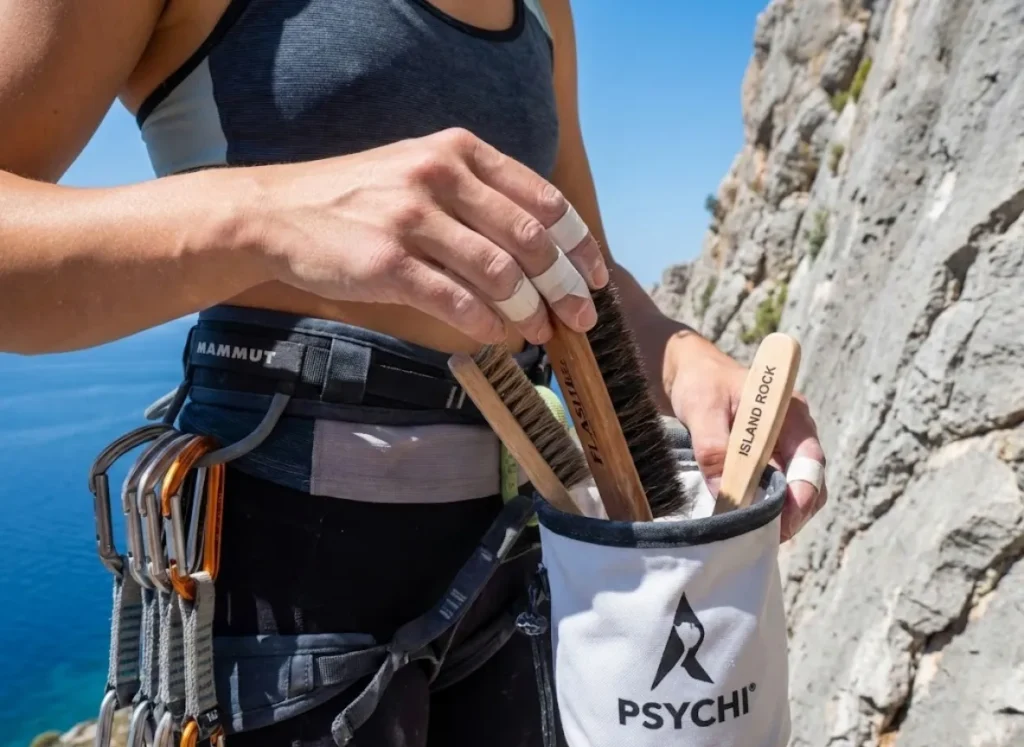
Picking the right brush is like choosing the right climbing shoes: one size doesn’t fit all. Here’s what you need to know about bristles, materials, and when to use what.
Boar’s Hair: The Gold Standard for Outdoor Rock
Natural boar’s hair is the industry standard for outdoor climbing, and for good reason. Under a microscope, boar bristles have overlapping scales—like tiny pine cones. These scales mechanically trap chalk particles and lift grime away from the surface instead of smearing it around.
Boar hair is also naturally oil-absorbent (it’s keratin, after all). This helps clean the gunk of skin oils mixed with chalk. The tips are tapered for gentle contact, while the dense packing provides enough stiffness to be effective.
Plus, boar hair is biodegradable. It won’t shed microplastics at the crag like synthetic options. Brands like Lapis, Sublime Climbing, and Flashed (with their Sumi Brush) all offer solid options in the $10-15 range.
For detailed product breakdowns, check out our comprehensive climbing brush comparison.
Nylon: Gym-Appropriate, Outdoor-Cautious
Nylon bristles are smooth, extruded cylinders. They’re durable and consistent in stiffness, but they lack the scale structure of boar hair. Instead of trapping and lifting particles, nylon tends to push dust around.
For gym holds—which are designed for durability and get pressure-washed periodically—nylon is perfectly fine. But outdoors, especially on soft rock, nylon can damage rock surface over time because the bristles are often harder than the rock’s cementing agents.
There’s also an environmental consideration: nylon sheds microplastic debris. At the base of popular boulders, those tiny filaments accumulate invisibly.
Wire/Brass Brushes: Prohibited Except for Development
Wire brushes and brass brushes are harder than sedimentary rock matrices. Using them on established problems creates permanent grooves and destroys micro-texture. They’re reserved exclusively for first-ascent development—removing heavy moss or lichen by experienced route developers.
If someone shows up at your local crag with a wire brush for regular maintenance, that’s a serious red flag. Document any damage you see and report it to local climbing organizations.
The Proper Technique (Step-by-Step)
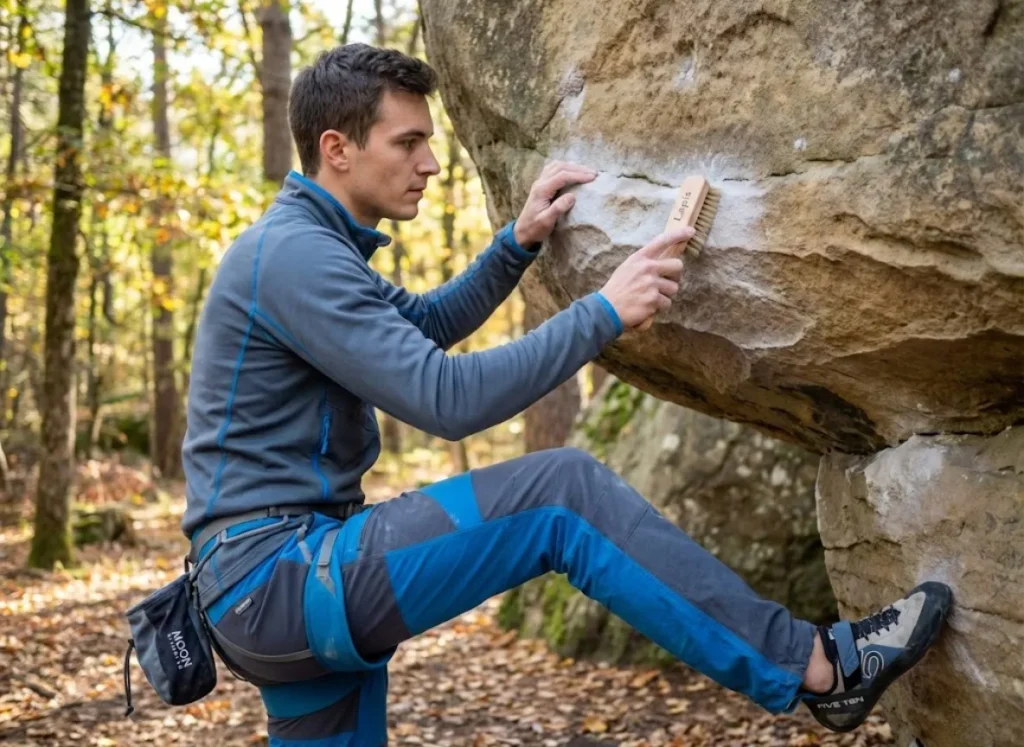
Knowing which brush to use is only half the equation. Proper brushing technique is what actually clears the hold and maximizes friction.
Step 1: Read the Hold First
Before you start brushing, look. Identify the greasy spots—areas that appear darker or shinier than surrounding rock. Check for tick marks that need removal. Note the rock type and any fragile edges.
Your eyes tell you where to focus. The tactile feel confirms when the job is done.
Step 2: Choose Your Stroke Pattern
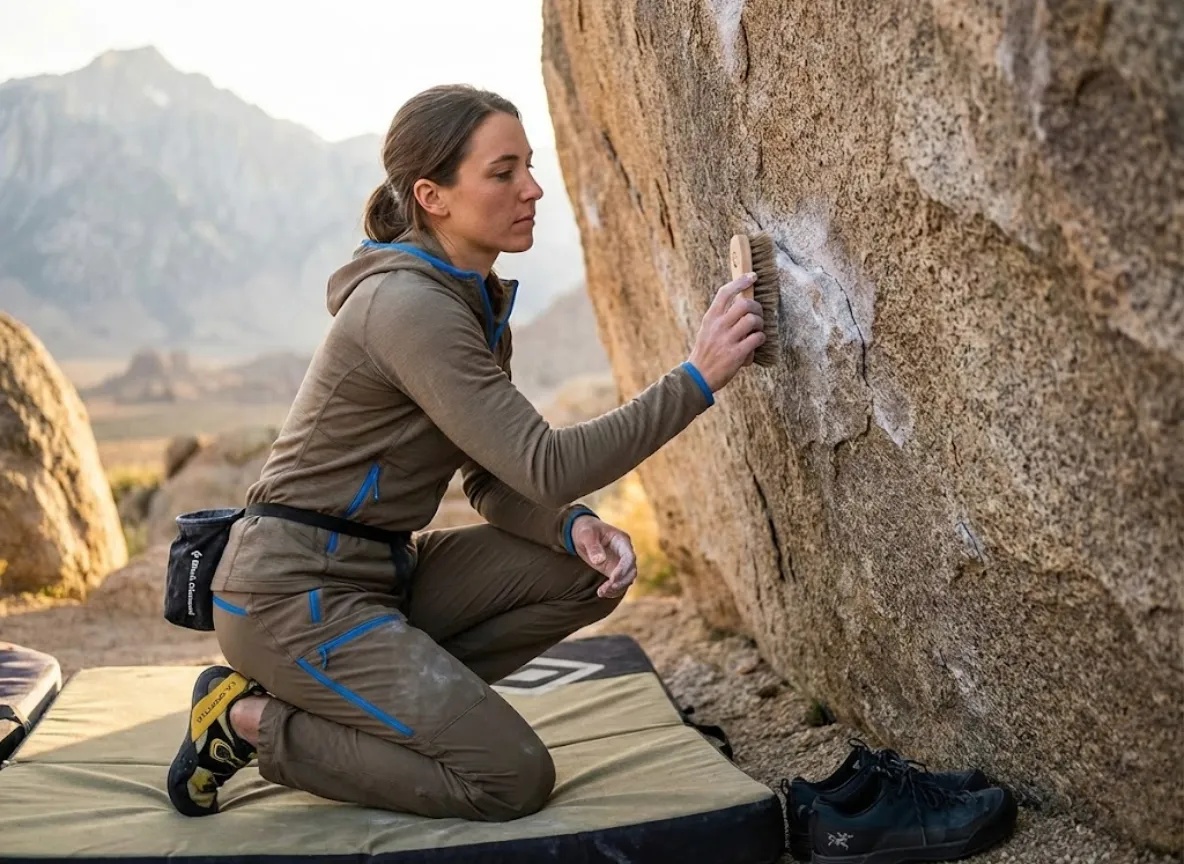
Different hold shapes need different approaches. For crimps, brush perpendicular to the edge. You want to clear the contact surface where your fingertips will press. For slopers, use circular motions to address the wider contact area. For pockets, angle your strokes or use a smaller brush to reach interior surfaces.
The key technique is “the flick”—end each stroke with a quick outward motion to eject dust from the hold rather than grinding it deeper into texture. Directional brushing matters. Always move debris away from critical contact zones.
Step 3: Calibrate Your Pressure
“Gentle but firm” is the universal guidance. Apply enough pressure to dislodge particles, but not enough to scour the surface.
On sandstone, use less pressure than you think necessary. On limestone, firmer pressure is acceptable to break up the oil-chalk sludge. On gym plastic, pressure tolerance is highest—those holds are built for it.
If your brushing sounds loud and scratchy, you’re probably too aggressive. Quiet strokes are effective strokes.
Step 4: Brush in Multiple Directions
Single-direction brushing leaves debris trapped in texture grooves. Cross-hatching—horizontal, then vertical, then circular—ensures complete coverage.
High-traffic holds especially benefit from multi-directional work. This technique removes chalk buildup embedded in micro-texture that a quick swipe misses. Plan on 15-20 seconds per hold for thorough cleaning rather than a half-hearted five-second pass.
Step 5: Finish with Tick Mark Removal
Tick marks—those chalk lines marking hold positions—are helpful while you’re projecting but considered visual pollution when left behind. Cleaning your own ticks after your session is non-negotiable at outdoor crags, and you should brush off any abandoned ones you find.
On sandstone, be especially gentle during tick removal. Aggressive scrubbing can smear chalk deeper into the rock.
“Don’t be a gumby, clean your ticks” is one of the most common refrains in outdoor climbing etiquette.
Etiquette: The Social Contract of Brushing
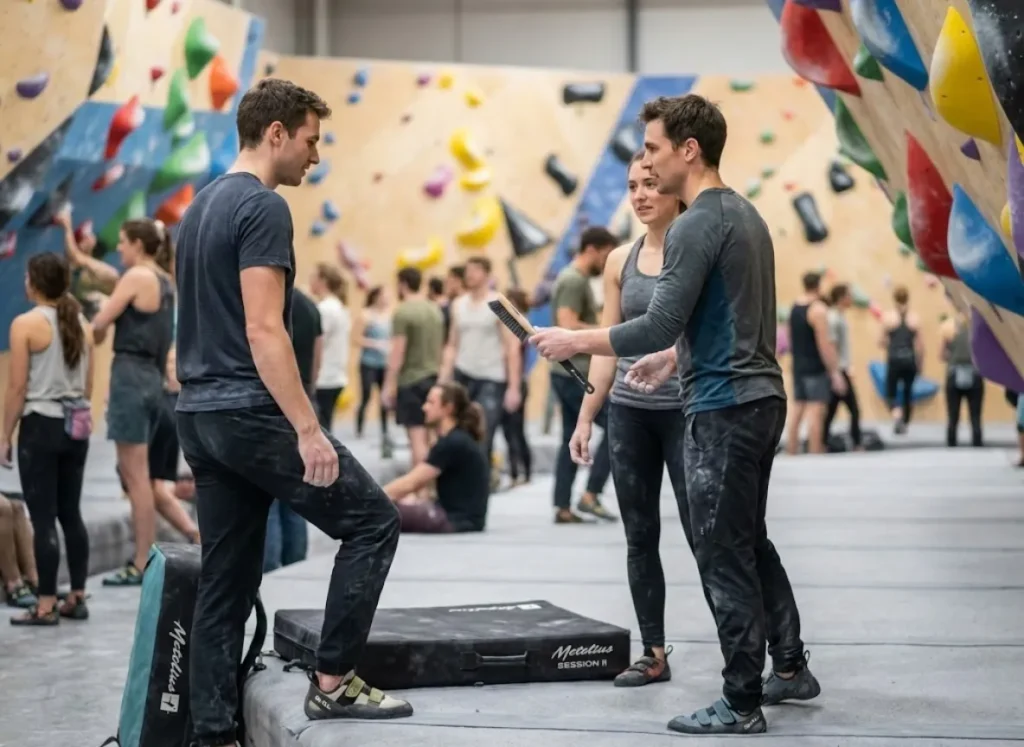
Brushing isn’t just about physics. There’s a whole social layer to how and when you brush—especially in crowded gyms.
“First Brush, First Climb”: The Gym Rule
In busy climbing gyms, brushing holds signals intent. When you take the time to brush a problem’s holds, you’ve essentially claimed the next attempt. Jumping on right after someone else brushes (without them offering) is considered rude and can cause friction—pun intended—with other climbers.
The etiquette works both ways. Brush for yourself, then offer to let others go if you need rest time. This builds community goodwill and creates an environment where everyone brushes for each other.
Pro tip: “Rage brushing”—aggressive, performative brushing after a fall—is seen as poor form. Keep your cool.
Understanding brush etiquette is part of the broader gym and outdoor ethics every climber should know.
Outdoor Stewardship: Brush After, Not Just Before
Outdoors, brushing is as much about preservation as performance. Brush the holds AFTER your session to remove your chalk deposits. Left overnight, chalk can start to harden and calcify into rock pores—becoming much harder to remove later.
Land managers—park rangers, forest service staff—view excessive chalk and tick marks as landscape degradation. This isn’t an abstract concern. Access issues have led to area closures in the past. Demonstrating responsible brushing habits and adherence to Leave No Trace principles is part of keeping crags open for everyone.
Respect your climbing environment. Leave the rock in better condition than you found it. Your future sends—and everyone else’s—depend on it.
When NOT to Brush: The Contrarian View
Not everyone agrees that obsessive brushing is purely beneficial. Ben Moon, legendary climber and founder of the MoonBoard, has argued that in many cases, brushing causes more long-term damage than it prevents. Every brush stroke applies friction to the rock. Multiply by thousands of climbers and decades, and that wear accumulates.
The balanced takeaway: brush with purpose, not compulsion. Focus on visible contaminants—sheen, caked chalk, grime—rather than reflexive cleaning. If a hold looks and feels clean, it probably is. Save your energy for the send.
Conclusion
Brushing holds properly comes down to three principles. First, understand the science: chalk helps with moisture, but excess chalk creates a grip-reducing layer that brushing removes. Second, match your tool to the terrain: boar’s hair for outdoor rock (especially sandstone), nylon for gym plastic, never wire on established routes. Third, respect the social contract: first brush, first climb in the gym; Leave No Trace outdoors.
The next time you rack up for a session, take an extra 20 seconds on that crux hold. Feel the texture return under your brush strokes. That’s not just chalk coming off—that’s friction coming back, your send getting closer, and the rock staying climbable for the next generation.
FAQ
Does brushing holds actually improve friction, or is it mostly psychological?
It’s real and measurable. Excess chalk creates a granular layer that reduces friction by acting like ball bearings between skin and rock. Brushing removes this layer and restores skin-to-rock contact. Studies show chalk can boost friction by 18-21% on rock, but only when loose particles are cleared.
Can I use a wire brush on gym holds?
No. While polyurethane gym holds are more durable than natural rock, wire brushes are overkill and can damage texture. Stick to boar hair or nylon even indoors. Wire brushes should only be used for first-ascent rock development, never for routine hold cleaning.
How long should I wait to brush outdoor sandstone after rain?
The standard rule is 24-72 hours depending on humidity, temperature, and sun exposure. If any part of the rock appears darker (wet) or feels damp, don’t climb or brush. Sandstone’s cementing matrix weakens dramatically when wet—give the rock time to fully dry.
Is it rude to brush someone else’s project at the gym?
Context matters. Brushing holds on a route someone is actively projecting without asking is generally poor gym etiquette. However, brushing shared warm-up holds benefits everyone. When in doubt, ask before you brush someone else’s project.
What’s the best brush for a beginner to buy first?
A quality boar’s hair brush like the Lapis (~$10) or Sublime Climbing Slimline (~$6-10) covers most use cases. Boar hair works on outdoor rock and gym holds alike, making it the smart all-around choice before building a collection.
Safety Notice: Rock climbing and mountaineering are inherently high-risk
activities that can involve physical trauma or fatal incidents. The information on Rock Climbing Realms is for
educational and informational purposes only. Techniques and advice presented here are not a substitute
for professional, hands-on instruction. Conditions and risks vary by location. Always seek guidance
from a qualified instructor before attempting new techniques. By using this website, you agree that you
are solely responsible for your own safety. Any reliance you place on this information is strictly
at your own risk, and you assume all liability for your actions. Rock Climbing Realms and its authors
will not be held liable for any harm, damage, or loss sustained in connection with the use of this information.
Affiliate Disclosure: We are a participant in the Amazon Services LLC Associates Program, an
affiliate advertising program designed to provide a means for us to earn advertising fees by advertising and linking
to Amazon.com. As an Amazon Associate, we earn from qualifying purchases. We are also an official affiliate partner
of Black Diamond Equipment via the AvantLink network. If you click on a Black Diamond affiliate link and make a
purchase, we may earn a commission at no additional cost to you. We also participate in other affiliate programs.
Additional terms are found in the terms of service.