
In this article
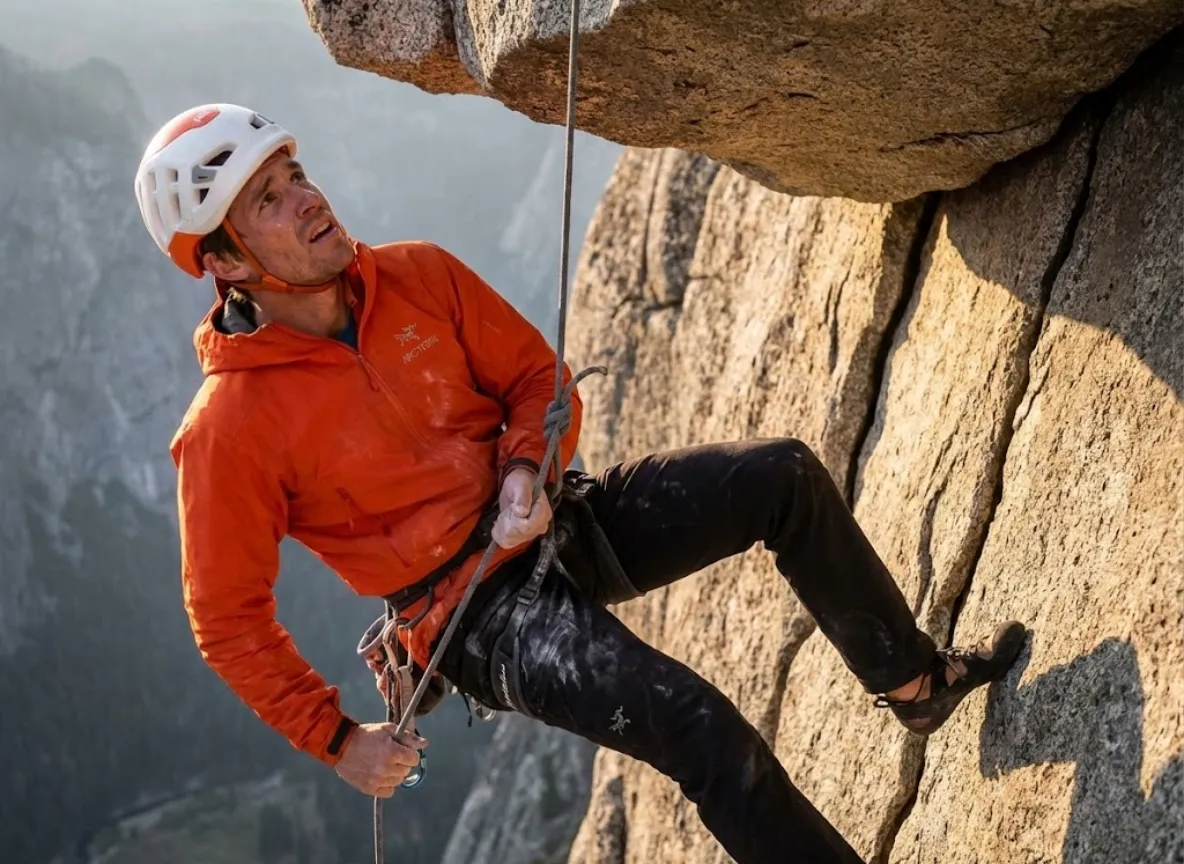
You are twenty feet below the roof lip, spinning slowly in free space. Your forearms are pumped, your belayer can’t hear you over the wind, and the rock is just out of reach. Gravity is no longer a concept; it is a physical weight dragging at your harness. In this moment, the ability to ascend the rope is not an optional skill for a rainy day—it is the only exit strategy you have.
However, climbing up is only half the equation. The true test of a rescue system is how quickly you can reverse it when things go wrong.
As a certified guide, I have seen competent climbers freeze in this exact scenario. They didn’t freeze because they lacked strength; they froze because they lacked a system. We are shifting the focus from simply “going up” to the Vertical Mobility System (VMS). This approach treats vertical movement as an engineering problem defined by friction management, gear hierarchy, and the critical ability to execute an ascent to descent transition in under sixty seconds. Whether you are rock climbing, engaging in big wall climbing, or performing rope access work, the principles of SRT (Single Rope Technique) remain the same.
What defines the physics of a safe Vertical Mobility System?
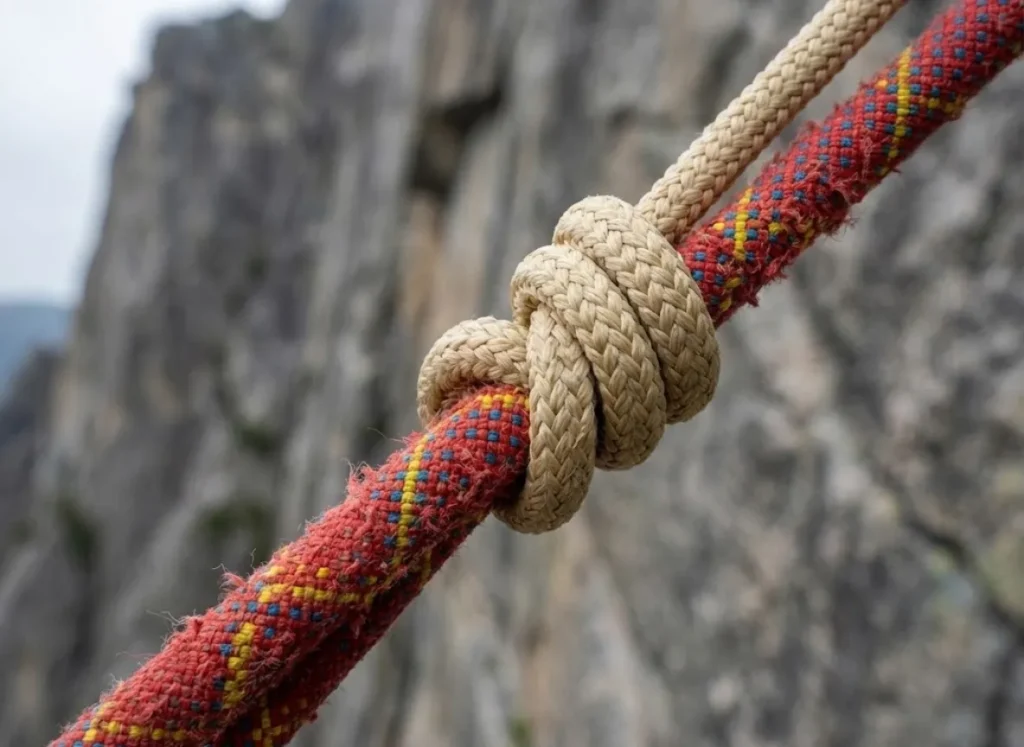
A safe Vertical Mobility System is defined by the balance between Progress Capture (holding weight) and Mechanical Efficiency (minimizing drag). These factors are governed by the thermodynamic limits of your equipment. It is not about muscling up the ascent line; it is about using physics to conserve the energy required to make rational decisions.
How does friction act as both a lifeline and a thermodynamic enemy?
Ascension relies on one-way capture, which is essentially managed friction. This mechanism allows the rope strand opposite the load to slide up but bites down to hold weight. It relies on the “Capstan Equation,” where holding force increases exponentially with the number of wraps in a friction hitch like a Prusik or Klemheist.
The sit-stand method creates a biomechanical rhythm of static holding (sitting) and kinetic sliding (standing). This cycle generates heat at the contact point. The critical danger here is “Parasitic Drag”—friction generated during the upward slide. On fuzzy abseil ropes or wet semi-static ropes, this can add 10-20 lbs of resistance per step, doubling your metabolic cost.

More dangerously, we must examine the thermodynamic risk. Dyneema vs Nylon is a critical material distinction. Dyneema (UHMWPE) has a low melting point of roughly 145°C. A rapid slip or friction burn can glaze or sever these fibers instantly. Conversely, Aramid fibers like Technora have a decomposition temperature of nearly 500°C, providing a necessary safety margin against sheath wear and melting.
Pro-Tip: Never use a Dyneema sling for a friction hitch. Always opt for Nylon or dedicated Aramid cords (like a HollowBlock) to handle the heat generated during the ascent cycle.
Once you understand how friction generates heat, you must look for signs of damage. After any heavy technical jugging session, you must be diligent about inspecting your rope for sheath glazing or melted fibers that could compromise future integrity.
What is the efficiency gap between a carabiner redirect and a ball-bearing pulley?
The efficiency gap is significant: a carabiner redirect operates at approximately 50% efficiency, while a sealed ball-bearing pulley operates at 91% efficiency.
Mechanical advantage often promises a 3:1 system ratio in setups like a Z-Rig. However, real-world friction reduces this drastically. A standard carabiner used as a redirect creates a sharp 180-degree bend over a static bar. This friction means a climber using a carabiner-based Petzl Tibloc setup is doing nearly double the work for the same vertical gain compared to a pulley system.

Sealed ball-bearing pulleys, like the Petzl Micro Traxion or a rollclip carabiner/pulley combo, transform a struggle into sustainable output. We call this metric “Calories per Pitch.” Gear selection directly impacts physical exhaustion. If you are exhausted, your decision-making quality degrades.
To understand the math behind this, look at the T-Method (Tension Method). A theoretical 3:1 Z-Rig with high friction carabiners effectively provides only a 1.6:1 advantage. If you are building an efficient rock climbing pulley system for hauling or rescue, ignoring these friction losses guarantees failure.
How do you execute an emergency ascent using only standard gear?
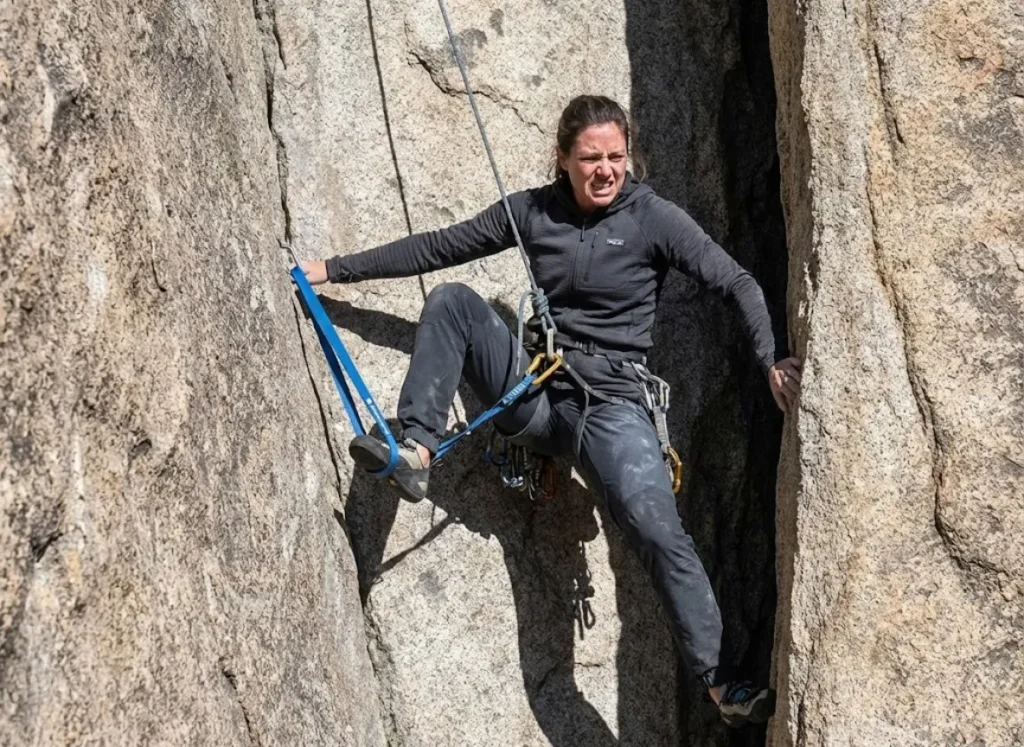
An improvised ascension, often called a “Level 1” response, utilizes the soft goods (cord, 120cm sling) and belay device currently on your harness. This technique facilitates self-rescue when no specialized mechanical ascender is available.
How does the “Sit-Stand” biomechanic drive a friction hitch ascent?
The system requires two friction points: a waist hitch connected to the harness belay loop and a foot loop connected to a long sling or cord. The “Sit” phase loads the waist harness, freeing the foot loop to be slid upward. The “Stand” phase generates leg power, freeing the waist hitch to move.
Coordination is key. The climber must crunch their core to lift the legs high, maximizing the travel distance per cycle—the “Inchworm Effect.” We often contrast the Prusik loop (multi-directional) with the Klemheist hitch. The Klemheist is unidirectional and easier to slide, making it superior for the foot loop to reduce drag.
The limitation of this method is the “Elasticity Problem.” Nylon ropes and slings stretch. This means the first few inches of every “Stand” are wasted taking out slack rather than gaining height. While this method is standard in techniques for how to climb ropes efficiently, it is physically demanding. Avoid attempting arm pull ups; rely entirely on leg power to drive the movement.
Why is the “Guide Mode” ascent considered a potential trap?
Climbers often rig a plaquette device (ATC Guide/Reverso) directly to the belay loop in guide mode (also known as plaquette mode) to act as an auto-blocking waist capture. This setup offers lower parasitic drag than a Prusik because the rope flows smoothly through the device while you pull the slack.
However, this creates a “Transition Trap.” Releasing a weighted guide mode device requires a complex leverage setup or a dedicated release cord. If the climber loses control of the brake rope during this release—perhaps while fumbling with a carabiner leverage point—the device fails to open or opens catastrophically.
This can result in an uncontrolled freefall. We strongly advise against this method for non-experts. It should be viewed as a last resort to escape the belay. Mastering essential self-rescue skills involves knowing when not to use a technique that complicates your exit.
How do mechanical devices change the efficiency equation for alpinists?
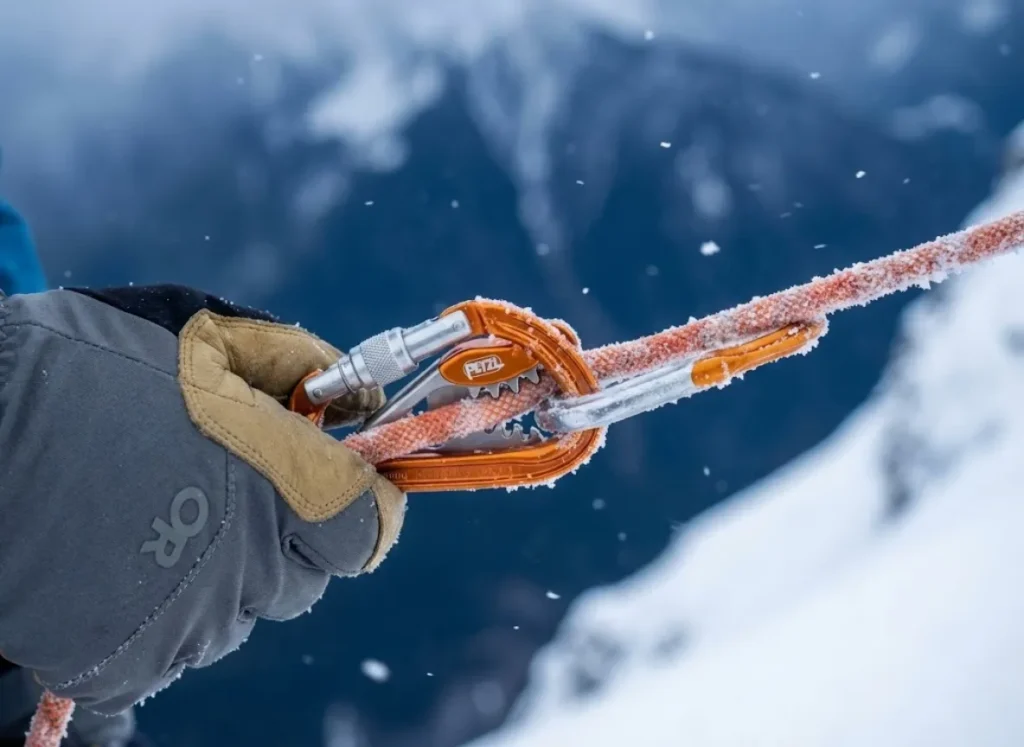
Mechanical ascending devices utilize toothed cams or eccentric pivots to capture progress. This creates a “Level 2” system that offers higher security and significantly reduced physical effort compared to a friction hitch.
How does the Petzl Tibloc engage the rope without damaging the sheath?
The Petzl Tibloc uses angled stainless steel teeth to penetrate the rope’s mantle (sheath) and engage the kern (core). This provides immediate grip on icy or muddy ropes, common in canyoning or alpine routes. Unlike a handled ascender like a Black Diamond Jumar, the Tibloc relies on a locking carabiner to press the rope against the teeth.
The shape of this carabiner is critical. You must use an Oval or HMS shape to ensure proper alignment. We define the “Active Thumb” protocol: The user must manually press the device against the rope during the upward slide. This ensures instant engagement and prevents the device from sliding down.
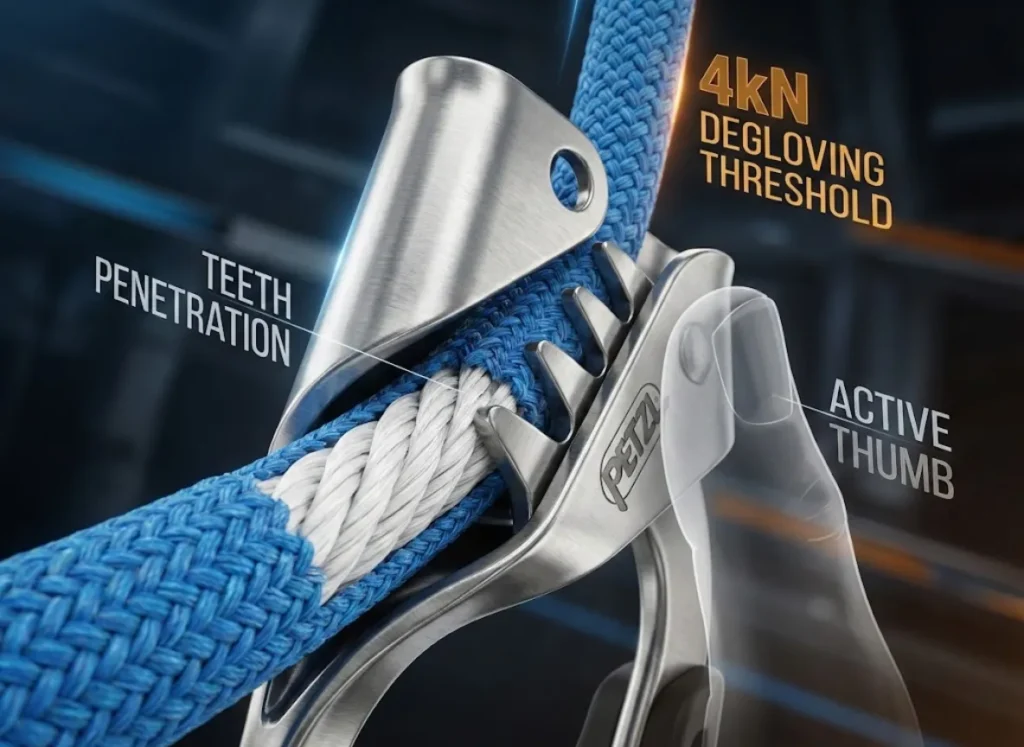
The danger here is “Shock Loading.” If the device slides down and catches abruptly, the teeth can strip the sheath (degloving) at forces as low as 4-6 kN. While it is the lightest option at 35g, choosing the right rock climbing ascender means weighing this risk against the utility. It scores low on our Transition Matrix because releasing a weighted, toothed cam is exceptionally difficult when exhausted.
When should you upgrade to a ball-bearing pulley like the Micro Traxion?
The Petzl Micro Traxion combines a toothed capture cam with a high-efficiency sealed ball-bearing sheave. It serves as the primary tool for the “Alpinist Layer” because it fulfills dual purposes: personal ascension and efficient hauling of a haul bag or partner.
This device eliminates parasitic friction entirely. The climber glides up the rope with significantly less caloric expenditure than a Prusik. Unlike the Tibloc, the cam can be locked open. This allows the device to function as a simple pulley, adding versatility for complex rescue rigging or mastering climbing pulley systems.
However, the “Teeth vs Friction” danger remains. Dynamic loads can still damage the rope sheath. Movement must be smooth and controlled. This is the “Pro-Light” standard: heavier than a Tibloc, but exponentially more capable for search and rescue scenarios.
What constitutes the “Gold Standard” for safe transitions?
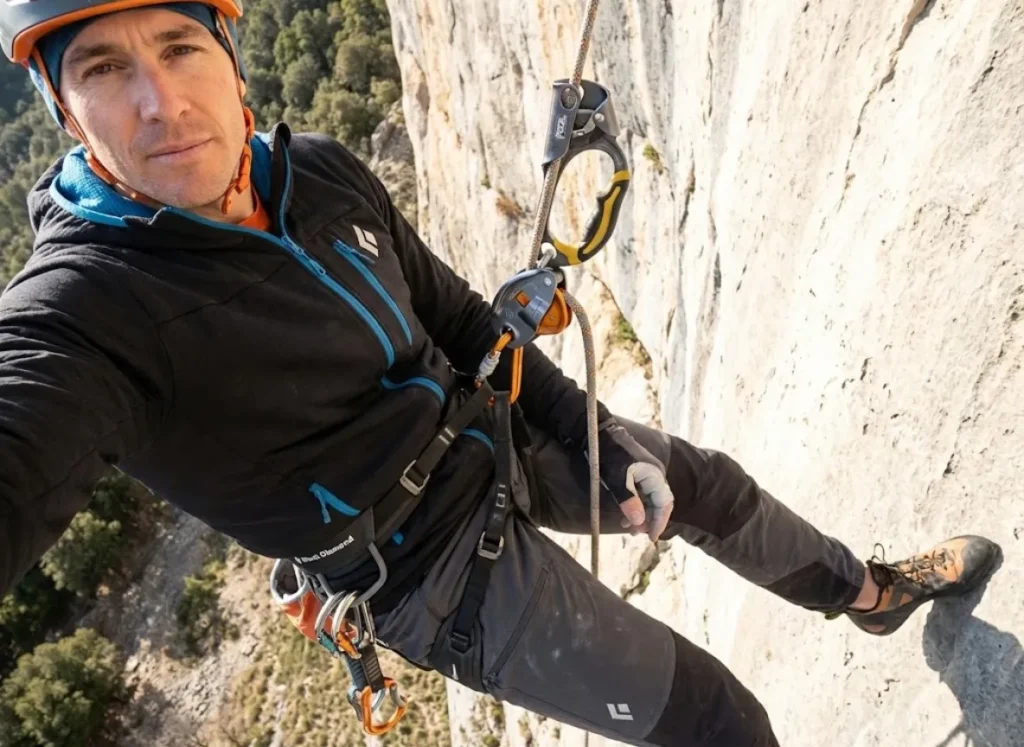
The “Gold Standard” is defined by the 60-Second Transition, a framework that prioritizes reversibility. The safest system is one that allows a climber to switch from ascending to abseiling instantly, without needing to unweight or re-rig the primary load-bearing point.
Why is the Grigri considered the ultimate self-rescue tool?
The Petzl Grigri is inherently a descent device (or rappel device) that can be used for ascent. This means it is always rigged for the way down. In the “RAD System” (Rapid Ascent/Descent), the climber pairs a Grigri on the harness with a handled ascender above. You sit on the Grigri and pull slack through it.
This setup scores a perfect 10/10 on the Transition Matrix. To descend, you simply unclip the top ascender while standing, sit back, and pull the descent handle. There is zero re-rigging of the load-bearing point.
The safety profile is superior because the camming mechanism is smooth. There are no teeth to strip the sheath during minor slips. Understanding how belay devices like the GriGri work reveals why this mechanical advantage is worth the extra weight (175g) on big walls or when working a steep sport route.
How do you safely transition from ascent to rappel in under 60 seconds?
We evaluate transitions using three zones: Green (Grigri – Instant), Yellow (Prusik – Complex), and Red (Tibloc – High Risk).
In the “Red Zone” transition, often encountered in a stuck rappel rope scenario, the climber is trapped until they can unweight the cam. This often requires rigging a secondary 3:1 system on their own harness just to lift themselves inches. The critical failure point is the “Critical Gap”—the moment the ascender is removed, but the rappel device is not yet fully weighted or locked.
Protocol for Safety: Always install the abseil device on the rope below the ascender and lock it off before attempting to disengage the ascent gear. Never let go of the brake ropes during the transition.

If you cannot reverse your system within 60 seconds during practice, the system is deemed unsafe for solo or remote climbing. This benchmark ensures you are ready for definitive protocols for how to rappel safely immediately after reaching your high point or bailing.
What safety protocols prevent catastrophic failure?
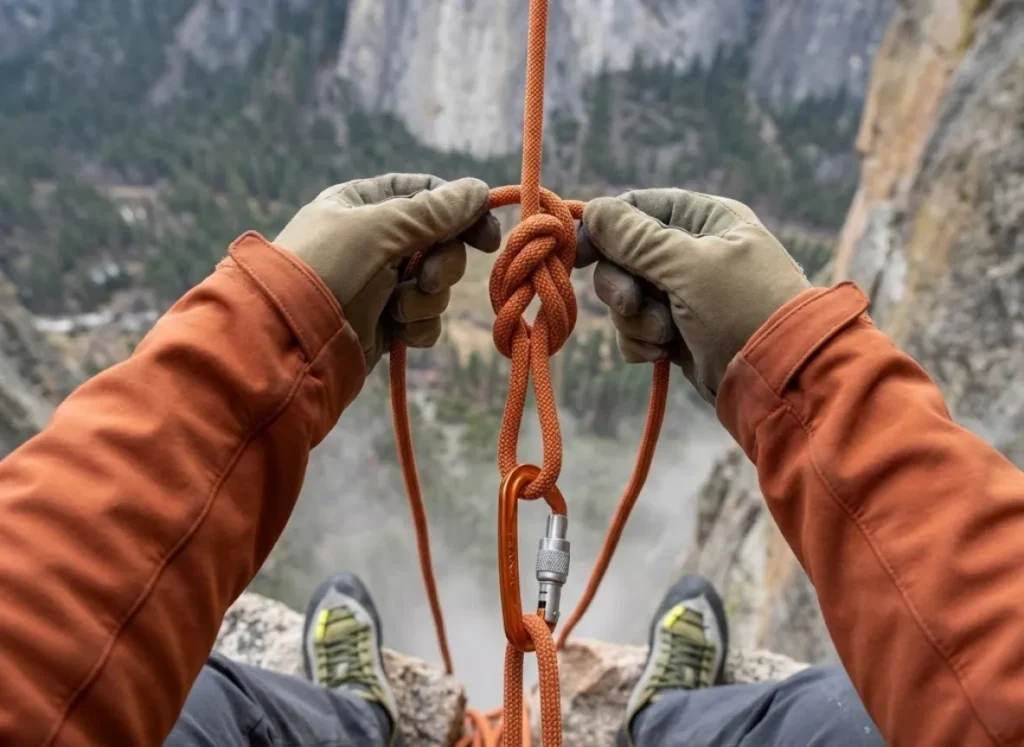
Safety protocols are the “Redundant Layer” of the system. They are designed to catch the climber if the primary mechanics fail due to equipment breakage, user error, or environmental hazards like rockfall.
How do you manage “Dead Rope” and backup knots?
As you ascend, a loop of dead rope accumulates below you. This weight is useful for pulling rope through devices, but it poses a snag hazard. More importantly, it is your backup.
We use the dead rope management protocol involving the “Catastrophe Knot.” Every 5-10 meters, tie an Overhand on a Bight in the dead rope and clip it to a locking carabiner on your belay loop. This creates a “hard deck.” If your primary ascenders strip the sheath or disintegrate, you will fall only as far as the last backup knot.
Pro-Tip: Don’t make the loops too long. If you fall onto a backup knot with 10 feet of slack, the shock load can still be injurious. Keep them frequent.
Case studies of ascender failure often involve “triggering” the cam open against an obstacle or debris. A back-up knot is the only defense against this mechanical error. Situational awareness is vital—regularly check that the dead rope isn’t hooked on flakes or getting stuck in cracks. Mastering essential climbing knots is a prerequisite for this protocol, specifically the ability to tie them one-handed.
Conclusion
Ascension is a thermodynamic balance. We must avoid melting soft goods with friction and stripping sheaths with teeth. We must recognize the “Efficiency Trap” of carabiner redirects and upgrade to ball bearings or ergonomic assisted braking devices like the Grigri whenever possible.
Most importantly, we must adopt the “60-Second Transition Matrix.” If you cannot reverse your system instantly under load, you are climbing into a trap. Redundancy is non-negotiable, and Catastrophe Knots provide the ultimate safety net.
Before your next multi-pitch, practice the “Red Zone” transition in a controlled environment—hanging from a tree or a gym bolt—until the movement is instinct, not theory.
FAQ – Frequently Asked Questions
Can I use a Petzl Tibloc to ascend without a specific carabiner?
No. The Petzl Tibloc requires a carabiner with a specific cross-section (typically Oval or HMS) to press the rope firmly against the teeth. Using a D-shaped or I-beam carabiner can cause the rope to pinch unevenly, reducing holding power and drastically increasing the risk of sheath wear.
Is it safe to use a Prusik knot on a Dyneema sling for ascending?
It is highly discouraged. Dyneema has a low melting point (~145°C), which can be reached quickly if the knot slips. Always use Nylon or, ideally, heat-resistant Aramid (Technora) cords like the Sterling Hollow Block for friction hitches to handle the heat of friction.
How do I get unstuck if my mechanical ascender is weighted and I can’t lift it?
You must rig a mechanical advantage (3:1) using a sling and carabiner attached to the ascender itself to winch your body weight upward. Once unweighted, you can manually disengage the cam. This difficulty is why we classify this as a Red Zone transition.
What is the main advantage of using a Grigri for ascending?
The primary advantage is Bidirectional Mobility. It allows the climber to switch from ascent to descent instantly without re-rigging the system. This eliminates the complex, dangerous steps required to transition from dedicated ascending devices like Jumars or Tiblocs.
Safety Notice: Rock climbing and mountaineering are inherently high-risk
activities that can involve physical trauma or fatal incidents. The information on Rock Climbing Realms is for
educational and informational purposes only. Techniques and advice presented here are not a substitute
for professional, hands-on instruction. Conditions and risks vary by location. Always seek guidance
from a qualified instructor before attempting new techniques. By using this website, you agree that you
are solely responsible for your own safety. Any reliance you place on this information is strictly
at your own risk, and you assume all liability for your actions. Rock Climbing Realms and its authors
will not be held liable for any harm, damage, or loss sustained in connection with the use of this information.
Affiliate Disclosure: We are a participant in the Amazon Services LLC Associates Program, an
affiliate advertising program designed to provide a means for us to earn advertising fees by advertising and linking
to Amazon.com. As an Amazon Associate, we earn from qualifying purchases. We are also an official affiliate partner
of Black Diamond Equipment via the AvantLink network. If you click on a Black Diamond affiliate link and make a
purchase, we may earn a commission at no additional cost to you. We also participate in other affiliate programs.
Additional terms are found in the terms of service.