In this article
Imagine you are fifty feet up a technical mountaineering route. Your muscles are burning, but the weight pulling at your harness feels like a heavy haul bag rather than a simple 9mm climbing rope.
This invisible weight isn’t gravity. It is the penalty of unmanaged friction, often called extreme rope drag. It is a silent enemy that makes it hard to move and creates a barrier between you and your belayer.
As a climbing guide, I see students try to fix this by just pulling harder. That usually leads to exhaustion. The real solution isn’t strength; it is fixing the rope path. To do that, you need the alpine draw (also known as an extendable quickdraw or runner). This tool allows you to change the geometry of your safety system instantly.
In this guide, we will look at why rope drag is dangerous, how to build these extendable runners to minimize weight, and the safety rules for using modern materials like Dyneema.
How Does Rope Drag Alter the Physics of a Fall?

Rope drag creates a pinch point in your system. It stops the climbing rope from stretching effectively during a fall, which puts much more stress on your top piece of gear.
How does the physics of friction actually work?
Most climbers think friction is just a weight penalty. You add a draw, you add a little weight. But the friction calculus is tricky. It doesn’t add up like 1+1=2. It multiplies based on the angles in your system.
When your rope runs in a straight line path (an “I-shape”), there is almost no drag. The only weight you feel is the cord itself. However, if you create a “Z-shape path” with your protection, the friction spikes. Even three moderate bends on a wandering route can create enough resistance that pulling up slack feels heavier than the rope actually is.
This is a lead climbing safety issue, not just a comfort issue. If friction holds the rope tight, it can’t stretch. This spikes the fall factor. It turns what should be a soft catch on a long rope into a hard, dangerous stop on a short section of cord. The analysis of fatal accidents caused by rope friction by the American Alpine Club shows how often this contributes to accidents.
Rough terrain makes it worse. A rope dragging over a slab generates friction that compromises energy absorption. This is a key concept in understanding dynamic rope mechanics and keeping your safety margins high.
How Do You Construct and Rack an Alpine Draw?
An alpine draw is not something you usually buy pre-made like sport draws or dogbones. It is a system you assemble yourself to balance utility-to-weight ratio and handleability.
What components do you need?
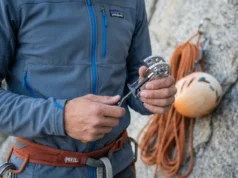
To build one, you need a 60cm sewn webbing sling (runner) and two lightweight wiregate carabiners.
Wiregates are the best choice for ice climbing and alpine rock. They are lighter than solid gates and don’t freeze shut as easily in ice and snow. They also reduce “gate flutter,” ensuring the gate doesn’t vibrate open during a fall. Look for keylock noses if possible to prevent snagging on your gear loops.
For the best handling, many guides use a specific color-coding strategy: “Silver for the gear, color for the rope.” Use a tiny silver micro-carabiner for the gear end to save weight. Then, use a full-sized colored wiregate for the rope end. This makes clipping much easier when your hands are tired and helps you identify the direction of travel.
The material science matters too. Most climbers use 8mm Dyneema (or Spectra) rather than 10mm webbing. It provides excellent tensile strength and packability, and it doesn’t soak up water. This prevents the sling from freezing into a stiff wire in the cold. Try to avoid thick nylon slings for alpine draws. Three strands of 16mm nylon become unmanageable when racked. If you look at the anatomy of climbing quickdraws, you’ll see that modern stitching helps prevent snagging when you extend the sling.
How do you fold the sling to rack it?
You can’t just let a 60cm dyneema sling dangle. You have to use “tripling the sling” techniques to make it compact.
First, clip both carabiners to the single 60cm loop. Next, pass one carabiner through the center of the other (“through the biner racking”). Finally, clip the “passed-through” carabiner onto the two hanging strands. This creates a neat bundle that is about the same length as a standard quickdraw.
To use it, clip the gear end to the wall. Then, utilize the “flick and pull technique”: unclip the rope-end carabiner from two of the loops and give a quick tug. Gravity and the weight of the carabiner will snap the sling open to its full length.
Pro-Tip: The “Flick and Pull” motion must be deliberate. If you pull messily, you might accidentally tie a knot on the top carabiner or create a “nose-hooking” scenario. Always look at the draw after you extend it to make sure it is clean.
This system lets you use the draw short (sport mode) or long (alpine mode) without ever unclipping it from the wall. This versatility is essential for building a streamlined trad rack that works on complex alpine climbs.
When Should You Extend a Placement to Minimize Friction?
Having the gear is only the first step. You need to know when to use it. You have to read the terrain to find the “Critical Path.”
How do you find the Critical Path?
The Critical Path is simply the straight line path the rope wants to follow from your belays up to you. If your protection is far to the left or right of this line, you need to extend it.
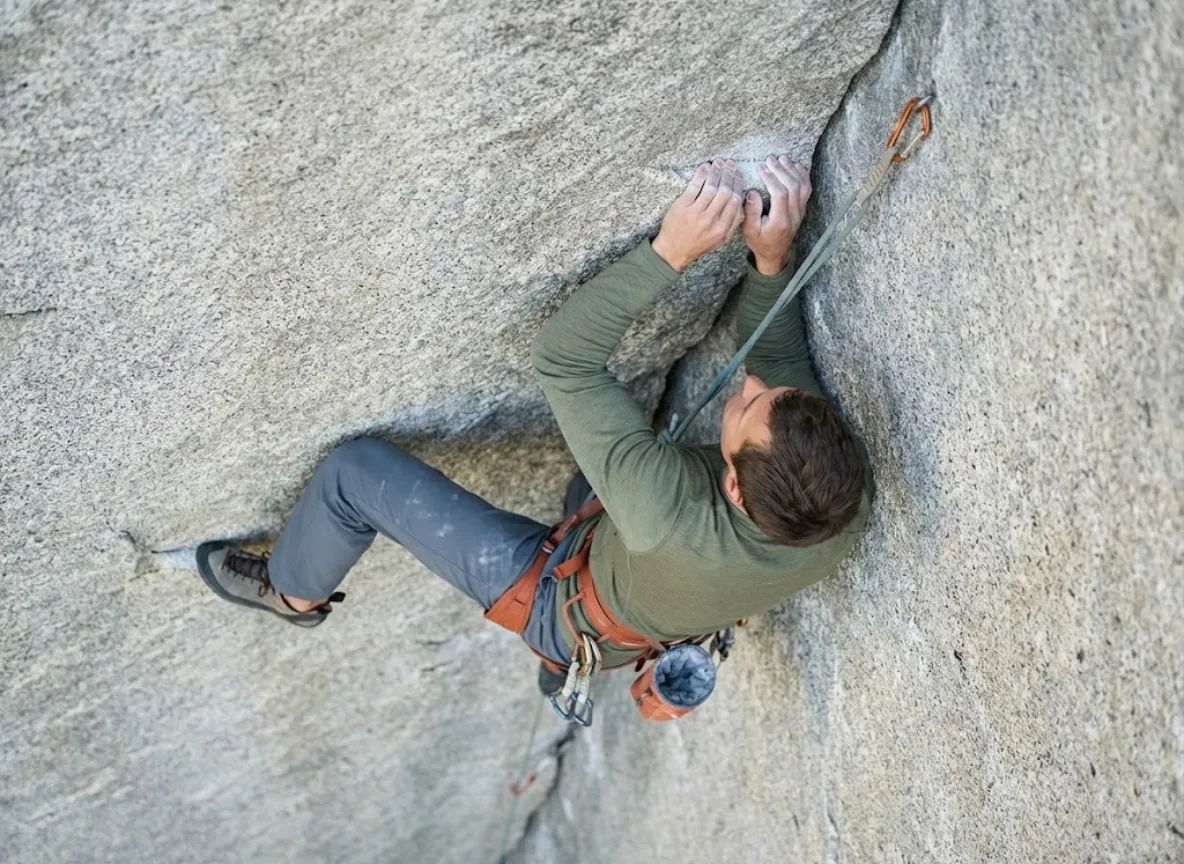
If a route zig-zags, extending a placement lets the gear stay to the side while the rope runs straight up the middle. This minimizes rope drag significantly on long rock routes.
It is also crucial to extend gear placed under a roof or deep dihedrals. If you use a short draw, the rope will drag over the sharp edges. By extending it, the rope hangs below the edge. This reduces drag and stops the rock from cutting your rope during a fall.
There is another benefit to extension. It acts as a rubber stabilizer for your gear. If you place a stopper or a nut, the rope movement can wiggle it out of place. A full-length sling isolates the gear from that movement. This is also vital for stabilizing active cam placements, keeping Camalots from “walking” too deep into a crack where they might get stuck.
Pro-Tip: Be careful extending placements right before a ledge. The extra two feet of play adds slack to the system. This increases the chance of “decking out” or hitting a ledge if you fall. In that specific spot, a shorter draw is actually safer.
What Are the Material Limitations of Dyneema Slings?
Dyneema is amazing because it minimizes weight, but it has weaknesses. It handles heat and shock differently than nylon webbing, and you need to respect that.
Why do you need to be careful with heat and knots?
Dyneema melts at a much lower temperature than nylon. This makes it vulnerable to friction heat. Never let a moving rope run directly over a stationary Dyneema sling. For example, never top-rope directly through a sling without a carabiner. The sawing motion can cut through the sling in seconds.
You also need to be careful with knots. Dyneema is slippery. Extension-limiting knots tend to slip under load. When they slip, they create internal friction heat, which can melt the fibers and cause the sling to break.
Finally, Dyneema is a static material. It does not stretch much (only about 3-5%). It cannot absorb the energy of a fall very well. If you use a Dyneema sling as an anchor tether, never shock load it. Even a short drop on a slack tether can generate massive forces on your harness and anchors. While it is great for the alpine environment because it doesn’t freeze, you must follow strict soft goods retirement guidelines if you see frayed slings or damage.
Conclusion
Rope drag isn’t just annoying; it creates forces that compromise your safety. By utilizing alpine draws—tripled 60cm slings—you can keep your rope straight. This reduces the impact of a fall and lets your dynamic rope do its job.
Extending your gear also prevents gear walking and protects your rope from sharp edges. However, remember that lightweight materials like Dyneema have limits regarding heat and shock loading.
Take a look at your rack and consider a mixed rack strategy. Practice the “flick and pull” motion on the ground before your next big multi-pitch climbing objective. When you are fifty feet up and tired, handling friction should feel automatic.
FAQ – Frequently Asked Questions
Do alpine draws reduce the impact force of a fall?
Yes. By reducing friction, alpine draws allow the whole rope to stretch and absorb the fall. High drag can pin the rope, which increases the impact force on your top piece of gear.
Can I use alpine draws for sport climbing?
Yes. They work well for wandering sport routes or getting around roofs. However, they are heavier and bulkier than normal quickdraws, so sport climbers usually don’t carry many.
Why shouldn’t I knot my Dyneema slings?
Knots weaken Dyneema significantly, sometimes by 50% or more. Also, if the knot slips, the internal heat can melt the fibers.
How many alpine draws should I carry?
A standard traditional rack usually has between 6 and 12 alpine draws. It depends on how long and winding the route is. Many climbers carry about 4 standard quickdraws and 8 alpine draws to cover big terrain.
Risk Disclaimer: Rock climbing, mountaineering, and all related activities are inherently dangerous sports that can result in serious injury or death. The information provided on Rock Climbing Realms is for educational and informational purposes only. While we strive for accuracy, the information, techniques, and advice presented on this website are not a substitute for professional, hands-on instruction or your own best judgment. Conditions and risks can vary. Never attempt a new technique based solely on information read here. Always seek guidance from a qualified instructor. By using this website, you agree that you are solely responsible for your own safety. Any reliance you place on this information is therefore strictly at your own risk, and you assume all liability for your actions. Rock Climbing Realms and its authors will not be held liable for any injury, damage, or loss sustained in connection with the use of the information contained herein.
Affiliate Disclosure: We are a participant in the Amazon Services LLC Associates Program, an affiliate advertising program designed to provide a means for us to earn advertising fees by advertising and linking to Amazon.com. As an Amazon Associate, we earn from qualifying purchases. We also participate in other affiliate programs. Additional terms are found in the terms of service.