In this article
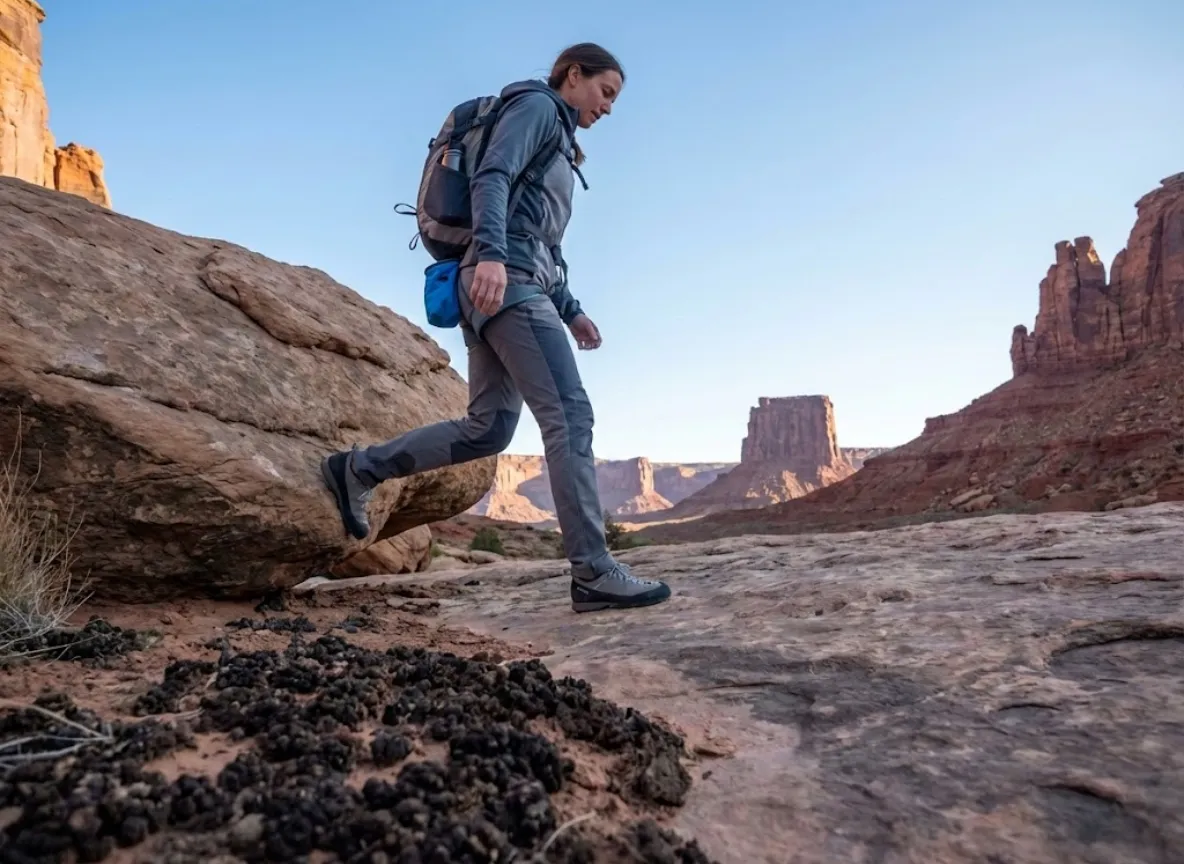
The crunch beneath your approach shoes stops you mid-stride. That sound—like stepping on a bag of stale chips—isn’t gravel. It’s the audible snap of cyanobacterial sheaths that took 50 years to form. You’ve just inflicted a wound on the desert floor that will outlive your climbing career, your children, and possibly your grandchildren.
After a decade of chasing splitters across the Colorado Plateau, I’ve seen this scene play out countless times at Indian Creek and beyond. New climbers walking straight across dark, knobby soil because nobody told them what they were stepping on. Veterans cutting switchbacks to save two minutes. The damage is invisible to the untrained eye until you know what to look for—and then you can’t unsee it.
This guide will transform you from an accidental destroyer into a crypto-literate steward. You’ll learn to identify biological soil crust, understand why a single footprint matters more than you think, and master the approach techniques that keep desert ecosystems intact for generations of climbers who’ll stand where you stand.
⚡ Quick Answer: Cryptobiotic soil is the living “crust” that holds desert sand in place—and it takes 50-250 years to recover from a single step. When climbing in Moab, Canyonlands, or Bears Ears, walk only on slickrock, dry washes, or designated trails. If you must cross crypto zones, travel single file, stepping in each other’s footprints. There’s no such thing as “careful walking” on biocrust—the only safe option is avoiding it entirely.
What Is Cryptobiotic Soil? The Living Skin Beneath Your Feet

The Biology of Desert Glue
That dark, bumpy surface you see across Utah’s desert floor isn’t dirt. It’s a living community called cryptobiotic soil—or “crypto” in climber slang. This biological soil crust is a complex matrix of cyanobacteria, lichens, mosses, fungi, and algae that colonizes the top few millimeters of arid ground.
The primary architect is Microcoleus vaginatus, a filamentous cyanobacterium that weaves through sand grains when wet, leaving behind sticky polysaccharide sheaths that glue particles together. Locals call this living layer “desert glue” or “nature’s protective armor“—and that name is earned.
This isn’t just about holding sand in place. Biocrusts fix atmospheric nitrogen at rates that make them the sole fertilizer for the entire desert ecosystem. The junipers you shade under after a hard pitch, the sagebrush anchoring the hillsides—all of it depends on crypto. Without this living crust, the Colorado Plateau would be shifting dunes rather than the stable landscape that supports world-class rock climbing ethics and stewardship principles.
Pro tip: The scientific term is biological soil crust, but you’ll hear climbers call it “crypto,” “the black stuff,” or “popcorn soil.” All mean the same thing—don’t step on it.
Why Climbers Encounter It More Than Hikers
Indian Creek, Capitol Reef, Arches National Park, and every sandstone crack climbing destination on the plateau sit directly in crypto country. The same conditions that create perfect parallel cracks—aridity, stable soil chemistry, minimal disturbance—create ideal biocrust habitat.
The problem is geometric. Maintained hiking trails avoid sensitive areas, but approaches to splitter cracks often traverse benches and terraces where crypto thrives. Bouldering compounds the issue: crash pads create massive “footprints” of destruction when placed on living soil.
Visual ID: How to Spot Crypto Before You Step
Learning to identify crypto is your first defense. Mature crust is obvious: dark black, brown, or orange coloring with a knobby, pedestaled texture—like a “toasted marshmallow appearance” or the bumpy surface of popcorn. This is the “no-go zone.”
Immature crust is the danger zone. It looks like slightly consolidated sand with faint darkening. To the untrained eye, it’s invisible—yet equally fragile. When in doubt, remember this rule from Dr. Jayne Belnap, the USGS research ecologist who’s spent decades studying these organisms: if it’s not solid rock and it’s not a designated trail, assume it’s alive and avoid it.
The Numbers That Should Haunt Every Climber
50 Years for Your Footprint to Heal
Here’s the data that should change your behavior: initial cyanobacterial recovery takes 5-7 years. But full functional diversity—the mosses and lichens that actually fix nitrogen and prevent wind and water erosion—requires 50-250+ years of undisturbed growth.
That recovery timeline isn’t linear. It depends on rare sequences of wet years. A decade of drought resets the clock. As documented in USDA research on biological soil crust ecology, the timeline operates on a scale that dwarfs human perception.
Dr. Jayne Belnap puts it plainly: “A wrong step or wrong doing would cause a lesion that would take four times my lifespan to heal.” That’s not poetry—it’s peer-reviewed science from the Canyonlands Research Station.
Why “Light Steps” Don’t Work
I’ve heard every rationalization: “I walked carefully.” “I stayed on my tiptoes.” “The ground looked solid.”
None of it matters. A dry crust crumbles under normal walking pressure—brittle failure is instantaneous. The “crunch” you hear is the sound of structural failure, the snapping of gelatinous filaments that took generations to weave together.
Wet conditions are worse, not better. Wet crusts undergo plastic deformation, creating deep ruts that channel water erosion for years afterward. There is no “careful walking” on crypto. The only safe path is complete avoidance.
Pro tip: If the sandstone is wet, the soil is wet too. Use the rain rule: wait 24-48 hours after rain before climbing OR walking on desert soil.
The Cascade: From Footprint to Flash Flood
The damage doesn’t end with your footprint. Destroyed crust means mobilized sediment, which means dust storms and accelerated water erosion. Invasive cheatgrass colonizes disturbed soil, dries out faster than native plants, and increases fire frequency across the desert environment.
Fires kill remaining crust (which isn’t fire-adapted), creating a degradation feedback loop that transforms stable ground into shifting sand. Downstream effects include increased flash flood velocity in drainages—including Indian Creek itself. Your shortcut to save two minutes ripples through the Leave No Trace principles for rock climbers that protect access for everyone.
The Three Safe Surfaces: Where You CAN Walk
Slickrock: Your Best Friend
Hardened Navajo or Wingate sandstone—the “slickrock” that defines Moab climbing—is the only soil-adjacent surface that can handle foot traffic. Look for polished, water-worn rock. That friction you feel is durability.
When transitioning from slickrock to soil, pause and scan. Sandy cracks in slickrock may harbor micro-crusts. The goal is to string together rock outcrops like stepping stones, minimizing any contact with soil.
Dry Washes: Nature’s Highways
Dry creek beds (washes) are naturally disturbed by periodic flooding—foot traffic adds no additional harm. Use wash bottoms as approach paths whenever possible. This is how experienced trad climbing dirtbags move fast without breaking crust.
Don’t confuse a wash with a terrace. Washes are clearly incised channels; terraces above them are prime crypto habitat. Stay in the channel bottom, not on the banks.
Designated Trails: Stay On Them
Official trails are pre-sacrificed corridors. Cutting switchbacks destroys the soil stabilization holding the trail up, leading to trail collapse and expanded damage. Social trails—unauthorized paths created by previous visitors—are not designated trails. They’re scars in progress.
At Indian Creek, the Access Fund deploys Climber Stewards who actively educate visitors on trail discipline. If you see them, listen. They know the ground. When selecting approach shoes for rock climbing, consider how you’ll navigate between slickrock patches and trails.
The Single File Rule (And Why Spread Out Is WRONG Here)
The Alpine Rule vs. The Desert Rule
Here’s where standard Leave No Trace ethics get confusing. In alpine meadows, you’re taught to spread out when off-trail to prevent creating a single trampled path—grasses recover, and dispersed impact is better than concentrated impact.
In crypto country, this logic is dead wrong.
Desert LNT requires you to walk single file. The goal is to confine damage to one sacrificial corridor rather than a 20-foot swath of destruction. Forum veterans on Mountain Project say it clearly: “Spreading out might have more impact in the desert.” This distinction—alpine spread vs. desert single file—is the mark of someone who actually knows the ground they’re walking on.
How to Execute Single File Approaches
Designate a leader who scouts the crypto-free path. Followers step EXACTLY in the leader’s footprints—follow each other’s footprints is the mantra. One set of footprints causes one corridor of damage. Ten sets spread across ten different paths cause ten corridors.
On slopes, resist the urge to fan out for stability. The shear force of pivoting on sandy slopes tears the cyanobacterial matrix worse than a straight step. Rock-hopping is your friend: look for isolated boulders and slickrock patches to step on rather than soil.
Indian Creek Specific: The Ground Rules for America’s Crack Climbing Mecca
Camping Zones: Beef Basin, Super Bowl, and the Crypto Minefield
Indian Creek in Bears Ears National Monument is ground zero for the climber-crypto conflict. Dispersed camping means high-impact zones expand into pristine crust every season. In areas like Beef Basin and Super Bowl, mature pedestaled crusts dominate between established sites.
Park ONLY on previously disturbed ground. Never drive off established roads—tire tracks create permanent channels for erosion visible for decades. When you’re camping, use WAG bags (pack-it-out human waste). Desert soil lacks the microbial activity to break down waste; a cat hole essentially mummifies feces rather than composting it.
Approach Trails to Classic Cracks
Approaches to walls like Supercrack Buttress and Donnelly Canyon cross sensitive soil zones. Follow established trails exactly. Social trails proliferate outside trail boundaries—don’t create or follow them.
Check Bureau of Land Management and Access Fund postings for raptor avoidance areas before your trip. Seasonal closures (typically March-August) for Golden Eagles and Peregrine Falcons often overlap with crypto-sensitive approach benches. The BLM Indian Creek visitor guidelines are your pre-trip reading.
Wet Rock, Wet Soil: The Double Hazard
Sandstone weakens significantly when wet—holds break, routes get damaged. The same rain that makes rock dangerous makes crypto ultra-vulnerable.
When soil is wet, it undergoes plastic deformation. Footprints create deep ruts that channel erosion for years. The rule from BLM is simple: wait 24-48 hours after rain before climbing OR walking on desert soil. Locals enforce this norm. “Recreate responsibly” isn’t a suggestion—it’s how we keep access open.
Planning a trip? Check Utah rock climbing destinations and travel planning for seasonal timing advice.
Gear Up for Crypto Country: What Helps (And What Hurts)
Approach Shoes and Crash Pads
There’s no perfect approach shoe lug pattern study for crypto impact—yet. But sticky climbing rubber designed for high friction may grab and tear cyanobacterial sheaths more effectively than hard lugged soles. Lighter, smooth-soled approach shoes work well for the rock-hopping technique that minimizes soil contact.
Bouldering demands extra vigilance. Crash pads create massive destruction zones when placed on crypto. Stage crash pads ONLY on slickrock, talus, or pre-disturbed ground. Never throw pads on “soft ground”—that soft ground is living crust. Don’t “garden” (remove vegetation) from boulder bases either; you’re removing anchors that hold soil in place.
WAG Bags and Waste Protocol
“Pack it in, pack it out” is mandatory, not optional. WAG bags are available at climbing shops in Moab and should be part of every desert rack. The rule extends beyond human waste to all trash—orange peels don’t biodegrade in the desert like they do in humid forests.
Check out the essential rock climbing gear checklist and add WAG bags to your standard packing list for any Colorado Plateau trip.
Pro tip: Designated vault toilets can’t handle WAG bags—dispose of them in regular trash receptacles instead.
Becoming a Crypto Steward: Active Protection, Not Just Avoidance
Join the Stewardship Community
The Access Fund deploys Climber Stewards at Indian Creek—educators at the crag teaching LNT and crust protection. These stewards are the “human message board,” and peer-to-peer education resonates more than signage. If you have the time and passion, consider volunteering through their stewardship and conservation programs. If not, a donation directly supports these programs.
The Accountability Conversation
When you see another climber stepping on crypto, a respectful correction matters. “Hey, watch the crypto” is the community phrase. The slogan “Don’t bust the crust” is a shibboleth—proof you belong to the climbing community that takes crypto stewardship seriously.
Lead by example. When approaching with new climbers, explicitly point out crypto and demonstrate avoidance techniques. The phrase “follow each other’s footprints” should be part of your approach beta for any desert route.
What About Restoration?
Here’s the hard truth: current science does NOT support “raking out” footprints. Raking disturbs more surface area and delays recovery. Inoculation research (spraying cyanobacteria on damaged areas) is being tested but isn’t field-ready for public use.
The best restoration is prevention. Every footprint you avoid today saves 50-250 years of recovery. That’s the math.
Conclusion
Three rules will keep you on the right side of crypto stewardship:
Crypto is alive. That crunch underfoot is 50-250 years of biological architecture snapping—a wound that will outlast you, your children, and their children.
Safe surfaces only. Slickrock, dry washes, designated trails. Everything else is off-limits.
Single file, always. When off-trail is unavoidable, confine impact to one sacrificial corridor. Rock-hop when possible. Step in each other’s footprints.
On your next desert trip, make crypto awareness your approach crux. Point out the crust to your partners. Correct the uninformed gently. Walk single file. When you top out a perfect Wingate splitter, know that you’re part of a rock climbing community and culture that keeps it climbable—not just today, but for generations who’ll stand where you stand, on ground that’s still alive because you chose not to bust the crust.
FAQ
How long does cryptobiotic soil take to recover after being stepped on?
Initial cyanobacterial recovery takes 5-7 years, but full functional diversity (mosses and lichens that fix nitrogen and prevent erosion) requires 50-250+ years of undisturbed growth. Recovery depends on rare wet years, so a footprint today may not fully heal for multiple human generations.
Can I walk on cryptobiotic soil if it is wet?
No—wet conditions are MORE damaging. Wet crusts undergo plastic deformation, creating deep ruts that channel water erosion for years. Wait at least 24-48 hours after rain before traveling on desert soil.
What does cryptobiotic soil look like?
Mature crusts are obvious: dark (black, brown, orange), knobby, and pedestaled—like popcorn soil or toasted marshmallow. Immature crusts are subtle: slightly consolidated sand with faint darkening. When in doubt, assume all soil is alive and avoid it.
Is the spread out Leave No Trace principle correct for desert travel?
No—this is the #1 mistake. Alpine LNT says spread out (grasses recover). Desert LNT requires SINGLE FILE travel to confine damage to one corridor. Spreading out creates a 20-foot swath of destruction instead of a narrow sacrificial path.
Where can I safely walk when approaching desert climbs?
Only three surfaces are safe: (1) slickrock (hardened sandstone), (2) dry wash bottoms (naturally disturbed creek beds), and (3) designated trails. Everything else is likely living crust and must be avoided.
Risk Disclaimer: Rock climbing, mountaineering, and all related activities are inherently dangerous sports that can result in serious injury or death. The information provided on Rock Climbing Realms is for educational and informational purposes only. While we strive for accuracy, the information, techniques, and advice presented on this website are not a substitute for professional, hands-on instruction or your own best judgment. Conditions and risks can vary. Never attempt a new technique based solely on information read here. Always seek guidance from a qualified instructor. By using this website, you agree that you are solely responsible for your own safety. Any reliance you place on this information is therefore strictly at your own risk, and you assume all liability for your actions. Rock Climbing Realms and its authors will not be held liable for any injury, damage, or loss sustained in connection with the use of the information contained herein.
Affiliate Disclosure: We are a participant in the Amazon Services LLC Associates Program, an affiliate advertising program designed to provide a means for us to earn advertising fees by advertising and linking to Amazon.com. As an Amazon Associate, we earn from qualifying purchases. We also participate in other affiliate programs. Additional terms are found in the terms of service.