
In this article
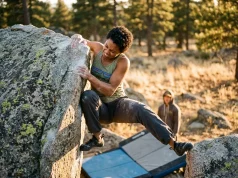
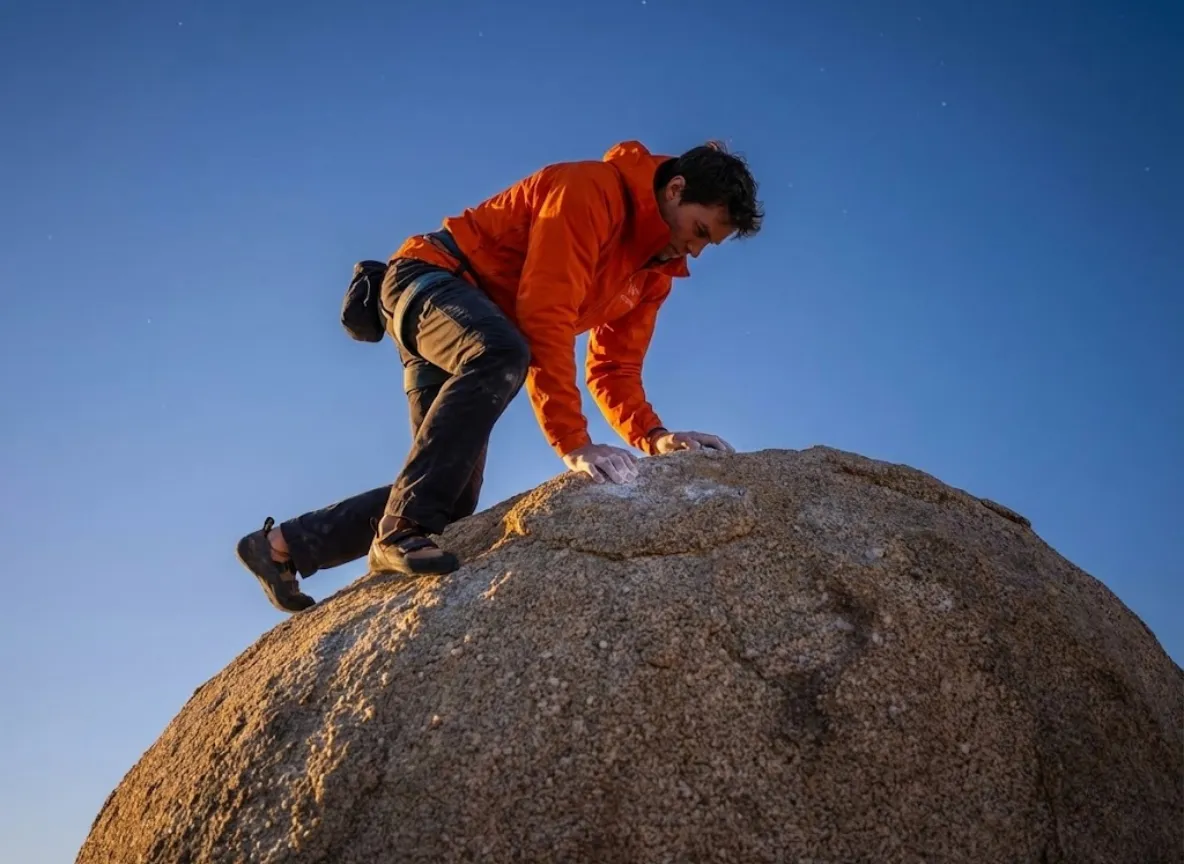
You hit the lip of the boulder, lungs burning, and throw your heel up. Suddenly, the vertical world ends, and you are left wrestling a sloping shelf of granite with nothing but friction and fear. The elegance of the climb fades into a desperate, belly-flopping struggle.
This specific failure—often called the “Beached Whale”—isn’t usually a lack of strength. It is a fundamental misunderstanding of physics. As a climbing guide, I watch strong gym climbers crumble here because they treat the top-out like a pull-up. The mantle is the great filter of outdoor climbing, demanding you invert your relationship with gravity by switching from a pull to a push.
To stop flailing and start topping out on steeper terrain, we need to strip the movement down to its biomechanical roots. We will look at why the standard “pool exit” analogy is dangerous, test your hip mobility with the “Faber” diagnostic, and build a technical blueprint for the press.
What is the Mantle and Why Does It Feel Counter-Intuitive?
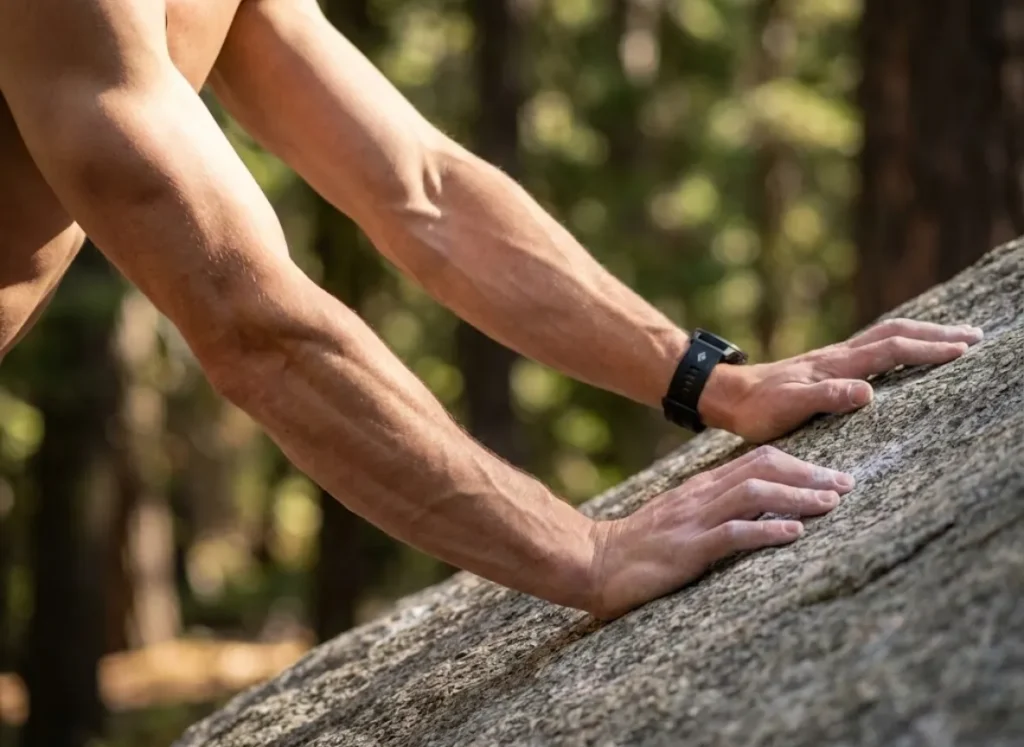
The mantle is a biomechanical inversion. For 90% of a climb, your hands are above your head, and you are gym-style pulling. During a mantle, your hands drop below your chest, and you must push. This sudden pull-to-push transition confuses the nervous system. While essential for bouldering top-outs, this move also secures rests on alpine climbing ledges and large traditional climbing ledges.
Why does the “Swimming Pool” analogy fail the outdoor climber?
Coaches often use the “Swimming Pool” heuristic: visualize pressing yourself out of the water without a ladder. This model correctly identifies the upper body transition—the rapid flip of the elbows from below the hands (pulling) to above the hands (pushing). It effectively teaches the “dip” mechanics, emphasizing the need for tricep extension and scapular depression to elevate the torso.
However, the analogy is incomplete and often leads to failure on rock. In a swimming pool move, water provides buoyancy, and your legs kick freely in an open chain. On rock, gravity is the sole adversary.
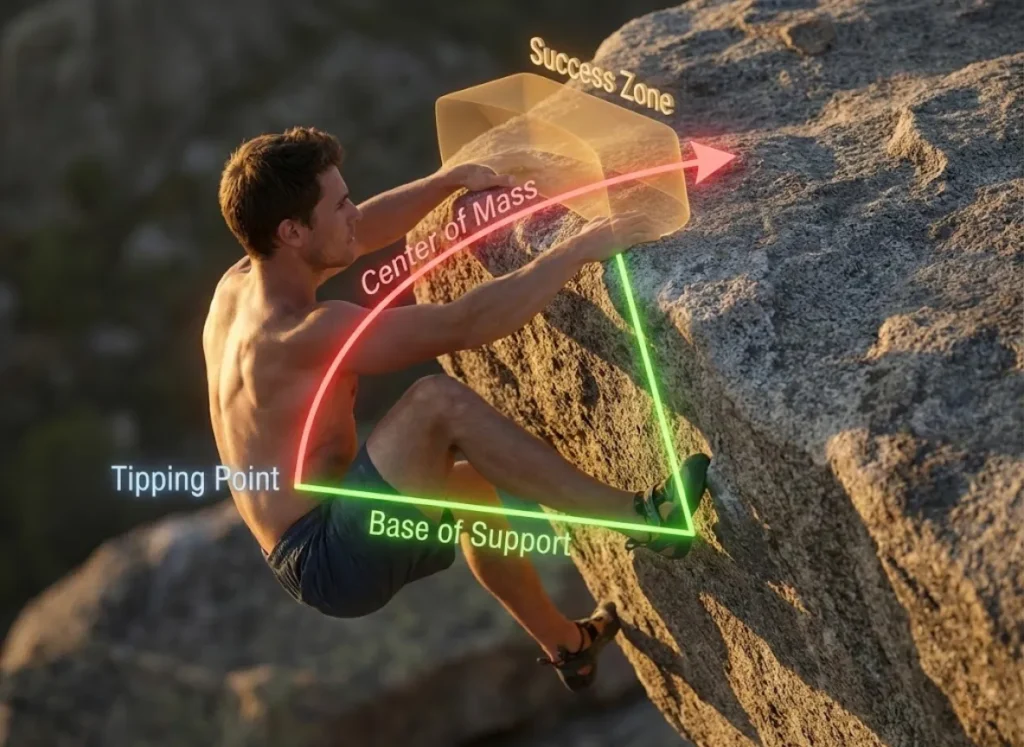
A true mantle requires a biomechanics of closed kinetic chain exercises where the foot—usually a heel hook—acts as a fixed fulcrum to lever the hips upward. Without this lower-body engagement, the movement becomes a “muscle-up,” a gymnastic feat relying on raw power rather than the leverage utilized by bouldering pioneer John Gill.
Once you understand that the legs drive the motion, you must analyze the biological hardware required to put them in position. This effectively means mastering other complex bouldering moves begins with understanding your own leverage vs power ratios.
Are You Physiologically Ready? The Biological Hardware
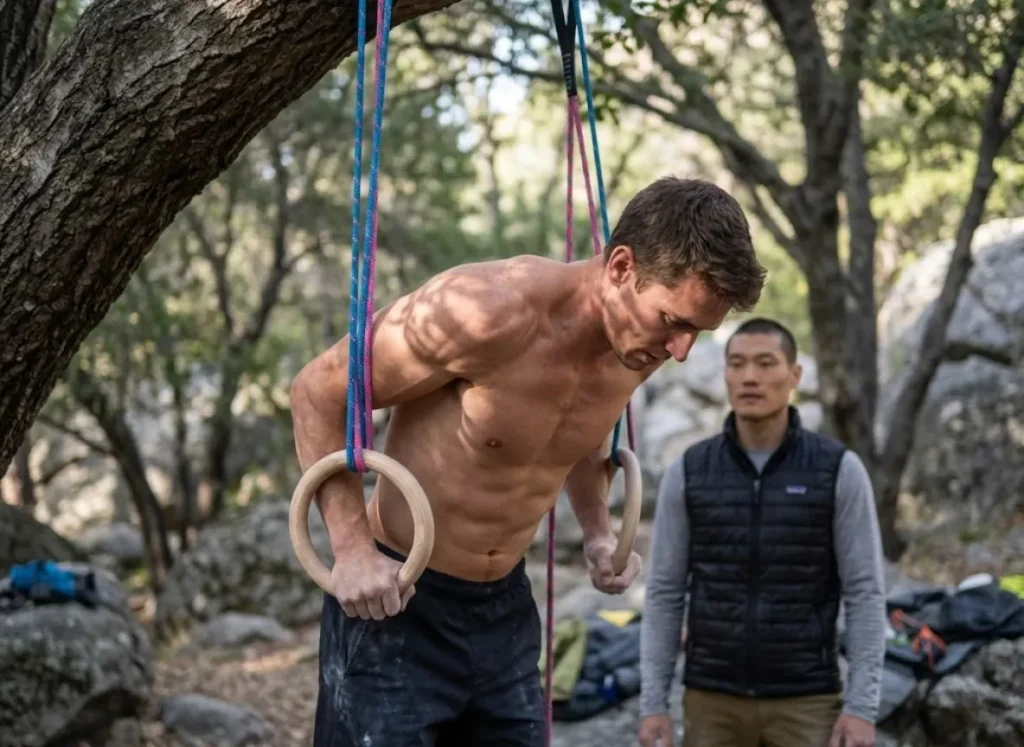
We often tell climbers to “try hard,” but physiological roadblocks can make a high mantle mechanically impossible regardless of effort. Many climbers fail because they lack the requisite hip mobility. We need to move from effort to diagnostics.
What is the “Faber Test” and why is it the gatekeeper of the mantle?
The primary limiter for mantling is rarely arm strength; it is the ability to perform a high “Rock-Over.” This requires extreme hip flexion and external rotation (hip turnout). If your hips cannot open, your Center of Gravity (CoM) stays too far from the wall, killing your leverage.
The Faber Test (Flexion, Abduction, External Rotation) is the gold standard orthopedic assessment to determine if your hips can mechanically achieve this position. To perform it, lie on your back and cross your ankle over the opposite knee (figure-4). The distance of the knee from the ground indicates your range of motion.
Pro-Tip: If your knee remains high during the Faber Test, force-feeding a high heel hook can damage your LCL (Lateral Collateral Ligament). Prioritize floor mobility work before projecting highball mantles.
Research on the reliability of the FABER test for hip pathology suggests that restrictions here force the hips away from the wall. This increases the lever arms on your triceps, making the press exponentially harder. Climbers with restricted mobility must prioritize mobility for climbers unlocking high-steps through a specific mantle flexibility routine involving “Tactical Frog” stretches.
How much pushing power is actually required?
While pulling strength gets you to the lip, tricep strength gets you over it. A solid benchmark for intermediate outdoor climbers (V4-V8) is the ability to perform weighted dips with approximately 20-30% of body weight added. Before attempting dynamic outdoor mantles, you should be capable of 8-10 strict bodyweight dips to ensure structural integrity.
We must also discuss the “Chicken Wing” technique (elbow high, thumb down). This places the shoulder in internal rotation. According to studies on the mechanisms of shoulder impingement syndrome, this position risks rotator cuff injury under load. Elite pro climbers like Jimmy Webb utilize antagonist training not just for injury prevention, but to master strength exercises for climbing that enable the “lock-off position” of the top-out safely.
The Technical Blueprint: How Do You Execute the Perfect Mantle?
Physiological capacity is potential; technique is the kinetic realization of that potential. The movement flows through distinct step-by-step phases: traction, transition, and compression.
Step 1: How do you establish the “Anchor” before the move begins?
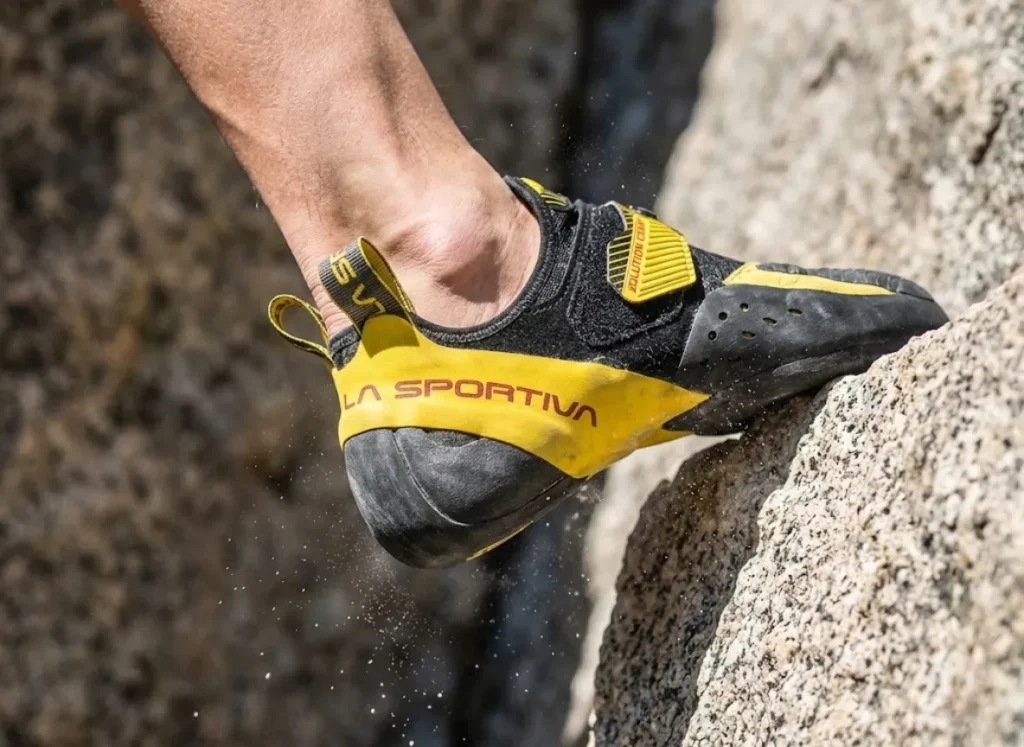
Success is determined during the traction phase by establishing a high point of contact. This is usually a heel hook rather than a toe point. The heel hook engages the powerful biceps femoris, allowing you to actively drag your hips toward the wall using muscle recruitment.
The mental cue “Heel to Butt” is essential. Do not just rest the foot; actively contract the leg to close the distance. This creates a fulcrum point where the knee becomes the lever driving the body upward.
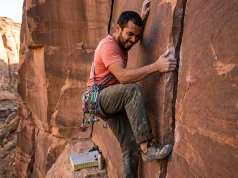
For a deep dive on why this works, you should consult a definitive guide to heel hook vs. toe hook mechanics. On featureless lips like those at Horsetooth Reservoir, Fontainebleau, or the rounded sandstone of Moab, Utah, the heel hook provides the only “closed” point in the system to counteract gravity.
Step 2: How do you navigate the “Dead Point” and hand transition?
The transition phase requires a moment of zero-gravity caused by upward momentum, known as the “Dead Point.” At this apex—the moment of truth—the hands must rapidly switch from pulling (fingers engaging) to pushing (palm press). You must choose your hand orientation carefully.
You can select “Hand-In” (Internal Rotation/Gaston) for power on flat ledges or “Hand-Out” (External Rotation) for stability on slopes. This timing is critical. It mirrors the physics of mastering the takeoff and latch of a dyno, where momentum capture dictates success.
As you rotate palm inward or outward, the flip must occur simultaneously with the “Rock-Over” of the hips. If the hands flip too early without hip support, you will slide off.
Step 3: How do you avoid the “Beached Whale” failure mode?
The “Beached Whale” occurs when a climber panics and flops their stomach onto the rock. While this feels safe, it creates a “friction lock.” To escape the compression phase, you must paradoxically reduce your contact area by engaging tricep activation to lift the chest off the rock.
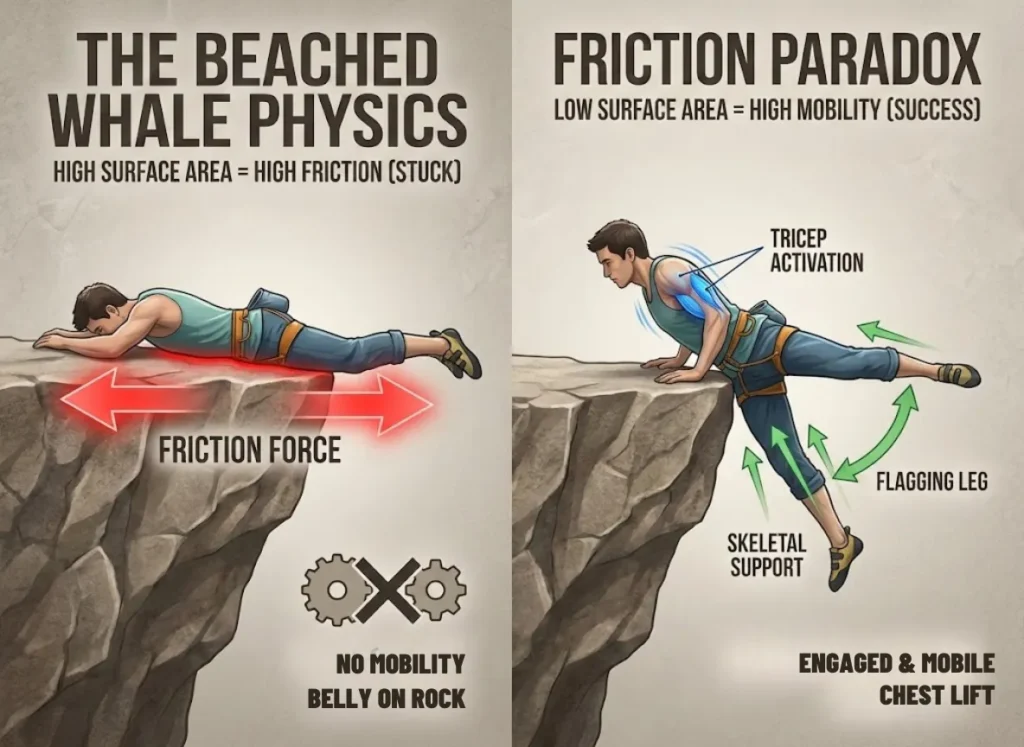
Engineering principles regarding coefficients of static friction on rough surfaces dictate that increasing surface area (the belly) makes overcoming friction harder. You must lift to transfer the load back onto the skeletal structure. Keep the rear leg flagging hard to counterbalance the rotational force, utilizing climbing movement principles like flagging to press the Center of Gravity over the lip.
What Gear and Safety Protocols Are Non-Negotiable?
Technical execution relies on trust, and trust is built on having the right equipment and safety nets.
Does heel cup rigidity actually affect mantle performance?
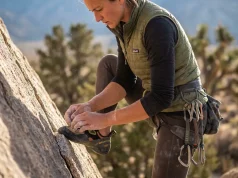
The initial phase of a hard mantle relies almost entirely on the integrity of the heel hook. If the shoe’s heel cup collapses or rolls under the heavy load of a full-body rock-over, the kinetic energy is lost to deformation. Shoes like the Scarpa Instinct VS feature a high-tension heel that locks rigidly once filled, acting as a solid fulcrum.
Performance Climbing Shoes Comparison
Analyzing Heel Technology, Stiffness, and Mantling Efficiency
Stiffness Profile
Very Soft. Pliable heel structure designed for maximum toe sensitivity and smearing.
Mantle Suitability
Low. Heel often collapses under heavy mantle weight transfer.
Primary Use Case
Steep overhangs requiring maximum toe sensitivity and smearing.
Stiffness Profile
Medium/Soft. Rigid rubber spine prevents rolling while keeping sensitivity.
Mantle Suitability
Advanced. Excellent crossover for friction-dependent slopers.
Primary Use Case
Gym volumes and slopers where sensitivity and structure are both needed.
Stiffness Profile
Stiff. High-tension rand creates a rigid lock once the volume is filled.
Mantle Suitability
Elite. The gold standard for technical mantling; transfers 100% leg drive.
Primary Use Case
Outdoor mantling requiring maximum torque transfer without heel deformation.
Stiffness Profile
Very Stiff. Pre-molded hard rubber acts like a prosthetic hook with zero sensitivity.
Mantle Suitability
Specialist. Maximum protection and leverage for specific aggressive features.
Primary Use Case
Sharp, aggressive edges or spine-like features where pain tolerance is the limiter.
Conversely, soft shoes designed for sensitivity may deform too much on sharp granite edges during a heavy mantle. Selecting a shoe with a stiff heel cup is effectively buying a better lever arm. This concept is a core component of climbing shoes fit secrets, where fit directly impacts leverage.
How should spotters manage the unique vectors of a top-out fall?
Falls from a mantle are rarely vertical. They often involve a “Barndoor” rotation or a backward tip-over fueled by the fear of falling backwards. Spotters must avoid standing directly under the climber to prevent being crushed. Instead, stand slightly back and to the side of the hanging foot.
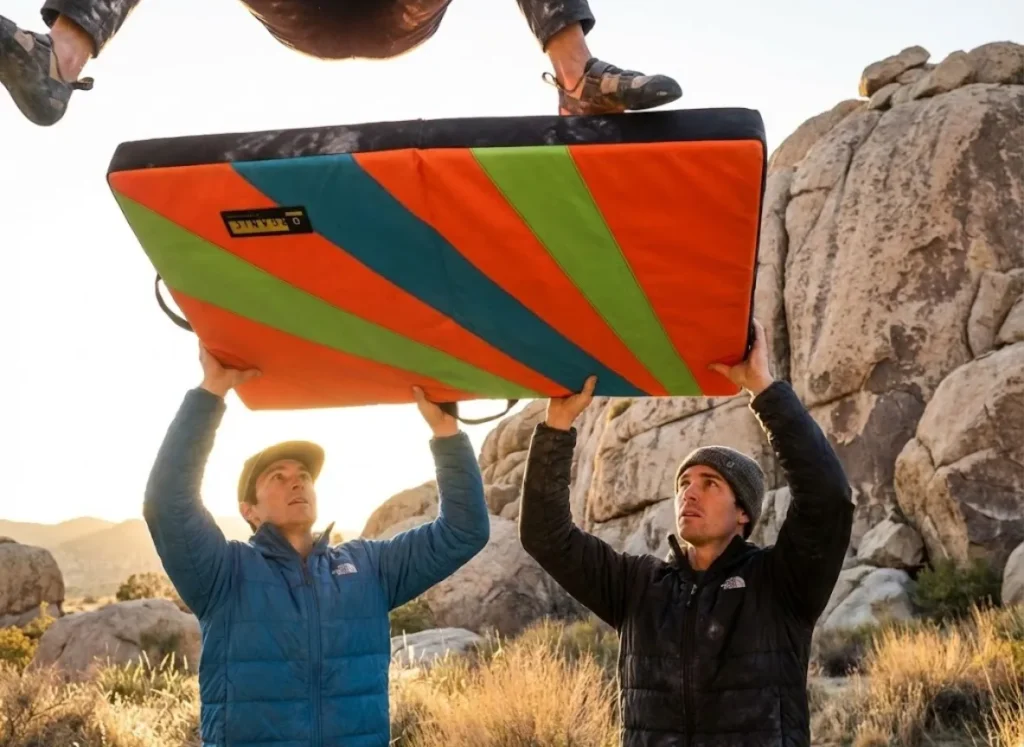
For highball mantles, use the “Floating Pad” technique where spotters hold a crash pad in the air to track the climber’s potential trajectory. This tracks the fall arc, which may extend far beyond the base layer of pads due to the lateral force of the rock-over. Effective spotting ensures safer bouldering through spotting and crash pads by turning a potential head-injury scenario into a controlled tumble.
Conclusion
Mastering the mantle requires more than grit; it requires a shift in physics. You must build the mobility to pass the Faber Test, the strength to press 120% of your body weight, and the mental commitment to trust a single heel hook over the security of a belly flop.
Next time you are at the gym, skip the pull-ups. Find a set of dip bars, rings, or a plyo box and practice your press. The top-out is waiting.
FAQ – Frequently Asked Questions
What is the difference between a mantle and a muscle-up?
A muscle-up is a gymnastics move performed on a free-hanging bar using only upper body momentum. A mantle uses the feet (usually a heel hook) to create a closed kinetic chain on a stable surface, relying more on leverage and hip flexibility than raw explosive power.
How do I stop my foot from slipping during the rock-over?
Slipping usually results from a lack of active engagement. You must actively pull your heel to butt using your hamstring. Additionally, ensure you are using a shoe with a stiff heel cup that won’t deform under the lateral load or utilize heel-to-toe camming if the feature allows.
Why does my shoulder hurt when I mantle?
Pain often stems from the Chicken Wing position (internal rotation with high elbows), which causes subacromial impingement. Strengthen your rotator cuff and triceps, and try to keep your elbows tucked closer to your ribs (external rotation) during the press.
Can I train for mantles in a regular gym?
Yes. You can use plyometric boxes (preferably wood, not soft foam) to simulate the press and rock-over motion. Combine this with Russian Dips on parallel bars or rings to condition your elbows or wrists for the transition phase.
Safety Notice: Rock climbing and mountaineering are inherently high-risk
activities that can involve physical trauma or fatal incidents. The information on Rock Climbing Realms is for
educational and informational purposes only. Techniques and advice presented here are not a substitute
for professional, hands-on instruction. Conditions and risks vary by location. Always seek guidance
from a qualified instructor before attempting new techniques. By using this website, you agree that you
are solely responsible for your own safety. Any reliance you place on this information is strictly
at your own risk, and you assume all liability for your actions. Rock Climbing Realms and its authors
will not be held liable for any harm, damage, or loss sustained in connection with the use of this information.
Affiliate Disclosure: We are a participant in the Amazon Services LLC Associates Program, an
affiliate advertising program designed to provide a means for us to earn advertising fees by advertising and linking
to Amazon.com. As an Amazon Associate, we earn from qualifying purchases. We are also an official affiliate partner
of Black Diamond Equipment via the AvantLink network. If you click on a Black Diamond affiliate link and make a
purchase, we may earn a commission at no additional cost to you. We also participate in other affiliate programs.
Additional terms are found in the terms of service.